
Nick is a real and common English word that means a small cut, notch, or slight damage. Knick is much less common and mainly appears in specific words or names, such as knick-knack.
A few years ago, I was checking a student’s writing exercise when I noticed a strange sentence: “I got a small knick on my finger while cooking.” I paused for a second. I knew exactly what they meant, but one small letter had changed the word.
That happens more often than you think.
Many people hear nick and knick the same way. Their sounds are very close. Fast typing makes things even harder. Spell-check tools sometimes miss the problem too.
The confusion grows because both words exist in English. Yet they are not used in the same way. One is part of everyday writing. The other appears in special cases.
If you have ever stopped and asked, “Wait, is it knick or nick?” you are not alone.
Some readers wonder how do you spell nick because the pronunciation of nick and knick sounds almost the same.
By the end of this guide, you will know which word to use, why people mix them up, and how to avoid making the mistake again.
Knick or Nick: Quick Answer
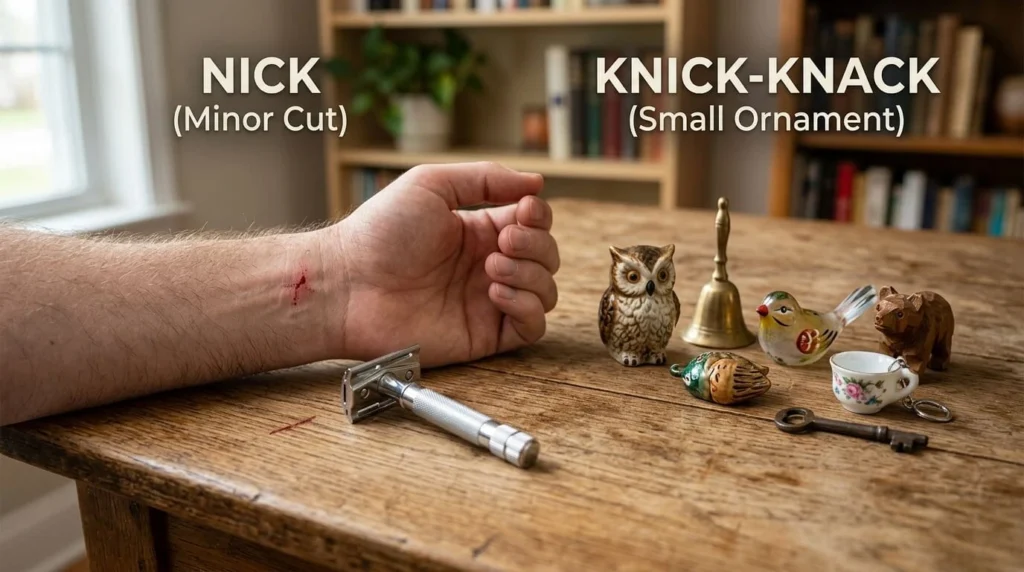
Nick is the word you usually need. It means a small cut, notch, mark, or slight damage.
Knick is rare by itself and mostly appears inside certain expressions.
Examples:
- “I got a nick while shaving.”
- “She collects old knick-knacks.”
One extra letter changes the meaning and usage.
The Origin: Background of Knick or Nick
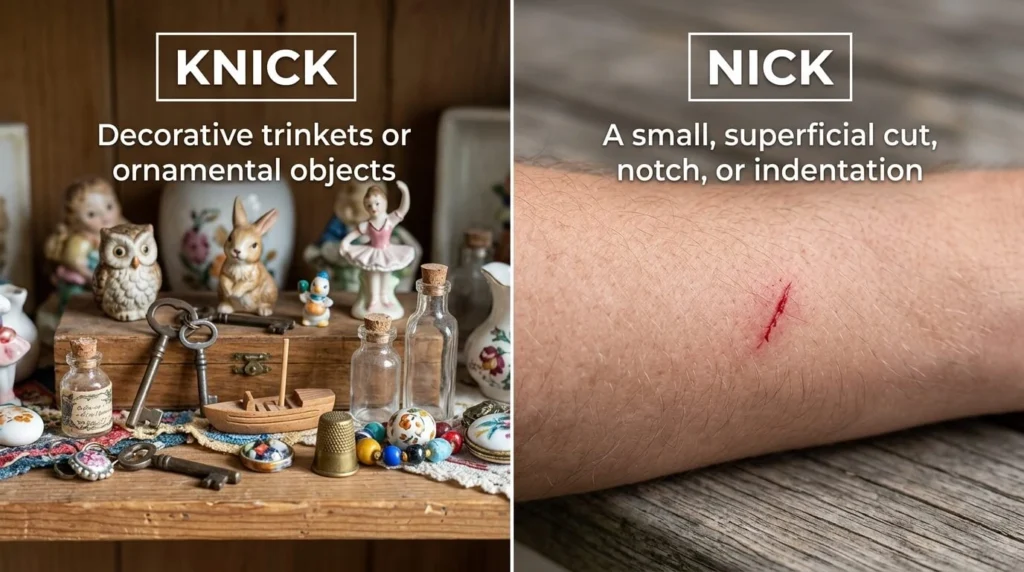
Knick meaning is much more limited than nick meaning. The word is rarely used by itself and mostly appears in expressions such as “knick-knack,” which refers to small decorative objects.
Words often travel through history in strange ways.
The word nick comes from older language roots and has been used for hundreds of years. It developed meanings related to small cuts, marks, or exact moments in time.
Knick has a different story. It came through language changes and became linked to decorative objects and small items.
Confusion happens because:
- Both sound almost the same
- Both begin with similar letters
- Silent letters confuse readers
- Typing mistakes happen quickly
Your brain often focuses on sound before spelling.
Knick or Nick Explained: Key Differences
Although these words sound alike, they do not work the same way.
| Term | Meaning | When to Use | Region/Context |
| Nick | Small cut, mark, notch, or slight damage | Everyday writing | Standard English worldwide |
| Knick | Rare word; mainly part of “knick-knack” | Special contexts | Limited use |
Understanding nick vs knick is simple once you know their usage. Nick refers to a small cut, mark, or slight damage, while knick is rarely used alone and mostly appears in expressions like knick-knack.
Examples
Nick
- “I got a nick on my hand.”
- “The knife left a small nick.”
Knick
- “My grandmother collects knick-knacks.”
Avoid using knick when talking about cuts or damage.
Which Version Should You Use?
The answer is simple in most situations.
- For students → use nick when talking about a cut or mark.
Reason: That is the standard word.
- For writers → use knick only when using words like knick-knack.
Reason: Readers expect that form.
- For global use → choose nick unless you clearly mean decorative objects.
Most of the time, nick is the safe choice.
Reckless or Wreclkess: Which Spelling Is Correct? ✅
Common Mistakes with Knick or Nick
People make these errors often.
| Mistake | Correction | Why It Happens |
| “I got a knick on my finger.” | “I got a nick on my finger.” | Similar sound |
| “The razor made a knick.” | “The razor made a nick.” | Spelling confusion |
| “The knife knicked my hand.” | “The knife nicked my hand.” | Wrong spelling |
| “There is a small knick in the paint.” | “There is a small nick in the paint.” | Typing mistake |
Quick tip
Ask yourself:
Am I talking about a small cut or damage?
Choose nick.
Am I talking about small decorative items?
Choose knick-knack.
Knick or Nick in Real-World Examples

Professional email
Subject: Product condition update
“We noticed a small nick on the surface during inspection.”
News headline
“Player leaves game after receiving a small nick during practice.”
Social media post
“Just dropped my phone and now there is a tiny nick on the corner.”
Formal report
“Inspection revealed a small nick on the outer metal edge.”
Knick or Nick: Data, Trends & Usage
Search behavior shows a pattern.
People usually search this topic because of:
- Spelling confusion
- Homework questions
- Writing corrections
- English learning
- Pronunciation issues
Search intent:
Informational
Common audiences include:
- Students
- Bloggers
- English learners
- Writers
Interesting insight:
People hear nick and knick almost the same way. Voice typing has increased confusion because speech tools sometimes select the wrong spelling.
Comparison Table
| Term/Variant | Meaning | Region/Context | Best Used When |
| Nick | Small cut or damage | Standard English | Everyday use |
| Knick | Rare term | Limited use | Special cases |
| Knick-knack | Small decorative object | Home and décor topics | Talking about collections |
Frequently Asked Questions
Q: What does knick or nick mean?
A: Nick means a small cut or mark. Knick is mostly used in words like knick-knack.
Q: How do you use knick or nick correctly?
A: Use nick for cuts or damage. Use knick only in special expressions.
Q: Knick vs nick what’s the difference?
A: Nick is a common English word. Knick is much less common.
Q: Is nick acceptable in formal writing?
A: Yes. It can appear in reports, emails, and professional documents.
Q: Which version is correct : knick or nick?
A: For small cuts or damage, nick is correct.
Q: Where does nick come from?
A: The word comes from older English roots linked to cuts and marks.
Q: Can nick be used in technical writing?
A: Yes. It can describe minor damage on surfaces or materials.
Q: Nick or knick: which one is correct?
A: For a small cut, mark, or slight damage, nick is correct. Knick is mostly used in words like knick-knack.
Q: How to Pronounce Nick and Knick?
A: Both words are usually pronounced the same: /nɪk/. The silent “k” in knick is one reason many people mix them up.
Conclusion
Small spelling changes can cause big confusion. You now understand the difference between knick and nick.
Remember these key ideas:
- Nick means a small cut or slight damage
- Knick is uncommon by itself
- Knick-knack refers to small decorative items
- Sound can trick your brain
Many people make this mistake because both words sound similar. That is normal. English has many words that seem alike but work differently.
Now you have an easy way to remember the difference.
Now you know exactly how to use knick or nick : go try it in your next piece of writing. Bookmark this guide so you never second-guess knick or nick again.
Knick or Nick Explained: Meaning, Spelling, Correct Usage, Examples, Learn Which Word to Use and Avoid Common Mistakes.
Carat or Karat: What’s the Difference and Which One Should You Use?