
Leery is the correct spelling when you mean cautious or suspicious, while leary is a common misspelling. For example, “She was leery of the offer.”
Have you ever written leery or leary and stopped because both spellings looked possible? You are not alone. The two words sound the same, so it is easy to choose the wrong spelling. This problem often appears in emails, schoolwork, news articles, and social media posts.
The quick answer is that leery is the standard and preferred spelling. It means that you do not fully trust someone or something. You may feel careful, doubtful, or suspicious. Leary does appear in some dictionaries, but it is listed as a less common spelling of leery. It can also be a family name, as in “Timothy Leary.”
This guide explains the difference between leery or leary in simple terms. You will learn their meaning, history, spelling rules, and correct use. You will also see clear examples for American and British English. By the end, you will know which spelling to use in casual, formal, and professional writing.
Leery or Leary – Quick Answer
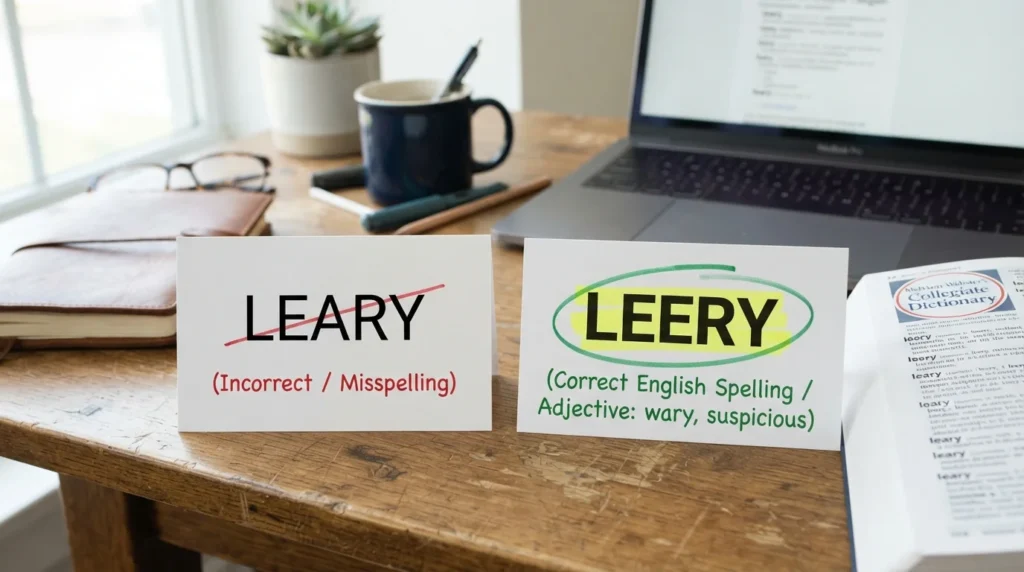
Leery is the standard spelling.
It means careful or suspicious because you do not fully trust someone or something.
Correct:
- I am leery of offers that seem too good to be true.
- She was leery of sharing her personal details.
- Customers may be leery of a new online store.
Leary is a less common spelling. Merriam-Webster lists it as a variant of leery, but most professional writers, editors, and dictionaries prefer leery.
For clear and modern writing, use:
Leery of something
Example:
He was leery of signing the contract without reading it.
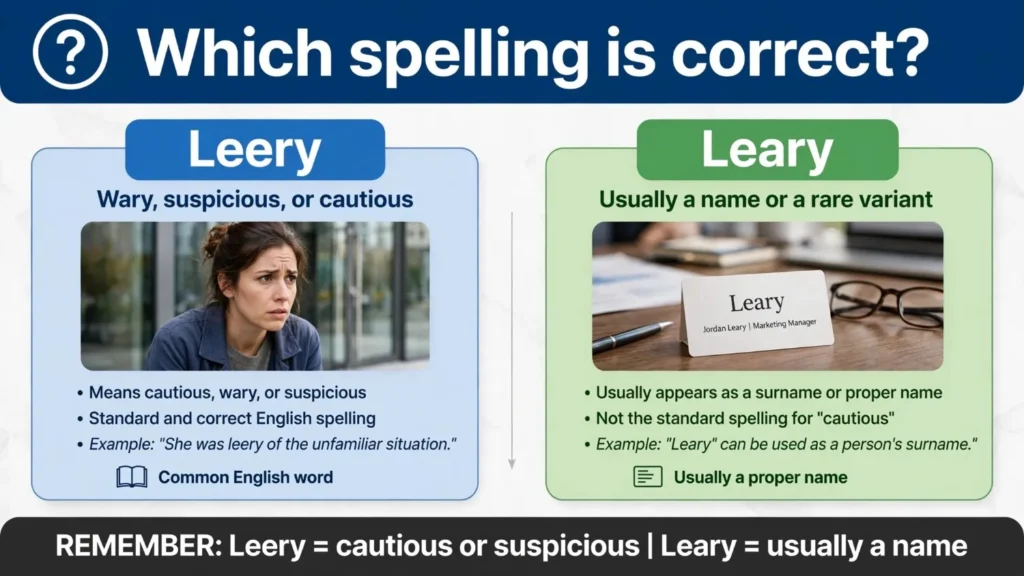
Do not confuse the adjective leery with Leary, which may be a person’s surname.
The Origin of Leery or Leary
The word leery has been used since at least 1718. It first appeared as slang. At that time, it could describe someone who was alert, watchful, knowing, or suspicious.
The exact origin of the word is not certain.
Some language experts believe it may be linked to an old word for knowledge or learning. Others think it may be connected to an older use of the verb leer, which could suggest moving in a secret or careful way.
The ending -y helps form an adjective. This gives us leery, which describes a person’s feelings or state of mind.
The spelling leary may have developed because of pronunciation. When spoken, leery sounds like “LEER-ee.” Some writers may hear the sound and spell it with -ary instead of -ery.
However, the older and more widely accepted form is leery.
It is also important to note that Leary is a common surname. This may be another reason people mistake it for the adjective.
British English vs American English Spelling

There is no major British and American spelling difference for leery or leary.
Both British and American English use leery as the main spelling. Cambridge Dictionary gives both UK and US pronunciations for leery and defines it as not trusting someone or something.
The spelling leary may appear in American sources as an informal or less common variant. However, it is not the preferred spelling for normal professional writing.
| English Variety | Preferred Spelling | Example |
| American English | Leery | American buyers are leery of hidden fees. |
| British English | Leery | British customers may be leery of unknown sellers. |
| Canadian English | Leery | Many users are leery of sharing private data. |
| Australian English | Leery | People are leery of claims with no proof. |
| Informal or rare use | Leary | Some writers use leary, but it is less common. |
Unlike words such as color/colour or center/centre, this word does not normally change between US and UK English.
Which Spelling Should You Use?
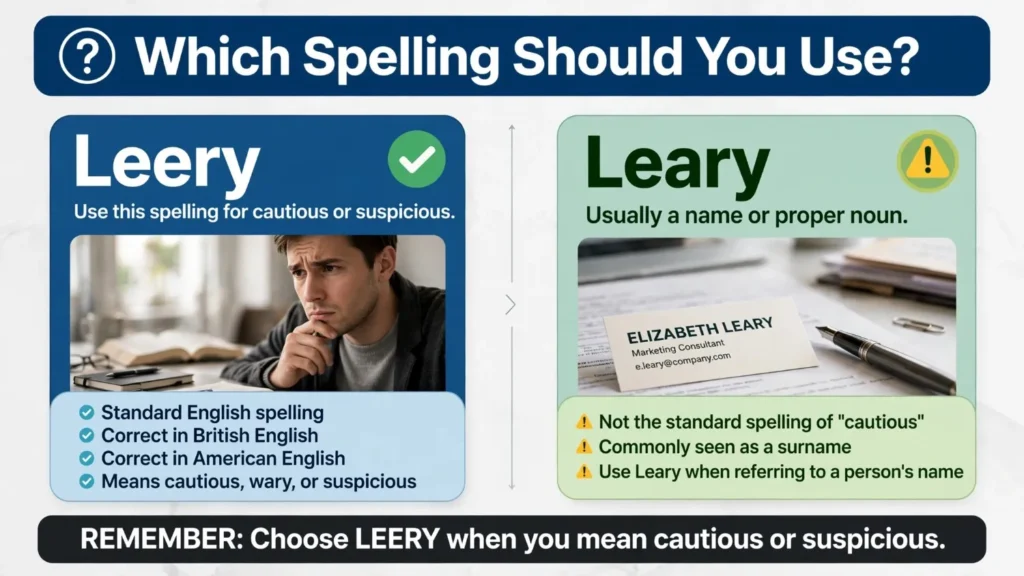
Use leery in almost every case.
For American Readers
Choose leery for websites, emails, articles, school papers, and business writing.
Example:
Investors are leery of plans that lack clear data.
Although some American dictionaries accept leary as a less common variant, leery looks more natural and professional.
For British and Commonwealth Readers
Use leery in British, Canadian, Australian, New Zealand, and other Commonwealth English.
Example:
The team was leery of changing the system too quickly.
The spelling stays the same across these forms of English.
For a Global Audience
Choose leery because it is the form most readers know. It is used by major dictionaries and professional publications.
When Should You Use Leary?
Use Leary when it is a person’s name.
Examples:
- Mr. Leary called the office.
- The report was written by Sarah Leary.
- Leary is an Irish family name.
In these examples, Leary should begin with a capital letter because it is a proper name.
Common Mistakes with Leery or Leary
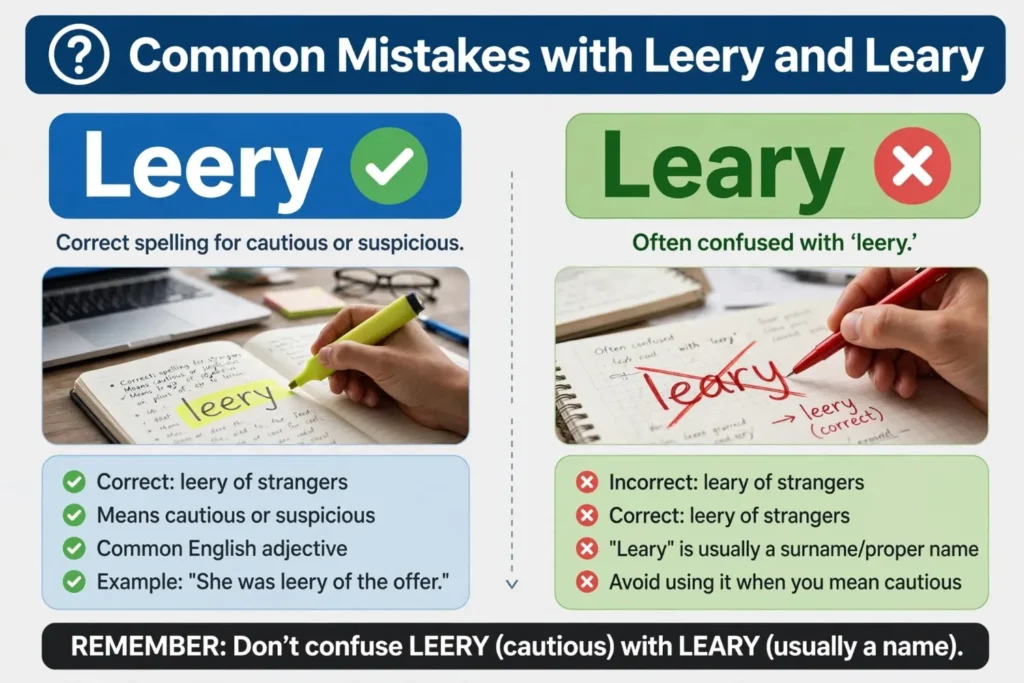
1. Using Leary in Formal Writing
Less clear:
The manager was leary of the new plan.
Better:
The manager was leery of the new plan.
The first version may be understood, but the second is the standard choice.
2. Confusing Leery with Weary
Leery means suspicious or careful.
Weary means tired.
Examples:
I am leery of the strange email.
I am weary after working all day.
These words sound similar, but their meanings are different.
3. Confusing Leery with Wary
Leery and wary have close meanings. Both can describe caution or distrust.
Examples:
She is leery of unknown websites.
She is wary of unknown websites.
Both sentences are correct. However, wary often means careful because danger may be present. Leery often suggests doubt or lack of trust.
4. Writing Leery Without “Of”
The word is often followed by of.
Correct:
He is leery of online deals.
You may sometimes use it without of when the meaning is already clear.
At first, the buyers seemed leery.
5. Treating Leary as a British Spelling
Leary is not the standard British form. Both British and American writers normally use leery.
6. Using a Capital Letter for the Adjective
Incorrect:
She was Leery of the offer.
Correct:
She was leery of the offer.
Use a capital letter only when Leary is a name.
Leery or Leary in Everyday Examples
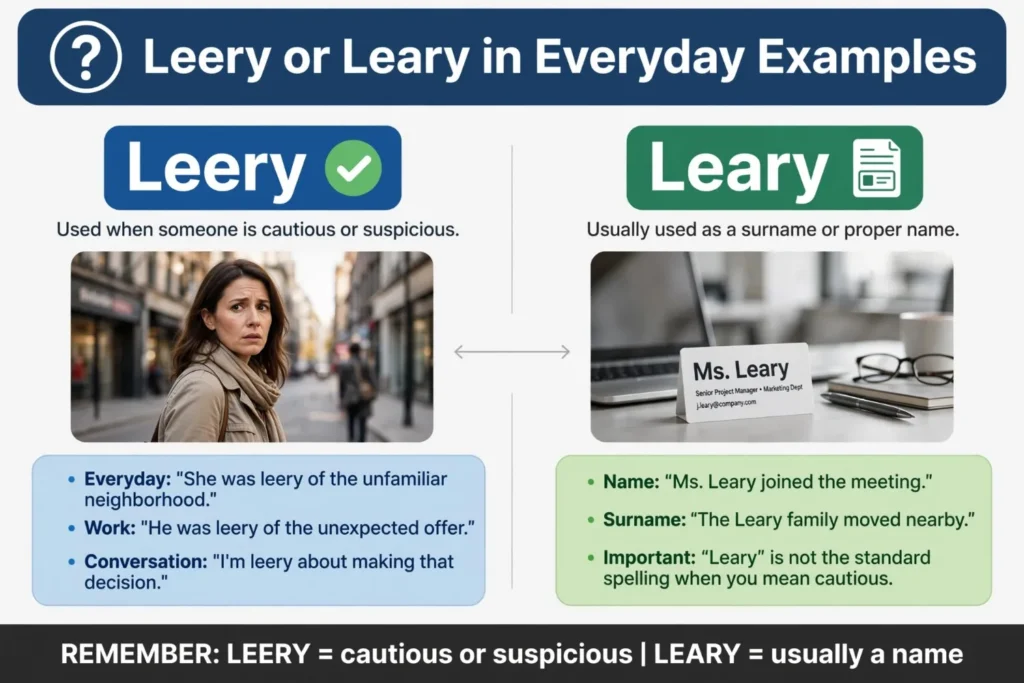
The easiest way to understand leery or leary is to see the word in real situations.
In Emails
I am leery of opening the attached file because I do not know the sender.
The client is leery of making a payment before receiving the contract.
Some staff members are leery of the new policy.
In News Writing
Local residents are leery of the plan because it may increase traffic.
Voters remain leery of promises that do not include clear details.
Small businesses are leery of taking on more debt.
Professional news writing normally uses leery, not leary. Cambridge also shows examples of leery in material from major news and media sources.
On Social Media
I am leery of accounts that ask for money in private messages.
People are getting leery of edited product reviews.
I was leery at first, but the service worked well.
Social media writing is informal, but leery is still the safest spelling.
In Formal Writing
The board remained leery of approving a project without a full risk report.
Consumers may be leery of companies that fail to explain how personal data is used.
Researchers were leery of drawing conclusions from the small sample.
In Daily Speech
I am a little leery of that dog.
She seemed leery of the stranger.
We were leery of buying such a cheap car.
Leery or Leary – Google Trends and Usage Data

Search and usage patterns strongly favour leery over leary.
People often search for leery or leary because they want to check the correct spelling. They may also search for phrases such as:
- Is it leery or leary?
- Leary meaning
- Leery meaning
- Leery of or leary of
- Leery vs wary
- Leery vs weary
The standard spelling leery is more common in dictionaries, edited articles, news reports, books, and professional content. Leary is more likely to appear as a surname, a rare spelling variant, or part of a spelling question.
Google Trends does not give exact search totals. It uses a relative scale from 0 to 100. The score shows search interest based on the chosen place and time. Very low-volume terms may appear as zero, and small spikes may be caused by statistical noise.
Search interest may be higher in English-speaking places such as:
- The United States
- The United Kingdom
- Canada
- Australia
- New Zealand
However, results can change based on the date, location, and search settings. The clearest usage pattern remains the same: leery is the dominant spelling, while leary is uncommon outside names and spelling searches.
Leery or Leary Comparison Table
| Word | Status | Meaning or Use | Example |
| Leery | Standard spelling | Suspicious, careful, or slow to trust | I am leery of the offer. |
| Leary | Less common variant | Sometimes used with the same meaning | He felt leary about the deal. |
| Leary | Proper surname | A person or family name | Ms. Leary joined the meeting. |
| Wary | Standard word | Careful because of possible danger | Be wary of scams. |
| Weary | Standard word | Very tired | She was weary after the trip. |
| Leer | Standard verb or noun | To look at someone in an unpleasant way | The man began to leer. |
Frequently Asked Questions
Is Leery or Leary Correct?
Leery is the standard and preferred spelling. Leary is listed by some dictionaries as a less common variant, but it should usually be avoided in professional writing.
What Does Leery Mean?
Leery means suspicious, careful, or not ready to trust someone or something.
Example:
She was leery of giving the website her card details.
Is Leary a Misspelling?
It is often treated as a spelling mistake because leery is much more common. However, some dictionaries list leary as a rare or less common variant.
Is Leery American or British?
It is used in both American and British English. There is no main regional spelling change.
Is It Leery of or Leary of?
Use leery of.
Example:
Customers are leery of products with no reviews.
What Is the Difference Between Leery and Wary?
Both words describe caution. Leery often shows doubt or distrust. Wary often means being careful because there may be danger.
What Is the Difference Between Leery and Weary?
Leery means suspicious.
Weary means tired.
Example:
I was leery of the long trip because I was already weary.
Can Leary Be a Name?
Yes. Leary can be a surname. When used as a name, it should begin with a capital letter.
Example:
Dr. Leary spoke at the event.
Conclusion
When choosing between leery or leary, use leery in almost every situation. It is the standard spelling in American, British, Canadian, Australian, and other forms of English. It means suspicious, careful, or slow to trust someone or something.
The spelling leary does exist, and some dictionaries list it as a less common variant. Still, it may look like an error to many readers. It can also cause confusion because Leary is a surname. For clear school, business, news, web, and formal writing, leery is the best choice.
Remember the common phrase leery of. You can be leery of a strange message, a risky deal, an unknown person, or a claim with no proof. Also, do not confuse leery with weary, which means tired, or wary, which means careful because of possible danger.
The simple rule is easy to follow: when you mean doubtful or suspicious, write leery.
Read More: Sewn or Sewed: Which Is Correct? Easy Grammar Guide

Hi, I’m Shafqat Rehman. With several years of experience in English grammar, spelling, word usage, and professional writing, I create simple and practical guides. My goal is to make confusing language rules easy to understand and help readers write with greater confidence and accuracy.