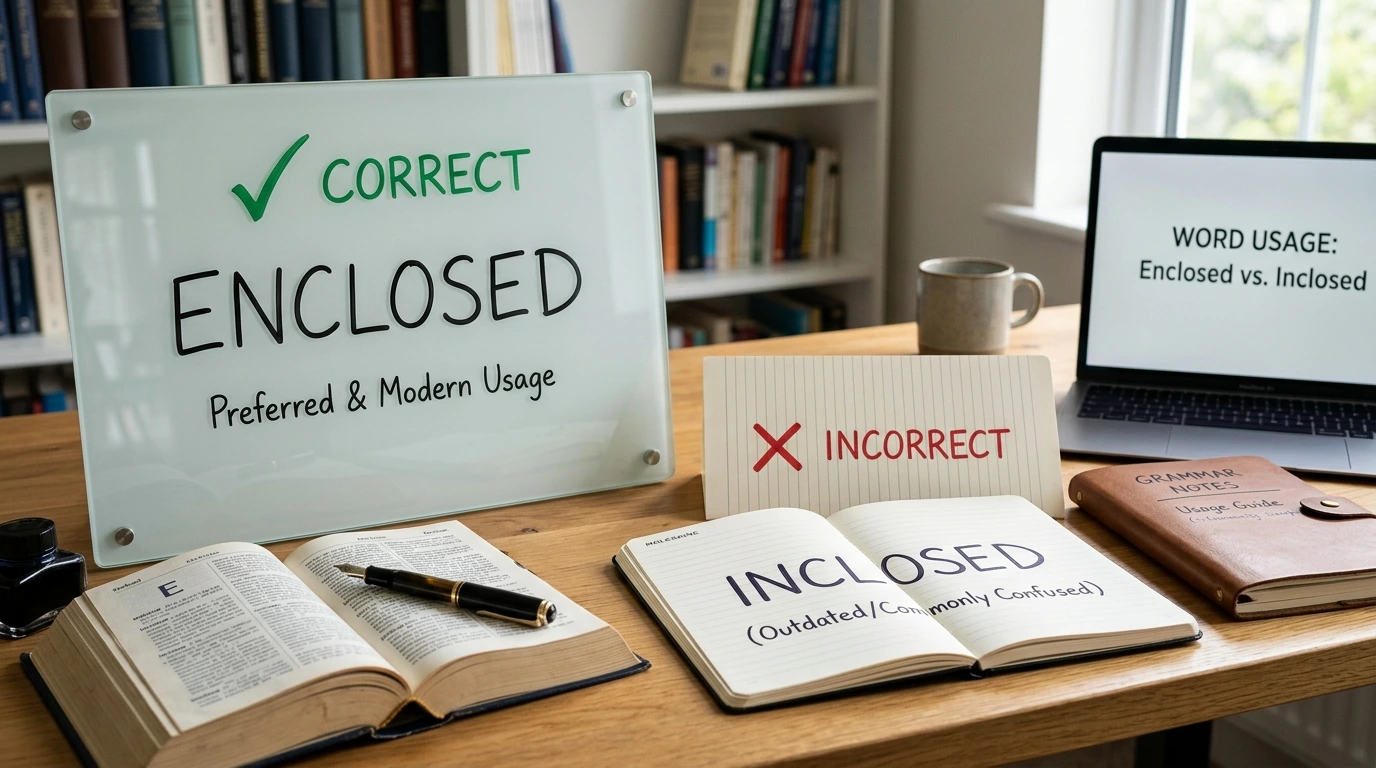
| Term | Meaning | When to Use | Region / Context |
| Enclosed | Surrounded, included, or placed inside | Modern English writing | Worldwide |
| Inclosed | Same meaning as enclosed | Historical texts, old documents | Historical English |
Enclosed is the correct and standard English word. Inclosed is an old spelling that is now considered outdated in modern writing, although it may still appear in historical texts and legal documents.
A few years ago, I was proofreading a formal business letter when I noticed the phrase “inclosed please find the documents.” At first, I assumed it was a simple spelling mistake. But after checking older books and dictionaries, I discovered that inclosed was once an accepted spelling of enclosed. That small discovery explained why many people still get confused today.
If you’ve seen inclosed in an old letter, a historical document, or even a legal paper, you may wonder whether it is still correct. Should you use inclosed or enclosed? Are they different words, or is one simply outdated?
The good news is that the answer is simple. Once you understand the history of these two spellings, you’ll know exactly which one belongs in modern English and which one should stay in the past.
By the end of this guide, you’ll confidently choose the correct word in emails, business letters, academic writing, and everyday communication.
Inclosed or Enclosed: Quick Answer
The correct spelling for modern English is enclosed.
The spelling inclosed is an older form that was common hundreds of years ago. Today, nearly all dictionaries, style guides, schools, businesses, and publishers recommend using enclosed.
Examples
✅ Please find the enclosed invoice.
✅ The garden is enclosed by a wooden fence.
❌ Please find the inclosed invoice. (Outdated in modern English)
✅ The word inclosed may appear in historical books or old letters.
Quick Rule:
If you’re writing today, always choose enclosed.
📔The Origin and Background of Inclosed or Enclosed
The confusion exists because both words come from the same historical source.
The English verb enclose developed from Old French enclore, meaning to shut in, surround, or include. The French word itself came from the Latin word includere, which means to shut in.
During the 16th, 17th, and even 18th centuries, English spelling was far less standardized than it is today. Writers often spelled the same word in different ways. Because of this, both enclosed and inclosed appeared in books, letters, newspapers, and official documents.
As dictionaries became more consistent during the 18th and 19th centuries, enclosed gradually became the preferred spelling.
Today:
- Enclosed is standard English.
- Inclosed survives mainly in historical documents.
- Modern grammar checkers usually flag inclosed as outdated.
Why Do People Still Search for “Inclosed”?
People usually encounter inclosed in situations like these:
- Reading old family letters
- Researching historical documents
- Looking through legal archives
- Reading classic literature
- Copying wording from an old business letter
Since both spellings once existed, many readers naturally wonder whether inclosed is still acceptable today.
Inclosed or Enclosed Explained: Key Differences
Although both words have the same meaning, they differ in modern usage.
What Does Enclosed Mean?
Enclosed can describe something that is:
- Placed inside another item
- Surrounded by walls or fences
- Included with a letter or package
Examples:
- The enclosed receipt contains your payment details.
- The playground is enclosed by a safety fence.
- Please review the enclosed documents.
What Does Inclosed Mean?
Inclosed carries exactly the same meaning.
The only real difference is that it belongs to an older stage of English.
Examples from historical writing may include:
- The inclosed letter was delivered yesterday.
- The land was inclosed with stone walls.
Although these sentences are historically correct, modern writers would replace inclosed with enclosed.
Why Did English Keep “Enclosed”?
English has changed over hundreds of years.
Many words once had multiple accepted spellings, including:
| Older Form | Modern Form |
| shew | show |
| musick | music |
| publick | public |
| chuse | choose |
| inclosed | enclosed |
Over time, dictionaries simplified English spelling. As a result, only one version usually survived.
For this word, enclosed became the international standard.
Is “Inclosed” Wrong?
Not exactly.
It is historically correct but modernly outdated.
Think of it like using words such as:
- thou
- thee
- whilst (in some regions)
- peradventure
People still understand them, but they sound old-fashioned in everyday writing.
The same idea applies to inclosed.
Modern Usage Comparison
Imagine you’re writing these documents today.
| Writing Situation | Best Choice |
| Business email | Enclosed |
| School assignment | Enclosed |
| Research paper | Enclosed |
| Legal document | Enclosed |
| Historical novel | Inclosed (if matching the historical period) |
| Old letter transcription | Inclosed (keep the original wording) |
This simple rule prevents almost every mistake.
Key Takeaways So Far
- Enclosed is the correct spelling in modern English.
- Inclosed is an old spelling that is rarely used today.
- Both words share the same meaning.
- The difference is historical, not grammatical.
- For everyday writing, always choose enclosed.
Which Version Should You Use?
Choosing between inclosed and enclosed is easier than it seems. In almost every modern situation, enclosed is the right choice.
Here is a simple guide based on your audience and purpose.
For Students
Use enclosed in:
- Essays
- Homework
- Research papers
- College applications
Example:
Please see the enclosed chart for the results.
For Business Professionals
Always use enclosed in:
- Emails
- Cover letters
- Contracts
- Reports
- Client communication
Example:
Please find the enclosed invoice for your records.
Using inclosed in business writing may make your document look outdated or like it contains a spelling error.
For Writers and Authors
Your choice depends on the setting.
Use enclosed for:
- Modern novels
- Blogs
- News articles
- Website content
Use inclosed only when writing:
- Historical fiction
- Period dramas
- Old-style letters
- Stories set centuries ago
This helps your writing feel authentic without confusing modern readers.
For Historians and Researchers
If you are quoting an original document, keep the original spelling.
Example:
“The inclosed map was delivered on Monday.”
Do not change historical spellings unless your publication style guide asks you to modernize them.
Best Choice for Global Readers
If your audience includes readers from different countries, always use enclosed.
It is the accepted spelling in:
- American English
- British English
- Canadian English
- Australian English
- International English
Final Recommendation:
For nearly every modern writing situation, choose enclosed.
⚠️Common Mistakes with Inclosed or Enclosed
Many people become confused because they have seen inclosed in old books or copied it from historical documents.
Here are the most common mistakes.
| Mistake | Correct Version | Why? |
| Please find the inclosed file. | Please find the enclosed file. | Modern English prefers enclosed. |
| The garden is inclosed by walls. | The garden is enclosed by walls. | Standard spelling today. |
| I always write inclosed in emails. | I always write enclosed in emails. | Professional writing uses enclosed. |
| My résumé has an inclosed cover letter. | My résumé has an enclosed cover letter. | Better for modern business communication. |
| Spell-check changed inclosed. | Keep enclosed unless quoting history. | Grammar tools follow modern standards. |
Why These Mistakes Happen
People often make these errors because:
- They read old books.
- They copy wording from historical letters.
- They assume both spellings are equally common.
- They believe inclosed is British English. (It is not.)
Remember this simple rule:
If you’re writing today, use “enclosed.”
Inclosed or Enclosed in Real,World Examples
Seeing a word in context makes it much easier to remember.
Professional Email
Subject: Project Documents
Dear Sarah,
Please find the enclosed project proposal for your review. Let me know if you have any questions.
Kind regards,
James
News Article
Example:
“The property is enclosed by a six-foot security fence.”
This is the wording you would expect in modern journalism.
Social Media Post
“Our welcome package has been shipped! The enclosed guide explains everything you need to get started.”
Simple, natural, and modern.
Formal Report
“The enclosed financial statement summarizes the company’s performance during the previous quarter.”
This is standard business English.
Historical Letter
“Please accept the inclosed documents as requested.”
Here, inclosed fits because the letter reflects historical language.
Inclosed or Enclosed: Data, Trends & Usage
Although inclosed still appears online, nearly all modern English favors enclosed.
Search Intent
People searching “inclosed or enclosed” usually want to know:
- Which spelling is correct
- Whether inclosed is outdated
- If inclosed is acceptable today
- Which word should be used in emails and letters
This keyword has a strong informational search intent.
Where Is This Topic Most Popular?
The question is commonly searched by:
- Students
- English learners
- Copywriters
- Editors
- Teachers
- Business professionals
- Job seekers
Anyone writing formal English may encounter this confusion.
Why Does It Still Matter?
Older documents are becoming easier to access through online archives and digital libraries. As more people read historical books, letters, and legal records, they continue to discover spellings like inclosed.
Knowing that enclosed is the modern standard helps you avoid mistakes while still understanding older texts.
Read more: Frie or Fry: Which Spelling Is Correct in English?
Standalone Comparison Table
| Term/Variant | Meaning | Region/Context | Best Used When |
| Enclosed | Included inside or surrounded by something | Modern English worldwide | Emails, letters, reports, academic writing, websites |
| Inclosed | Same meaning as enclosed | Historical English | Original historical documents, quotations, historical fiction |
| Included | Added as part of something | General English | Lists, documents, packages, conversations |
| Attached | Sent with an email or document | Digital communication | Emails, online file sharing |
| Encircled | Surrounded completely | Descriptive writing | Maps, military writing, geography, storytelling |
Quick Summary
- ✅ Enclosed = Correct modern spelling.
- ✅ Inclosed = Historical spelling.
- ✅ Use enclosed in almost every situation today.
- ✅ Keep inclosed only when preserving historical accuracy.
Frequently Asked Questions (FAQs)
Q1: What does “enclosed” mean?
Enclosed means included inside something or surrounded by something. It is commonly used in letters, emails, reports, and everyday English.
Example:
Please review the enclosed documents before Friday.
Q2: Is “inclosed” a real word?
Yes. Inclosed is a real English word, but it is an old spelling of enclosed. It was common centuries ago but is rarely used in modern English.
Unless you are quoting a historical document or writing historical fiction, choose enclosed instead.
Q3: Which is correct: “inclosed” or “enclosed”?
For modern English, enclosed is the correct and recommended spelling.
Inclosed is considered archaic. Most dictionaries, editors, grammar checkers, and style guides prefer enclosed.
Q4: Can I use “inclosed” in a business email?
No. In professional communication, always use enclosed.
Correct:
Please find the enclosed invoice.
Using inclosed may make your writing appear outdated or mistaken.
Q5: Why do old letters use “inclosed”?
English spelling was not standardized several centuries ago. Writers often used different spellings for the same word.
As dictionaries became more consistent, enclosed became the accepted standard, while inclosed gradually disappeared from everyday use.
Q6: Is “inclosed” British English?
No. This is a common misunderstanding.
Both British English and American English now use enclosed. The spelling inclosed is simply an older form that existed before modern spelling rules became standardized.
Q7: Can I keep “inclosed” when quoting historical documents?
Yes. If you are quoting an original letter, legal record, diary, or historical text, keep the original spelling.
Changing historical spellings can alter the authenticity of the document.
🎯Conclusion
The confusion between inclosed and enclosed comes from the history of the English language, not from a difference in meaning. Both words originally meant the same thing, but English spelling has evolved over time.
Today, the answer is straightforward:
- Enclosed is the standard spelling in modern English.
- Inclosed is an archaic spelling found mainly in historical documents, classic literature, and old legal records.
- Whether you’re writing an email, a business letter, a school assignment, or a blog post, enclosed is the word you should use.
- Reserve inclosed only when quoting or recreating historical writing.
Remember one simple rule: If you’re writing for today’s readers, choose “enclosed.” It’s clear, professional, and recognized around the world.
Now you know exactly how to use inclosed and enclosed with confidence. Bookmark this guide so you never second-guess the correct spelling again, and share it with anyone who has ever been confused by these two words.
Read more: Callus or Callous: Which Spelling Is Correct and When to Use It?

Passionate about language and clear communication, I explore the subtle differences between words and expressions through well-researched, practical content. My goal is to help readers write with greater clarity, confidence, and precision by making complex language concepts easy to understand.