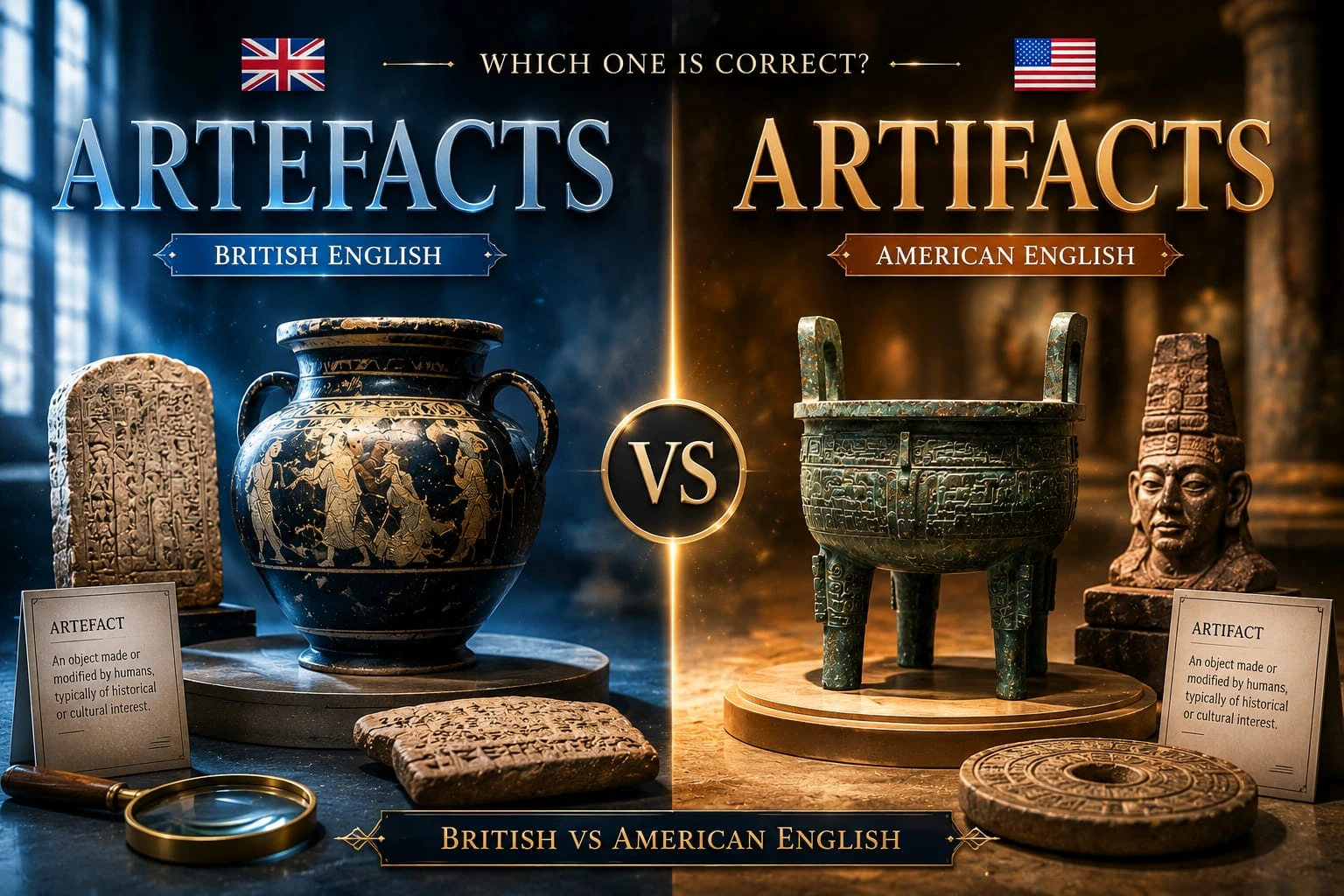
Artefacts or artifacts mean objects made by humans, often from the past, such as tools, pottery, or historical items. Both spellings are correct, but artifacts is common in American English while artefacts is used more in British English.
A few years ago, I was helping a student edit a history project. Everything looked great until one small word stopped us. The paper used artefacts in one paragraph and artifacts in another. The student looked confused and asked, “Wait, which one is actually correct?”
That tiny question appears more often than you might think.
You may see one spelling in a museum article and another in a science paper. Then you open a website and find something different again. Suddenly a simple word becomes a source of doubt.
People search for this because they want a clear answer. They want to know if one version is wrong, if the spelling changes by country, or if the meaning changes too.
The good news is that the answer is simple. By the end of this guide, you will know what these words mean, why two spellings exist, where each one belongs, and how to use them with confidence.
Let’s clear up the confusion.
Artefacts or Artifacts: Quick Answer
Artefacts and artifacts have the same meaning.
They both describe objects created by people. These objects often have historical, cultural, scientific, or digital value.
Simple examples:
- A clay pot from an ancient city is an artifact.
- A Roman coin found underground is an artefact.
- Strange marks in a digital image can also be called artifacts.
The only real difference is spelling.
The Origin of Artefacts or Artifacts
The word comes from two old Latin roots:
- Arti = skill or craft
- Factum = something made
Together they created a meaning close to something made by human skill.
Over time, English adopted the word and used it in different areas:
- Archaeology
- History
- Science
- Medicine
- Technology
The spelling difference appeared later.
British English often keeps spellings that look closer to older forms. That is why artefact became common in the United Kingdom and some other countries.
American English usually prefers shorter spellings. That made artifact more popular in the United States.
The difference is like:
- Colour vs color
- Favourite vs favorite
- Centre vs center
Same meaning. Different spelling style.
Artefacts or Artifacts Explained: Key Differences or Variations
The meaning stays the same. The spelling changes based on region.
| Term | Meaning | When to Use | Region/Context |
| Artefact | Human-made object | British writing | UK, Australia, New Zealand |
| Artifact | Human-made object | American writing | United States |
| Digital artifact | Distortion in media | Tech discussions | Global |
| Cultural artifact | Historical object | Academic use | Global |
Examples:
British English:
“The museum displayed ancient Egyptian artefacts.”
American English:
“The museum displayed ancient Egyptian artifacts.”
Technology example:
“The image showed digital artifacts after compression.”
Notice something important.
The meaning never changed.
Only the spelling did.
Which Version Should You Use?
The answer depends on your audience.
For students in American schools
Use artifacts because most textbooks and educational systems in the United States follow American spelling.
For students in British schools
Use artefacts because it matches local language rules.
For academic researchers
Check the style guide first.
Many journals follow a specific language style.
For websites with global readers
Choose one version and stay consistent.
Consistency matters more than switching back and forth.
Direct recommendation
- American audience → Artifacts
- British audience → Artefacts
- Global audience → Choose one and use it everywhere
Common Mistakes with Artefacts or Artifacts
People usually make the same few mistakes.
| Mistake | Correction |
| Using both spellings in one article | Pick one version |
| Thinking one spelling is wrong | Both are correct |
| Using it only for old objects | It can also describe digital issues |
| Misspelling as artifacts | Use artifacts |
| Adding extra letters randomly | Follow regional spelling rules |
Why does this happen?
Most people read content from many countries online. They see different spellings and assume one must be incorrect.
The internet mixes language styles every day.
Artefacts or Artifacts in Real-World Examples
Professional email
“Please attach photographs of the historical artifacts found during the excavation.”
News headline
“Ancient artefacts discovered near old settlement”
Social media post
“Just visited a museum today. The ancient artifacts were amazing.”
Formal report
“The recovered artefacts provide evidence of human activity during the early period.”
Notice how naturally the word fits different situations.
Artefacts or Artifacts: Data, Trends & Usage
Search behavior shows strong interest in this topic because people often want spelling help.
Common search intent:
Informational
People usually ask:
- What does artifacts mean?
- Which spelling is correct?
- Artefacts vs artifacts
- Is artefacts British English?
Regions that search heavily:
- United States → Artifacts
- United Kingdom → Artefacts
- Australia → Artefacts
- Canada → Mixed usage
A useful insight matters here.
Global content has grown fast. People now read websites from many countries. That means readers see both spellings more often than before.
Years ago, many people stayed inside local language systems.
Now they do not.
That creates confusion and increases searches.
Comparison Table
| Term/Variant | Meaning | Region/Context | Best Used When |
| Artefact | Human-made object | British English | Writing for UK audiences |
| Artifact | Human-made object | American English | Writing for US audiences |
| Digital artifact | Distortion in audio or images | Technology | Discussing media problems |
| Cultural artifact | Item with cultural value | History and education | Talking about societies |
FAQs
Q: What does artefacts or artifacts mean?
A: Both words mean objects created by people. They are often historical items, tools, artwork, or objects with cultural value.
Q: How do you use artefacts or artifacts correctly?
A: Choose the spelling that matches your audience. Use artifacts for American English and artefacts for British English.
Q: Artefacts vs artifacts: what is the difference?
A: There is no meaning difference. The only change is spelling based on region.
Q: Is artefacts acceptable in formal writing?
A: Yes. It is completely acceptable in British English and many international publications.
Q: Which version is correct: artefacts or artifacts?
A: Both are correct. The right choice depends on the language style you use.
Q: Where does the word come from?
A: The word has Latin roots linked to human skill and things that are made.
Q: Can artifacts be used in technology?
A: Yes. In technology, artifacts can describe unwanted marks or distortions in images, videos, or sound files.
Conclusion
The confusion around artefacts or artifacts is easier to solve than many people think.
Remember these key points:
- Both spellings are correct.
- The meaning stays the same.
- Artifacts is common in American English.
- Artefacts is common in British English.
- Consistency matters more than choosing one over the other.
You do not need to worry every time you see a different spelling online. The main goal is to match your audience and keep your writing clear.
Language changes as people use it. Different countries shape words in different ways. That does not make one version better than the other.
Now you know exactly how to use artefacts or artifacts with confidence. Bookmark this guide so you never second-guess the word again, and share it with someone else who has wondered which spelling is right.
Artefacts or artifacts explained meaning, spelling, correct usage, examples, and guidance to choose the right version without confusion.
Kneeled or Knelt: What’s the Difference?