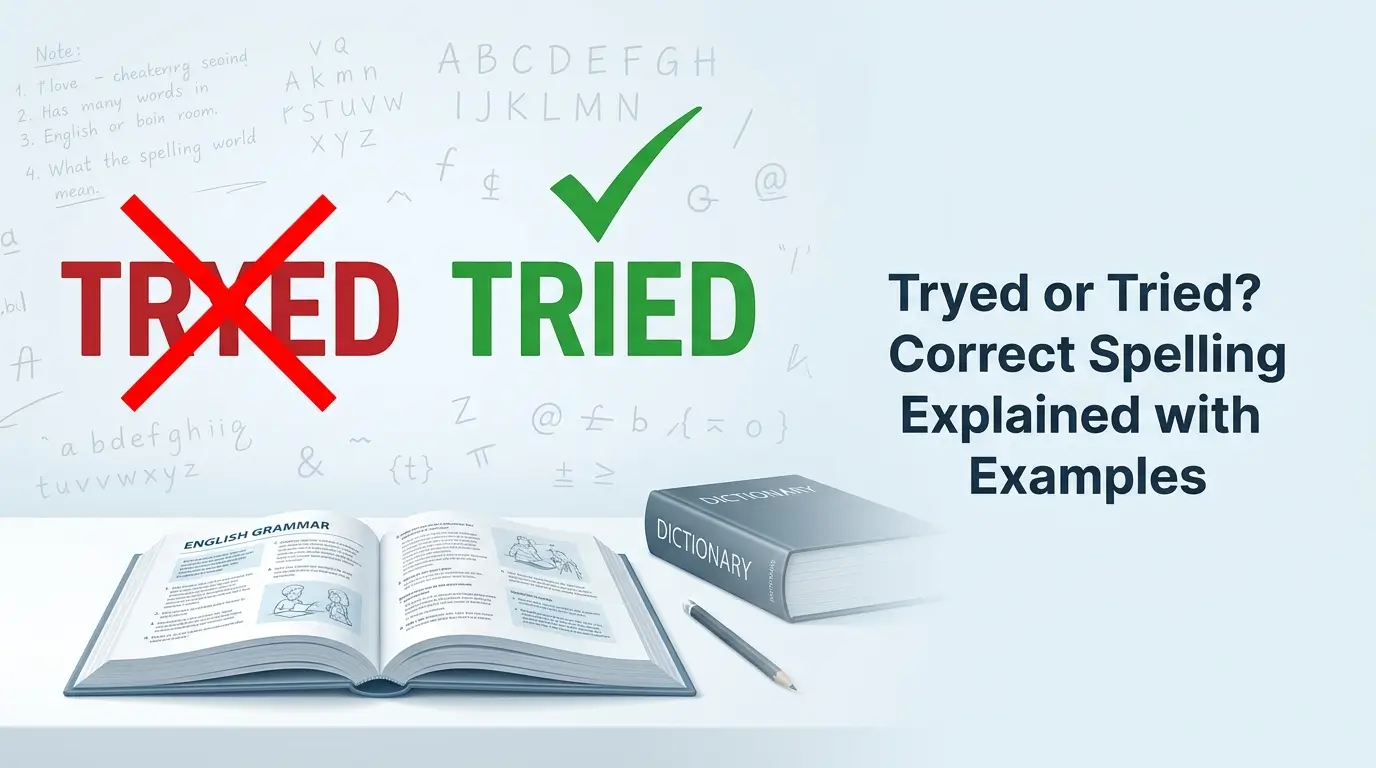
The correct spelling is tried; tryed is incorrect. Tried is the past tense and past participle of try.
Have you ever typed “tryed” and wondered if it was correct? You are not alone. Many English learners search for “tryed or tried” because both spellings look correct. Since the verb try ends with the letter Y, it can be confusing to know how to form its past tense.
The good news is that the rule is simple once you understand it. In English, many verbs ending in a consonant followed by Y change the Y to I before adding -ed. That is why tried is correct, while tryed is not.
This guide explains the correct spelling, grammar rule, examples, and common mistakes. . By the end, you will know exactly when to use tried and why tryed should always don’t use
Tryed or Tried: Quick Answer
Correct spelling: ✅ Tried
Incorrect spelling: ❌ Tryed
The past tense and past participle of try is tried.
Examples
- ✅ I tried to call you yesterday.
- ✅ She tried her best.
- ✅ We tried a new restaurant.
- ❌ I tryed to help.
Quick Tip:
When a verb ends with a consonant + Y, change Y to I before adding -ed.
Try → Tried
The Origin of Tryed or Tried
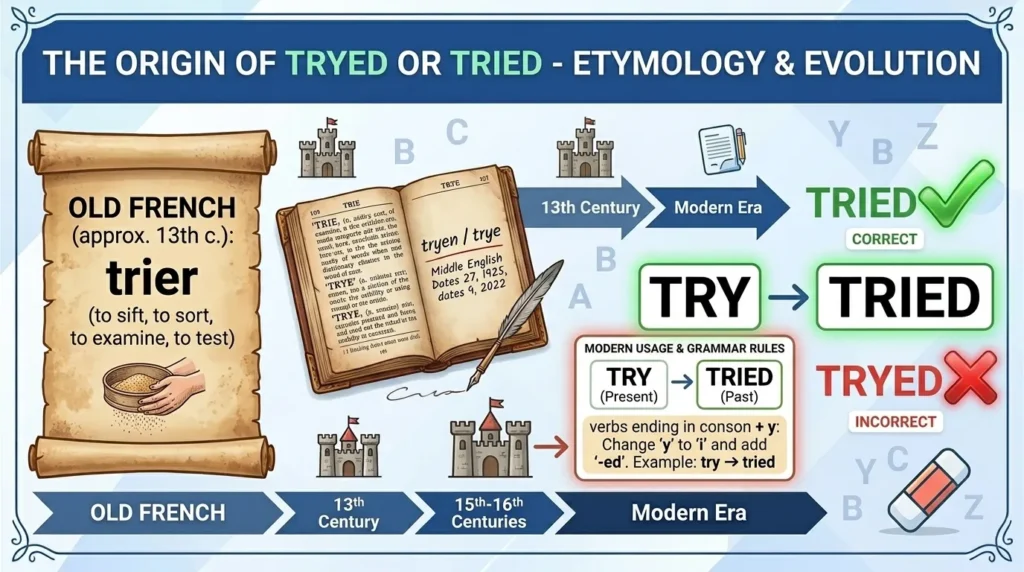
The word try comes from Old French trier, meaning “to examine,” “test,” or “select.” It entered English during the Middle English period and has been used for centuries.
English spelling follows grammar rules for verbs ending in Y.
When try became a regular English verb, it followed this rule:
- Cry → Cried
- Carry → Carried
- Study → Studied
- Try → Tried
Many people write tryed by simply adding -ed to try. But this spelling is wrong. In English, try changes to tried, not tryed.
British English vs American English Spelling
There is no spelling difference between British and American English. Both use tried.
Both countries use exactly the same spelling.
| Feature | British English | American English |
| Correct spelling | Tried | Tried |
| Incorrect spelling | Tryed | Tryed |
| Past tense | Tried | Tried |
| Past participle | Tried | Tried |
Examples
British English
- I tried to contact the company.
American English
- I tried calling customer support.
Both are correct because the spelling never changes.
Which Spelling Should You Use?
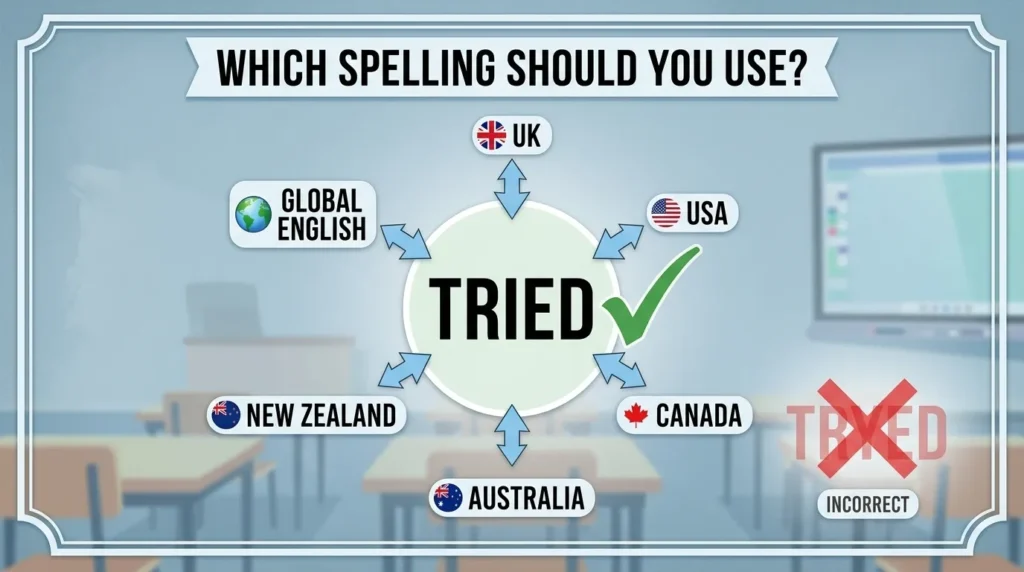
Always use tried.
If your audience is in the United States
Use tried.
If your audience is in the United Kingdom
Use tried.
If your audience is in Canada, Australia, New Zealand, or other Commonwealth countries
Use tried.
If your audience is global
Use tried because it is the only accepted spelling in standard English.
Common Mistakes with Tryed or Tried
Many learners make the same spelling mistakes.
| Incorrect | Correct |
| Tryed | Tried |
| I have tryed | I have tried |
| She tryed hard | She tried hard |
| We tryed again | We tried again |
Why does this happen?
People often think every verb only needs -ed added.
That works for words like:
- Walk → Walked
- Jump → Jumped
But verbs ending in a consonant + Y follow a different rule.
Remember
Consonant + Y = Change Y to I + ED
Examples:
- Try → Tried
- Cry → Cried
- Fry → Fried
- Reply → Replied
Tryed or Tried in Everyday Examples
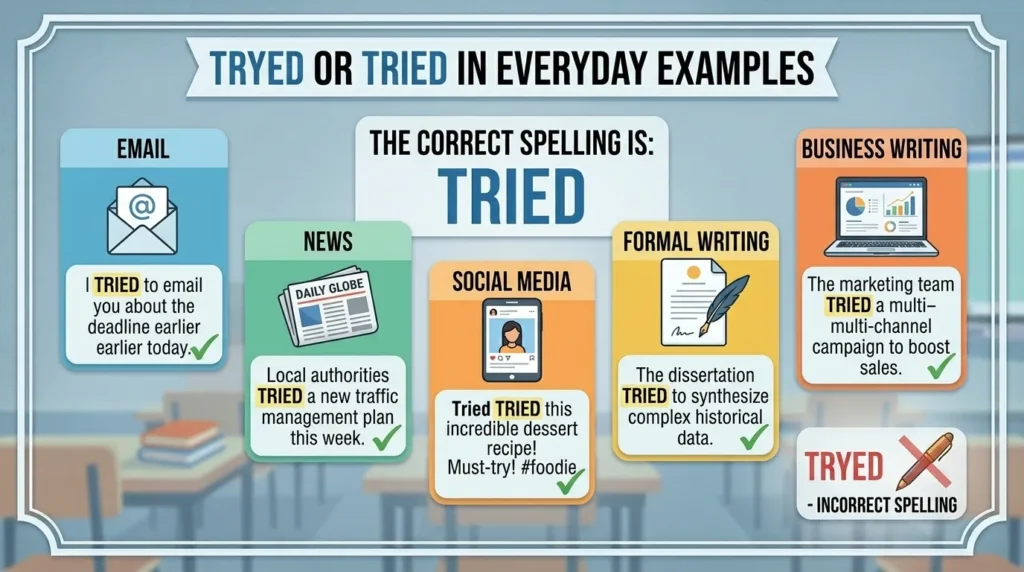
✅ I tried to reach you yesterday.
News
✅ Officials tried several methods before making a decision.
Social Media
✅ I finally tried the new coffee shop!
Formal Writing
✅ Researchers tried different approaches during the experiment.
Business Writing
✅ Our team tried multiple solutions before choosing the best one.
Tryed or Tried: Google Trends & Usage Data
Many people search for tryed because they are not sure which spelling is correct.
The misspelling is common among:
- English learners
- Young students
- Fast mobile typists
- People relying on pronunciation instead of grammar
The correct spelling tried is more common in:
- United States
- United Kingdom
- Canada
- Australia
- Ireland
- New Zealand
“Tryed” is not a correct English word, so spell checkers replace it with “tried.”
See Also: Countries or Country’s: What’s the Difference?
Comparison Table
| Word | Correct? | Meaning |
| Tried | ✅ Yes | Past tense of “try” |
| Tryed | ❌ No | Incorrect spelling |
| Try | ✅ Yes | Present tense |
| Trying | ✅ Yes | Present participle |
| Tries | ✅ Yes | Third-person singular |
FAQs
Is “tryed” ever correct?
No. Tryed is never considered correct in standard English.
Why is it “tried” instead of “tryed”?
Because verbs ending in a consonant + Y change Y to I before adding -ed.
Is “tried” used in British English?
Yes. British English and American English both use tried.
What is the past tense of “try”?
The past tense of try is tried.
What is the past participle of “try”?
The past participle is also tried.
Example:
“I have tried everything.”
Why do people search for “tryed”?
Many people simply guess the spelling based on pronunciation and do not know the Y → I grammar rule.
Is “tried” a regular verb?
Yes. Try is a regular verb that follows the standard spelling rule for verbs ending in Y.
Conclusion
Knowing the difference between tryed or tried is easier than it first appears. The correct spelling is tried. It is the past tense and past participle of try. Many people write tryed, but that spelling is incorrect. The correct rule is to change Y to I before adding -ed, so it becomes tried.
This rule also works for many common verbs like cry, carry, reply, and study.. There is no difference between British English and American English for this word. Tried is always the correct spelling. Use tried in emails, essays, or social media posts to keep your writing correct and easy to understand.
There is no difference between British English and American English for this word. Always use tried. It keeps your writing clear, correct, and professional.
If you want, I can make it even easier for beginner English learners (Grade 5–6 level). If you’re not sure, remember this: try always becomes tried, not tryed.

Passionate about language and clear communication, I explore the subtle differences between words and expressions through well-researched, practical content. My goal is to help readers write with greater clarity, confidence, and precision by making complex language concepts easy to understand.