
Have you ever wondered whether it is dawn or dusk when the sun first appears or when it disappears? Many people search this phrase because both words sound similar and describe changing sky colours. It is easy to mix them up, especially if English is not your first language.
Knowing the difference between dawn and dusk helps you write, and avoid confusion. You may see these words in weather reports, books, travel guides, news articles. Many people also search this topic before writing stories, captions, or professional documents.
This guide explains the meaning of dawn and dusk in simple English. Learn their origins, usage, common mistakes, and when to use each word. By the end, you will know exactly when to use each word with confidence.
Dawn or Dusk – Quick Answer
Dawn is the time just before or as the sun rises.
Dusk is the time just after or as the sun sets.
Examples
- We started hiking at dawn.
- Birds usually sing at dawn.
- The lights came on at dusk.
- We reached home before dusk.
Quick Comparison
| Dawn | Dusk |
| Morning | Evening |
| Sunrise | Sunset |
| Start of the day | End of the day |
| Sky becomes brighter | Sky becomes darker |
The Origin of Dawn or Dusk
The word dawn comes from the Old English word dagian, meaning “to become day” or “daybreak.” It has been used for hundreds of years to describe the first light of morning.
The word dusk comes from the Old English word dox, meaning dark or shadowy. Over time, it became the common word for the fading light after sunset.
Unlike many English words, dawn and dusk are not different spellings of the same word. They are two separate words with different meanings. People confuse them because both describe twilight periods when the sky changes colour.
British English vs American English Spelling
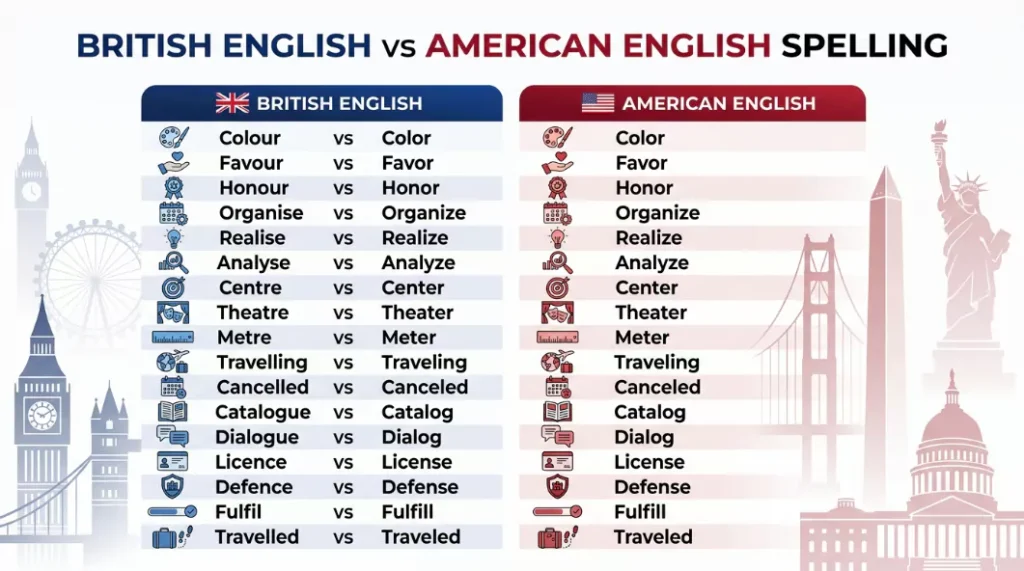
There is no spelling difference between British English and American English.
Both countries use:
- Dawn
- Dusk
The meanings are exactly the same in both forms of English.
Comparison Table
| British English | American English | Meaning |
| Dawn | Dawn | Sunrise period |
| Dusk | Dusk | Sunset period |
Whether you write for readers in the UK, the United States, Canada, Australia, or New Zealand, you can use the same spellings.
Which Spelling Should You Use?
Since dawn and dusk are standard English words, there is no regional spelling choice.
If your audience is in the United States
Use dawn for morning light.
Use dusk for evening light.
If your audience is in the United Kingdom
The same words apply.
If your audience is global
Continue using dawn and dusk because they are understood worldwide.
There is no need to change the spelling for different English-speaking audiences.
Common Mistakes with Dawn or Dusk
Many learners confuse these two words because both happen during twilight.
Mistake 1
❌ The sun rises at dusk.
✅ The sun rises at dawn.
Mistake 2
❌ We watched the sunset at dawn.
✅ We watched the sunset at dusk.
Mistake 3
❌ Dawn happens in the evening.
✅ Dawn happens in the morning.
Mistake 4
❌ Dusk means sunrise.
✅ Dusk means sunset or evening twilight.
Mistake 5
❌ Dawn and dusk mean the same thing.
✅ They describe opposite times of the day.
Dawn or Dusk in Everyday Examples
“Our team will begin maintenance at dawn.”
News
“The rescue operation started at dawn.”
“The city lights turned on at dusk.”
Social Media
“What a beautiful dusk over the beach!”
“I love watching the sunrise at dawn.”
Formal Writing
“Field observations began at dawn to record bird activity.”
“The event concluded shortly after dusk.”
Dawn or Dusk – Google Trends & Usage Data
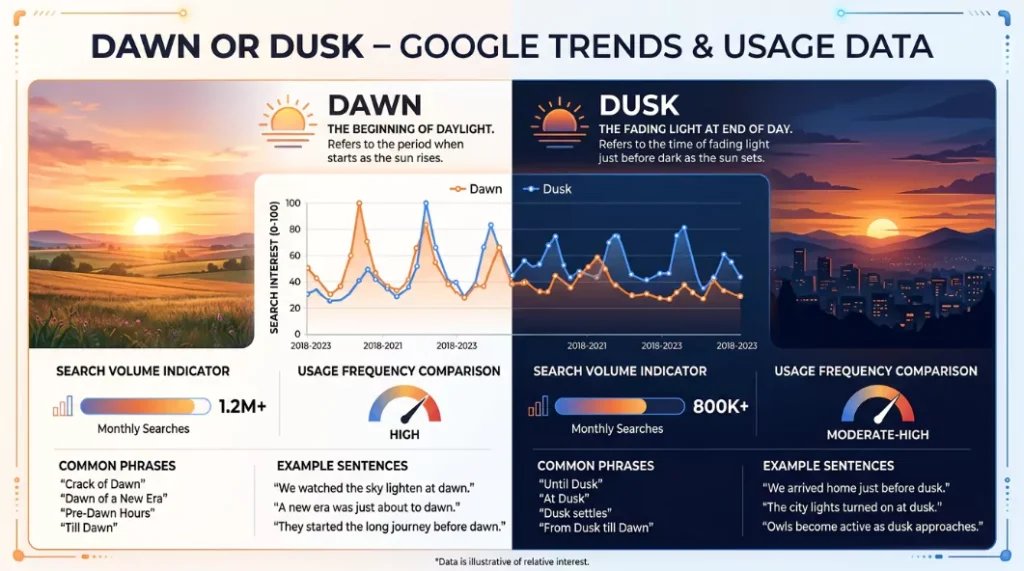
Searches for dawn and dusk stay steady because students and English learners often look up their meanings.
Where people search most
- United States
- United Kingdom
- Canada
- Australia
- India
Common search topics
- Difference between dawn and dusk
- Sunrise vs sunset
- Morning vs evening
- Twilight meaning
- Best time for photography
- Prayer times
- Weather information
“Dawn or dusk” is common in travel, nature, wildlife, photography, and outdoor activities. These times offer the best natural light.
Read Also: Shinny or Shiny? Which Spelling Is Correct?
Dawn vs Dusk Comparison Table
| Feature | Dawn | Dusk |
| Time of Day | Morning | Evening |
| Happens Around | Sunrise | Sunset |
| Light | Increasing | Decreasing |
| Sky | Getting brighter | Getting darker |
| Common Activities | Morning walks, bird watching | Evening walks, photography |
| Symbolism | New beginnings | Ending of the day |
Frequently Asked Questions
Is dawn before sunrise?
Yes. Dawn begins shortly before sunrise when the sky first starts to brighten.
Is dusk before or after sunset?
Dusk happens just after sunset as daylight fades.
Which comes first, dawn or dusk?
Dawn comes first because it happens in the morning. Dusk happens later in the evening.
Are dawn and dusk the same as twilight?
Yes. Dawn and dusk are both forms of twilight. Dawn is morning twilight, while dusk is evening twilight.
Can I use dawn and sunrise interchangeably?
Not always. Dawn starts before the sun appears. Sunrise is the moment the sun comes above the horizon.
Why do people confuse dawn and dusk?
Both describe changing light conditions and sound similar, making them easy to mix up.
Which word should writers use?
Use dawn when referring to morning light and dusk when referring to evening light.
Conclusion
Understanding the difference between dawn and dusk is easy when you know when each happens. Dawn marks the beginning of the day as the sky becomes brighter before sunrise. Dusk marks the end of the day as daylight fades after sunset. These words are often confused. However, they have opposite meanings and are used in different situations.
British and American English use the same spelling. You can confidently use dawn and dusk everywhere. Use the correct word in school work, emails, news, travel content, and social media posts. It makes your writing clearer and more professional.
Whenever you are unsure, remember this simple trick. Dawn means sunrise, and dusk means sunset. This easy rule will help you avoid mistakes and communicate clearly with readers.

Hi, I’m Nadeem Akhtar, a passionate content writer dedicated to creating clear, engaging, and easy-to-understand content. I enjoy writing informative articles on education, technology, business, grammar, SEO, and data analytics. My focus is on delivering practical, accurate, and valuable information that helps readers learn with confidence and apply knowledge in real-life situations. Every piece of content I create is designed to be simple, informative, and genuinely useful for a wide audience.