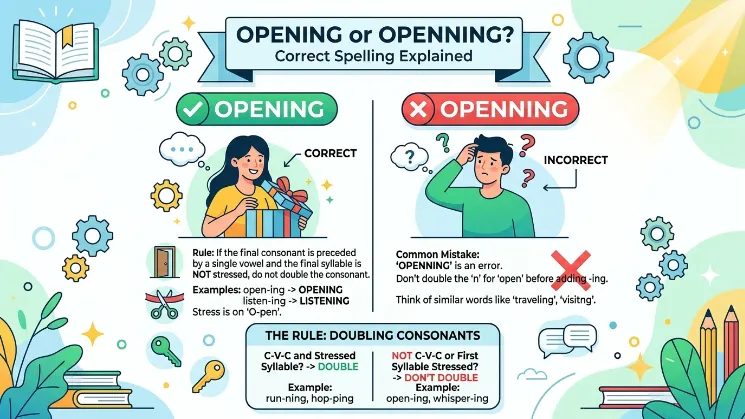
“Opening” is the correct spelling. “Openning” is incorrect because the letter “n” is not doubled in this word.
You’re writing a message “The opening ceremony starts at 9 AM.” Suddenly, you pause. Should it be opening or openning? That extra “n” feels tempting, especially since many English words double letters when adding endings.
This is a very common confusion. People search for “openning or opening” because English spelling rules can feel inconsistent. Sometimes letters double (like running), and sometimes they don’t (like opening). Without knowing the rule, it’s easy to make mistakes.
The good news is simple: only one spelling is correct. Once you understand the basic rule behind it, you’ll never get confused again. In this guide, you’ll learn the correct spelling, the rule behind it, common mistakes, and real-life examples to help you use opening confidently in writing.
Openning or Opening – Quick Answer
👉 Correct: Opening ✅
👉 Incorrect: Openning ❌
Meaning:
Opening means:
👉 The start or beginning of something
👉 An available position or opportunity
Examples:
- The opening ceremony was amazing. ✅
- There is a job opening in the company. ✅
- The openning ceremony was great. ❌
✔ Always use opening
The Origin of Opening
The word comes from the base verb “open.”
When we add “-ing” to form a continuous verb or noun, English follows a rule:
👉 If a word ends with:
- a vowel + consonant AND the stress is on the last syllable → double the consonant
- otherwise → do NOT double the consonant
Why “opening” (not openning)?
- “Open” = o-pen (stress on first syllable)
- So we simply add -ing → opening
No doubling of “n” happens.
Spelling Rule (British vs American English)
Unlike many words, “opening” does NOT change between British and American English.
Key Point:
👉 Both UK and US use opening
Comparison Table
| Form | British English | American English |
|---|---|---|
| Correct | Opening | Opening |
| Incorrect | Openning | Openning |
✔ Same spelling globally
Which Spelling Should You Use?
Simple Answer:
👉 Always use opening
There is no regional variation or alternative spelling.
Use “opening” in:
- Academic writing
- Emails
- Social media
- Exams
- Professional documents
Never use:
❌ Openning
Common Mistakes with Opening
Mistake 1:
❌ Openning ceremony
✔️ Opening ceremony
Mistake 2:
❌ Job openning available
✔️ Job opening available
Mistake 3:
❌ Store grand openning
✔️ Store grand opening
Mistake 4:
❌ Thinking “n” should double
✔️ No doubling because of stress rule
Opening in Everyday Examples
In Daily Life:
- The shop had its grand opening today
- The movie opening was exciting
In Emails:
- We have an opening for a teacher
- The event opening starts at 10 AM
On Social Media:
- “Grand opening today 🎉”
- “New job opening announced!”
In Formal Writing:
- The opening session begins at 9 AM
- There is an opening in the department
Opening – Usage & Trends
Usage data shows:
- “Opening” is the only accepted spelling worldwide
- “Openning” appears only as a spelling mistake
Key Insight:
👉 “Opening” is used in all contexts—formal, informal, global
Common Uses:
- Opening ceremony
- Job opening
- Opening statement
- Opening hours
Comparison Table: Opening vs Openning
| Feature | Opening | Openning |
|---|---|---|
| Spelling | Correct | Incorrect |
| Meaning | Beginning/start | No valid meaning |
| Usage | Global | Error only |
| Grammar Rule | Follows rule | Breaks rule |
| Example | Opening ceremony | ❌ Wrong spelling |
FAQs
1. Is it opening or openning?
The correct spelling is opening.
2. Why is openning incorrect?
Because English rules do not double “n” in this word.
3. What does opening mean?
It means the start of something or an available opportunity.
4. Does British English use openning?
No, both British and American English use opening.
5. When do we double consonants?
When the stress is on the last syllable (e.g., running, sitting).
6. Is openning ever correct?
No, it is always a spelling mistake.
7. Can I use opening in formal writing?
Yes, it is fully correct and widely used.
Conclusion
The confusion between openning or opening is very common, but the answer is simple. Opening is the only correct spelling, and openning is always incorrect.
This mistake usually happens because English sometimes doubles consonants when adding “-ing.” However, in the word open, the stress is not on the last syllable, so the “n” is not doubled. That’s why we write opening, not openning.
The best way to avoid this mistake is to remember the rule and practice using the correct form in daily writing. Whether you are writing emails, essays, or social media posts, using the correct spelling helps your writing look clear and professional.
Now that you understand the rule, you can confidently use opening in any situation without hesitation.

Michael A. Turner is a senior content writer specializing in well-researched, easy-to-understand articles. Helps readers make informed decisions through reliable content.