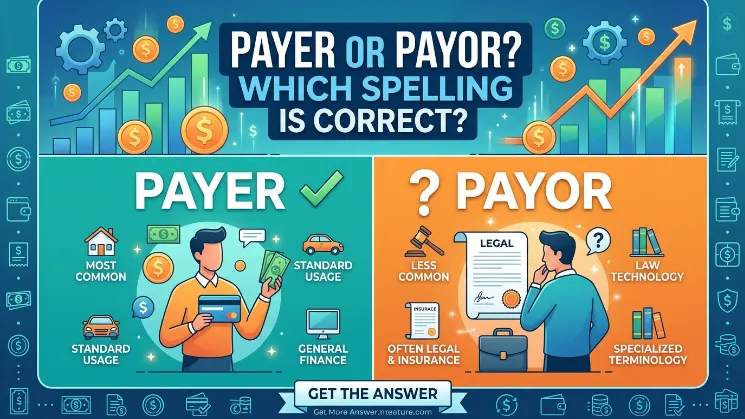
“Payer” is the standard and most common spelling. “Payor” is used mainly in legal and insurance contexts.
You’re filling out a form and see a field labeled “Payor Name.” You pause. Isn’t it supposed to be payer? Or are both correct?
This is a very common confusion. Many people search for “payor or payer” because both spellings exist in real-world use. You’ll see payer in everyday English, but payor often appears in legal documents, contracts, and insurance forms. That difference makes people unsure which one is correct.
The truth is simple: both words have the same meaning, but they are used in different contexts. One is standard English, while the other is a specialized variant used for clarity in formal industries.
In this complete guide, you’ll learn the difference between payor and payer, their origin, when to use each, common mistakes, and real-life examples so you can use the right spelling confidently.
Payor or Payer – Quick Answer
👉 Payer = Standard, common spelling
👉 Payor = Used in legal and insurance contexts
Meaning:
Both mean:
👉 A person or entity that makes a payment
Examples:
- The payer is responsible for the bill. ✅
- The insurance payor approved the claim. ✅
✔ Same meaning
✔ Different usage contexts
The Origin of Payor or Payer
The base word is “pay.”
When forming a noun (a person who performs an action), English usually adds:
- -er → payer
So why “payor”?
The spelling payor comes from legal and Latin-influenced writing styles. In legal language, -or endings are often used for clarity and tradition.
Examples of similar patterns:
- Grantor
- Lessor
- Debtor
Because of this pattern, payor became common in:
- Legal documents
- Insurance policies
- Financial contracts
British English vs American English Spelling
Unlike many words, this difference is not about British vs American English.
Key Point:
👉 Both US and UK primarily use payer
👉 Payor is industry-specific, not region-specific
Comparison Table
| Feature | Payer | Payor |
|---|---|---|
| Region | US & UK | US & UK |
| Usage | General English | Legal/insurance |
| Frequency | High | Lower |
✔ Not a regional spelling difference
Which Spelling Should You Use?
Choosing between payor or payer depends on context.
Use “payer” when:
- Writing general content
- Sending emails
- Writing essays or blogs
- Communicating normally
Use “payor” when:
- Writing legal documents
- Filling insurance forms
- Drafting contracts
- Following official terminology
Simple Rule:
👉 Everyday writing → payer
👉 Legal/technical writing → payor
Common Mistakes with Payor or Payer
Mistake 1:
❌ Using “payor” in general writing
✔️ Use payer
Mistake 2:
❌ Thinking “payor” is incorrect
✔️ It is correct in legal contexts
Mistake 3:
❌ Mixing both in one document
✔️ Choose one based on context
Mistake 4:
❌ Assuming it’s a US vs UK difference
✔️ It’s about usage, not region
Payor or Payer in Everyday Examples
In Daily Use:
- The payer must submit payment on time
- Each payer receives a receipt
In Legal Documents:
- The payor agrees to pay the amount
- The insurance payor processed the claim
In Emails:
- Please confirm the payer details
- The payer is responsible for charges
In Business:
- Identify the primary payer
- The third-party payor covers costs
Payor or Payer – Google Trends & Usage Data
Usage patterns show:
- Payer is far more common globally
- Payor appears mainly in:
- Legal documents
- Insurance industry
- Healthcare billing
Key Insight:
👉 “Payer” dominates everyday usage
👉 “Payor” is limited but important in specific fields
Comparison Table: Payor vs Payer
| Feature | Payer | Payor |
|---|---|---|
| Meaning | Same | Same |
| Usage | General English | Legal/technical |
| Frequency | High | Lower |
| Context | Everyday writing | Contracts, insurance |
| Formality | Standard | Specialized |
Payor vs Payer in Professional Contexts
In Healthcare:
- “Payor” is often used for insurance companies
- Example: Primary payor
In Law:
- Contracts may use “payor” for consistency
- Example: The payor agrees to terms
In Business Writing:
- “Payer” is more common
- Example: The payer will cover costs
FAQs
1. Is it payor or payer?
Both are correct. “Payer” is standard, while “payor” is used in legal contexts.
2. Which spelling is more common?
“Payer” is much more common in everyday English.
3. Do they have different meanings?
No, both mean a person or entity that pays.
4. Why is payor used in legal documents?
Because legal writing often uses “-or” endings for clarity and tradition.
5. Can I use payor in normal writing?
It’s better to use “payer” in general writing.
6. Is payor a US spelling?
No, it’s not regional it’s context-based.
7. Which should I use in exams?
Use “payer” unless the context is legal or technical.
Conclusion
The confusion between payor or payer is understandable because both words exist and are used in real-world situations. However, the difference is not about correctness it’s about context.
Payer is the standard and widely accepted spelling used in everyday English. Whether you are writing emails, essays, or general content, payer is the safe and correct choice.
On the other hand, payor is a specialized term used mainly in legal, financial, and insurance documents. It exists for consistency and clarity within those industries.
The key takeaway is simple:
👉 Use payer for general writing
👉 Use payor only in formal or technical contexts
By understanding this difference, you can write more clearly and professionally without confusion. Now you can confidently choose between payor or payer in any situation.

I am Oliver Kentwood, an English author fascinated by the quirks of language. I explore correct and incorrect spellings, helping readers navigate common confusions with clarity and style.