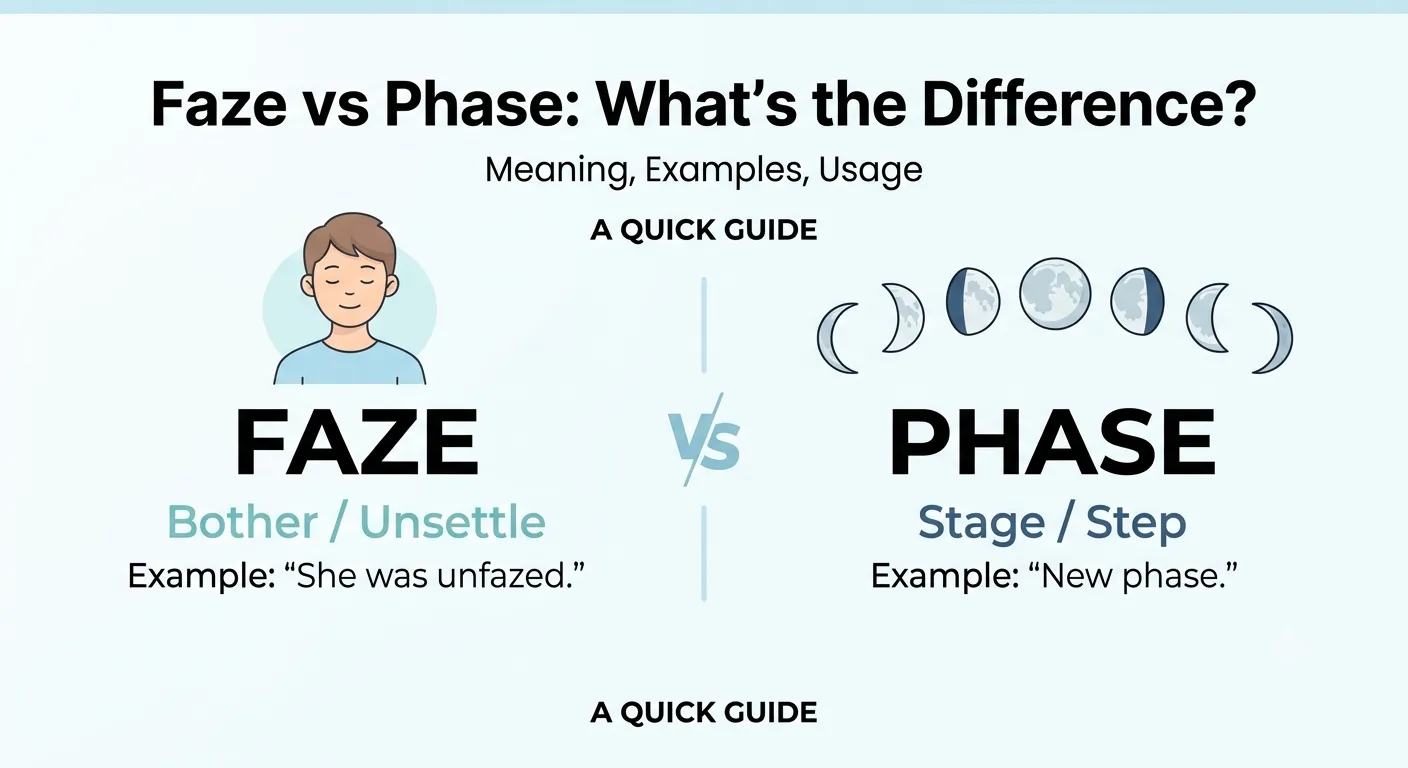
Faze means to disturb or upset someone, while phase means a stage, period, or step in a process.
Many people confuse faze and phase because they sound the same but have different meanings and spellings. Using the wrong word can change the meaning of a sentence.
People search for faze vs phase to understand the correct spelling when writing.. They want to know which spelling is correct and when to use each word. The answer is simple once you understand their meanings.
Faze means to disturb, upset, or bother someone. Phase means a stage in a process or a period of development. Although the words sound alike, they are used in completely different situations.
This guide explains faze and phase with simple examples and rules. You will learn when to use each word.
Faze vs Phase: Quick Answer
Quick Answer: Use faze when talking about upsetting or disturbing someone. Use phase when talking about a stage, period, or step in a process.
Examples
- The criticism did not faze her.
- We are entering the final phase of the project.
- Loud noises never faze him.
- The first phase of construction is complete.
Easy Rule:
Faze = Disturb Phase = Stage
The Origin of Faze vs Phase
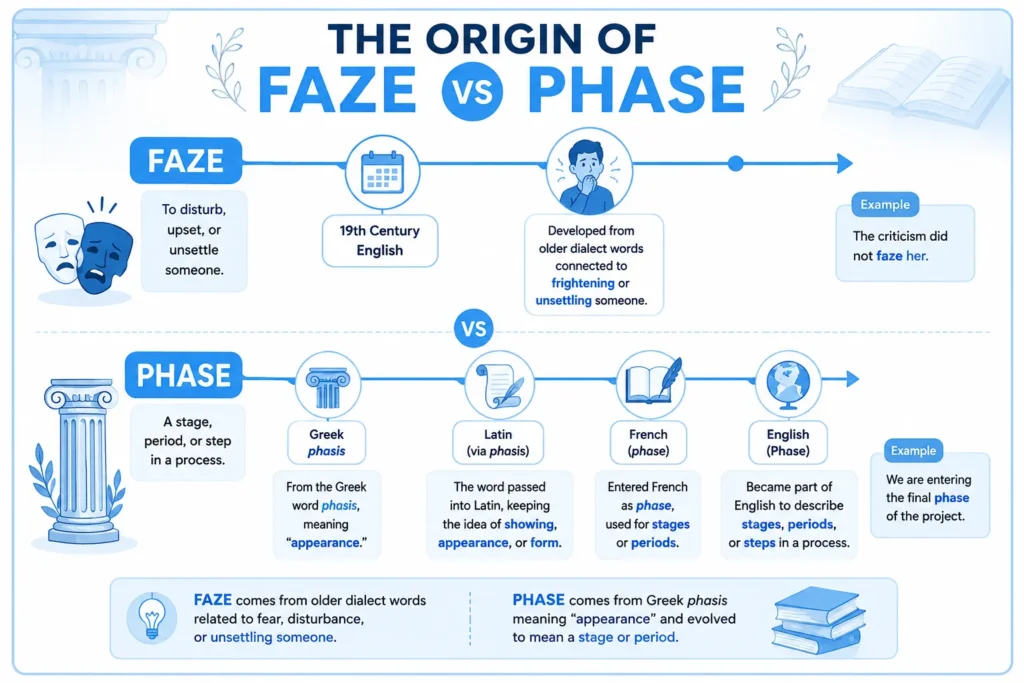
The word faze appeared in English during the 19th century. It likely developed from older dialect words meaning to frighten or unsettle someone.
The word phase comes from the Greek word phasis, meaning “appearance.” It came from Latin and French and later described stages, periods, and changes over time.
Although they sound the same, they have different meanings and origins.
British English vs American English Spelling
:
There is no spelling difference between British English and American English.
Both countries use:
- Faze for disturbing someone.
- Phase for a stage or period.
| Meaning | British English | American English |
| To disturb someone | Faze | Faze |
| A stage or period | Phase | Phase |
Examples
| Sentence | Correct Word |
| Nothing could _____ him. | Faze |
| The project reached its final _____. | Phase |
| Her confidence did not _____ after the loss. | Faze |
| We completed the planning _____. | Phase |
Which Spelling Should You Use?
Choose the word based on its meaning, not your location.
| Audience | Recommended Usage |
| United States | Faze or Phase (based on meaning) |
| United Kingdom | Faze or Phase (based on meaning) |
| Canada | Same rule |
| Australia | Same rule |
| Global audience | Same rule |
Remember:
Faze describes emotions or reactions. Phase describes stages or periods.
Common Mistakes with Faze vs Phase
Many people accidentally replace one word with the other because they sound alike.
| Incorrect | Correct |
| The first faze of the project. | The first phase of the project. |
| Nothing could phase him. | Nothing could faze him. |
| We entered a new faze. | We entered a new phase. |
| The bad news did not phase me. | The bad news did not faze me. |
Memory Tip:
Faze affects feelings. Phase describes progress.
Faze vs Phase in Everyday Examples
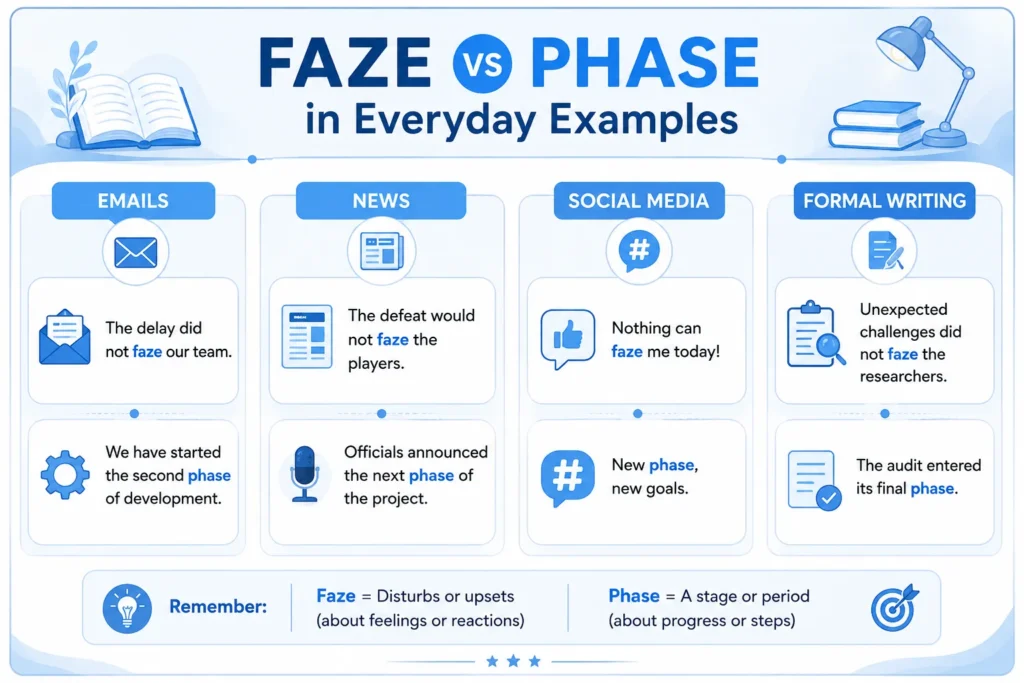
Emails
- The delay did not faze our team.
- We have started the second phase of development.
News
- The coach said the defeat would not faze the players.
- Officials announced the next phase of the project.
Social Media
- Nothing can faze me today!
- New phase, new goals.
Formal Writing
- The audit entered its final phase.
- Unexpected challenges did not faze the researchers.
Faze vs Phase – Google Trends & Usage Data
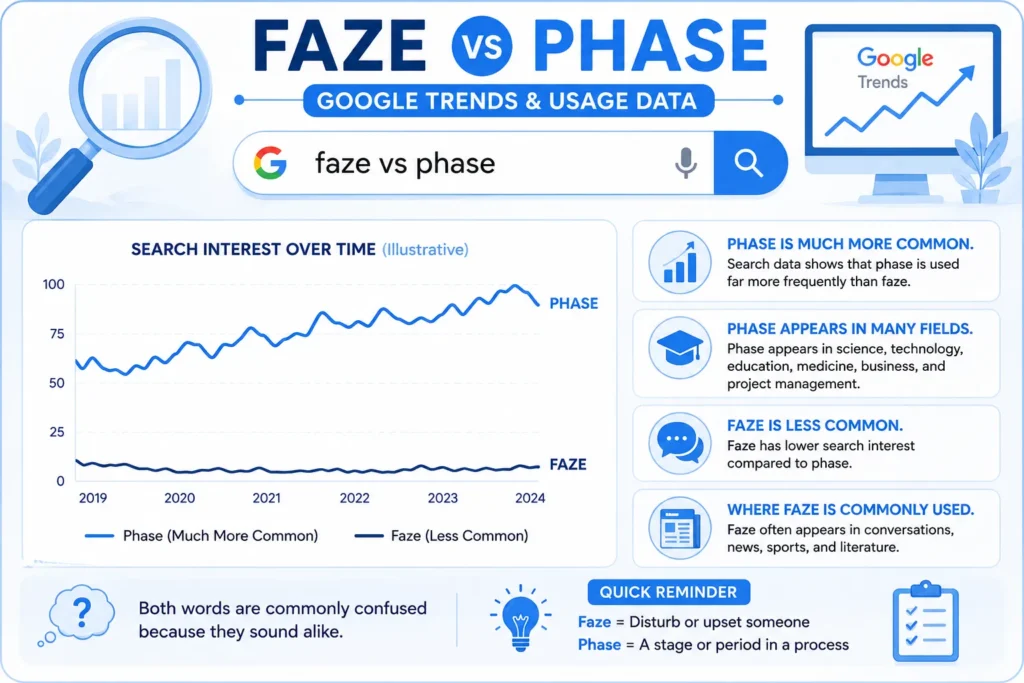
Search interest for faze vs phase remains steady because these words are common homophones. Many people search for the difference while writing reports, school assignments, emails, and online content
General usage patterns show:
- Phase is much more common because it appears in science, technology, education, medicine, business, and project management.
- Faze is less common and usually appears in conversations, news stories, sports writing, and literature.
English learners often search for these words because pronunciation alone does not reveal the correct spelling.
Read More 👉:Breech vs Breach: Meaning & Differences
Faze vs Phase Comparison Table
| Feature | Faze | Phase |
| Meaning | Disturb or upset | Stage or period |
| Part of Speech | Verb | Noun (and sometimes verb) |
| Common Context | Emotions, reactions | Projects, science, growth |
| Example | Nothing fazed her. | Final phase of the plan. |
| Remember | Feelings | Stages |
Frequently Asked Questions
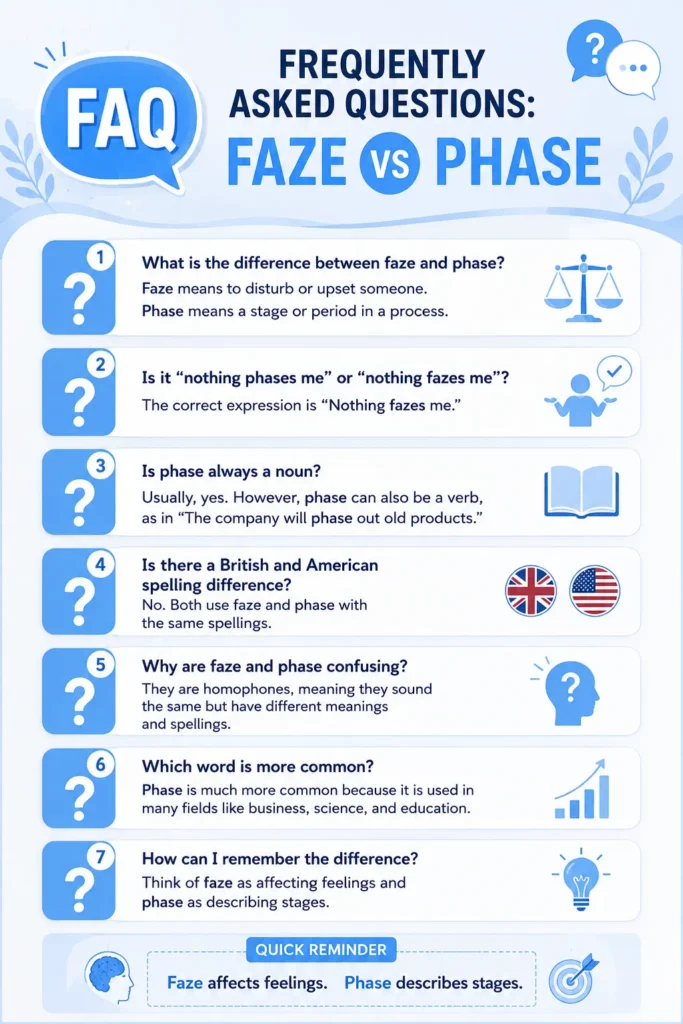
1. What is the difference between faze and phase?
Faze means to upset or disturb someone. Phase means a stage or period in a process.
2. What is the difference between phase and phrase?
Phase means a stage or period in a process, while phrase refers to a group of words that expresses a particular idea.
3. Is it “nothing phases me” or “nothing fazes me”?
The correct expression is Nothing fazes me.
4. Is phase always a noun?
Usually, yes. However, phase can also be a verb, as in:
“The company will phase out old products.”
5. Is there a British and American spelling difference?
No. Both use faze and phase with the same spellings.
6. Why are faze and phase confusing?
They are homophones, so they sound the same but have different meanings and spellings.
7. Which word is more common?
Phase is much more common because it is used in many fields such as business, science, and education.
8. How can I remember the difference?
Think of faze as affecting feelings and phase as describing stages.
9.Is it correct to spell it as phaze or faze?
The correct standard dictionary spelling is faze (meaning to disturb or disconcert someone). The spelling phaze is incorrect and a common spelling error.
Conclusion
Although faze and phase sound exactly the same, they have very different meanings. Faze is used when something disturbs, surprises, or upsets a person. Phase refers to a stage, step, or period in a process or development. Choosing the correct word makes your writing clearer and more professional.
There is no spelling difference between British English and American English. The correct choice depends only on the meaning of your sentence. If you are talking about emotions or reactions, use faze. If you are talking about progress, growth, or stages, use phase.
A simple way to remember the difference is this: faze affects feelings, while phase describes stages. Keeping this rule in mind will help you avoid one of the most common homophone mistakes in English.

Hi, I’m Sehrish Iqbal, and I enjoy writing about the English language and the little differences between words that often cause confusion. I create simple and easy-to-understand articles about grammar, spelling, commonly confused words, and correct word usage. My goal is to make English easier to understand and help students, writers, and English learners use the right words with confidence.