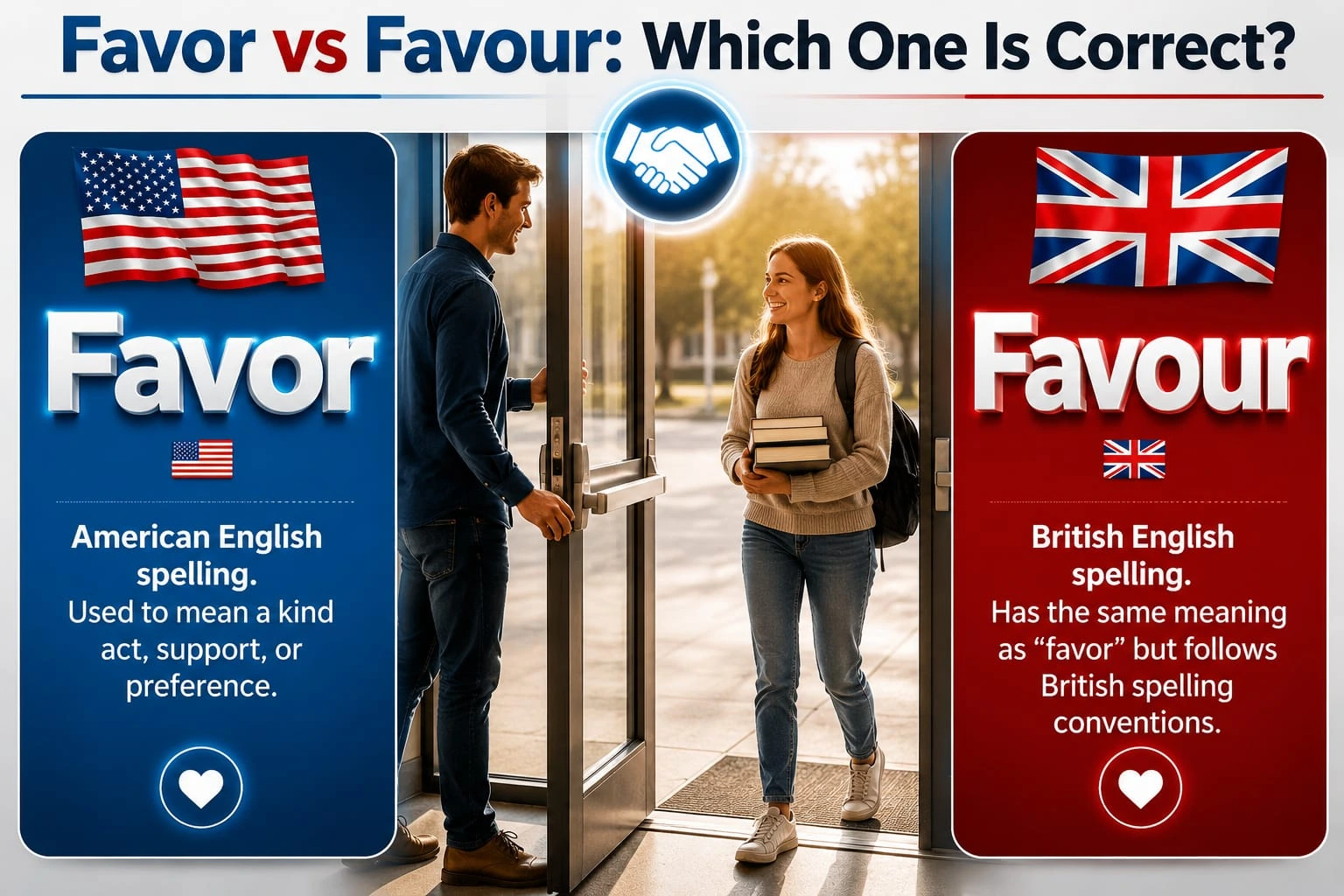
Favor (American English) and favour (British English) both mean help, kindness, support, or showing preference toward someone or something. ____________________________________________________________________________________________
I still remember helping one of my students with an email years ago. She wrote, “Can you do me a favour?” Then she stopped and looked worried.
She asked, “Wait… should that be favor or favour?”
Many people do the same thing. You may see one spelling in school books and another spelling online. Then confusion starts. You wonder if one is wrong. You wonder if teachers, employers, or readers will judge your writing.
The tricky part is simple. Both words are correct.
The real problem is knowing when to use each version.
People search for this because they want confidence. Nobody likes second-guessing every sentence. You want to write emails, essays, social posts, and messages without stopping every few seconds.
By the end of this guide, you will know exactly which spelling fits your situation and why the difference exists.
Let’s clear it up.
Favor or Favour: Quick Answer
Favor and favour mean the same thing.
Both can mean:
- Helping someone
- Showing support
- Preferring one thing over another
Examples:
- “Can you do me a favor?”
- “Could you do me a favour?”
Another example:
- “The coach showed favor toward the new player.”
- “The coach showed favour toward the new player.”
The meaning stays the same.
Only the spelling changes.
The Origin of Favor or Favour
The word came from old Latin and French roots. Over time it entered English and became favour.
Later, spelling changes happened in America.
An American dictionary writer named Noah Webster wanted spelling to be simpler. He removed extra letters from many words.
Examples:
- colour → color
- honour → honor
- favour → favor
Britain kept older spellings.
America moved toward shorter forms.
That is why both versions still exist today.
Favor or Favour Explained: Key Differences or Variations
The words have identical meanings.
The difference comes from location and writing style.
| Term | Meaning | When to Use | Region/Context |
| Favor | Help, support, preference | American writing | United States |
| Favour | Help, support, preference | British writing | UK, Canada, Australia, many others |
Examples:
American English
“Please do me a favor.”
British English
“Please do me a favour.”
Formal writing
“Our company favors customer satisfaction.”
Casual speech
“Can you do me a favor?”
Which Version Should You Use?
Different readers need different choices.
- For students in the United States → use favor because schools and books follow American spelling.
- For students in the UK → use favour because British English uses that form.
- For business writers → match your company’s style guide.
- For global audiences → stay consistent. Pick one version and use it everywhere.
A mixed style looks strange.
Wrong:
“Our company appreciates your favour and asks for another favor.”
Better:
“Our company appreciates your favor and asks for another favor.”
or
“Our company appreciates your favour and asks for another favour.”
Common Mistakes with Favor or Favour
People often mix the two styles.
Mistake 1
❌ “Please do me a favour in my American school essay.”
✅ “Please do me a favor in my American school essay.”
Reason:
American writing usually avoids -our spellings.
Mistake 2
❌ Mixing spellings in one article
✅ Use one style throughout
Reason:
Consistency matters.
Mistake 3
❌ Thinking one word is wrong
✅ Both spellings are correct
Reason:
The spelling changes by region.
Mistake 4
❌ Assuming spelling changes meaning
✅ Meaning stays the same
Reason:
Only spelling changes.
Favor or Favour in Real-World Examples
Professional Email
“Could you do me a favor and review the document before Friday?”
News Headline
“Voters favor new education policies.”
Social Media Post
“Small acts of kindness and favour can change someone’s day.”
Formal Report
“The survey results show strong favor toward flexible work schedules.”
Favor or Favour: Data, Trends & Usage
People search this topic because English has different versions around the world.
Most interested regions:
- United States → favor
- United Kingdom → favour
- Canada → often favour
- Australia → favour
- India → mixed usage
Search intent: Informational
People usually want answers like:
- Which spelling is correct?
- Is favor wrong?
- Is favour British?
- Which should I use?
A growing number of people now write for global audiences. Remote work and international communication make spelling choices more important than before.
Comparison Table
| Term/Variant | Meaning | Region/Context | Best Used When |
| Favor | Help or support | American English | Writing for US readers |
| Favour | Help or support | British English | Writing for UK readers |
| Favoring | Supporting something | US style | American content |
| Favouring | Supporting something | UK style | British content |
Frequently Asked Questions
Q: What does favor or favour mean?
A: Both words mean help, support, kindness, or preference. The meaning stays exactly the same.
Q: How do you use favor correctly?
A: Use favor if you follow American English. Keep the spelling consistent in your writing.
Q: Favor vs favour: what is the difference?
A: The difference is spelling only. America uses favor. Britain and many other countries use favour.
Q: Is favor acceptable in formal writing?
A: Yes. It is completely acceptable if your writing style follows American English.
Q: Which version is correct: favor or favour?
A: Both are correct. The correct choice depends on your audience and location.
Q: Where does the word come from?
A: The word came from older French and Latin roots before English developed different regional spellings.
Q: Can favor or favour be used in business writing?
A: Yes. Many companies use these words in emails, reports, and communication. Just stay consistent.
Conclusion
Now the confusion should feel much smaller.
Remember these key points:
- Favor and favour mean the same thing
- America usually uses favor
- Britain and many other countries use favour
- Stay consistent in your writing
You do not need to worry about one spelling being right and the other being wrong.
Think about your readers first.
If your audience is American, use favor. If your audience follows British English, use favour.
That simple choice can make your writing feel more natural and professional.
Now you know exactly how to use favor or favour. Bookmark this guide so you never second-guess the word again. Share it with someone who still gets confused.
focussing or focusing: Which Spelling Is Correct?