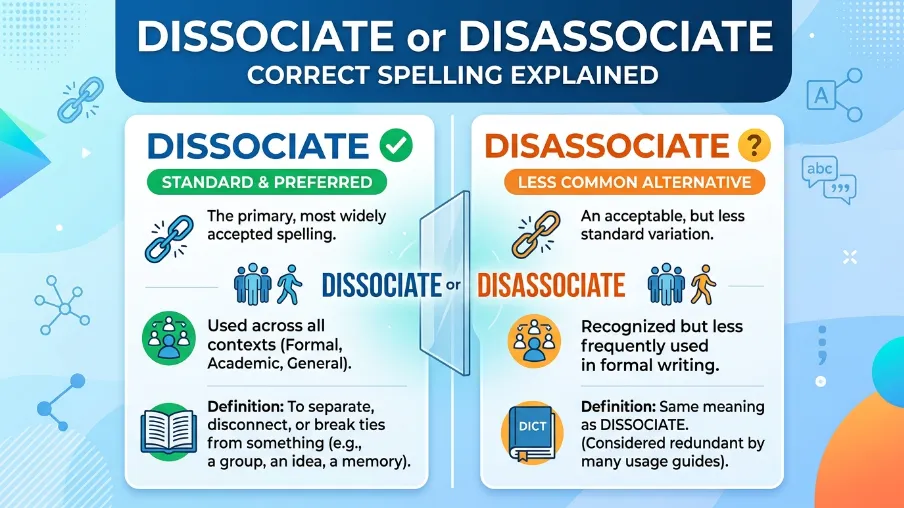
Snippet: “Dissociate” is the older and more widely preferred standard spelling, while “disassociate” is a later variation with the same meaning.
You’re writing a sentence like, “I want to dissociate myself from the issue,” but then spellcheck suggests disassociate instead. Now you pause and wonder: which word is actually correct?
This confusion is very common because both dissociate and disassociate exist in modern English and often mean the same thing. Many people assume one must be wrong, while others use them interchangeably without realizing there are slight differences in usage preference.
People search for “dissociate or disassociate” because these words appear frequently in:
- psychology discussions
- professional writing
- legal statements
- social media
- news reports
- emotional conversations
The good news is simple:
👉 both words are correct
👉 both usually mean “separate” or “disconnect”
However, dissociate is generally considered the more traditional and preferred form in formal English, especially in psychology and academic writing.
In this guide, you’ll learn the meanings, origins, examples, spelling differences, comparison tables, common mistakes, and practical advice for correctly using dissociate and disassociate.
Dissociate or Disassociate – Quick Answer
👉 Dissociate = Standard and more widely preferred form ✅
👉 Disassociate = Accepted variation with the same meaning ✅
Meaning:
Both mean:
- separate
- disconnect
- detach from something
Examples:
- She tried to dissociate herself from the scandal. ✅
- He disassociated himself from the argument. ✅
✔ Same meaning
✔ Both are correct
✔ “Dissociate” is more common in formal usage
The Origin of Dissociate or Disassociate
Origin of “Dissociate”
The word dissociate comes from Latin roots related to:
- separation
- division
- disconnecting things
It has existed in English for a long time and became the traditional standard form.

Origin of “Disassociate”
“Disassociate” developed later as an extended variation.
Because many English words begin with:
👉 “dis-”
speakers naturally formed:
- disassociate
Over time, it became accepted in modern English, although many style guides still prefer:
👉 dissociate
Dissociate vs Disassociate – Meaning Explained
What Does “Dissociate” Mean?
“Dissociate” means:
- separate from something
- disconnect mentally or emotionally
- avoid association
Examples:
- The company dissociated itself from the controversy.
- She dissociated from negative influences.
- He struggled to dissociate emotions from work.
What Does “Disassociate” Mean?
“Disassociate” has nearly the exact same meaning.
Examples:
- The actor disassociated himself from the rumors.
- She disassociated from the group.
- He wanted to disassociate his name from the issue.
British English vs American English Usage
Both British and American English use:
- dissociate
- disassociate
However:
👉 “dissociate” is generally preferred in formal writing worldwide.
Comparison Table
| Word | UK Usage | US Usage |
|---|---|---|
| Dissociate | Very common | Very common |
| Disassociate | Accepted | Accepted |
✔ Both are understood globally
Which Word Should You Use?
Use “Dissociate” When:
- writing formally
- using academic English
- discussing psychology
- writing professionally
- following traditional style guides
Use “Disassociate” When:
- using casual modern English
- matching conversational tone
- following personal style preference
Simple Rule:
👉 Formal and traditional = Dissociate
👉 Informal variation = Disassociate
Common Mistakes with Dissociate or Disassociate

Mistake 1
❌ Thinking “disassociate” is completely wrong
✔ It is accepted modern English
Mistake 2
❌ Assuming both have different meanings
✔ Meanings are almost identical
Mistake 3
❌ Using inconsistent spelling in one document
✔ Choose one style and stay consistent
Mistake 4
❌ Believing “dissociate” sounds incorrect because of double “s”
✔ “Dissociate” is actually the older standard form
Dissociate or Disassociate in Everyday Examples
Professional Communication
- The company dissociated itself from the comments.
- He disassociated from the controversy publicly.
Psychology
- Some people dissociate during stressful experiences.
- Emotional dissociation may affect memory.
Social Media
- “I need to dissociate from negativity.”
- “She disassociated herself from drama online.”
Legal or Public Statements
- The organization dissociated itself from the accusations.
- The celebrity disassociated from the incident.
Dissociate or Disassociate – Google Trends & Usage Data
Search patterns show:
- “Dissociate” remains more common in:
- academic writing
- psychology
- formal communication
- “Disassociate” appears frequently in:
- conversational English
- internet usage
- casual writing
Key Insight:
👉 “Dissociate” is still the preferred traditional form.
Comparison Table: Dissociate vs Disassociate
| Feature | Dissociate | Disassociate |
|---|---|---|
| Correct spelling | Yes | Yes |
| Traditional form | Yes | No |
| Formal preference | Strong | Less common |
| Meaning | Same | Same |
| Used in psychology | Very common | Sometimes |
Dissociate in Psychology
In psychology, “dissociate” is commonly used to describe:
- mental disconnection
- emotional separation
- altered awareness
Examples:
- dissociative experiences
- dissociation symptoms
Professional psychology writing strongly favors:
👉 dissociate
Why People Prefer “Disassociate”
Many speakers naturally expect:
👉 “dis-” at the beginning of words meaning separation
Examples:
- disconnect
- disapprove
- disagree
Because of this pattern:
👉 “disassociate” feels more intuitive to some people.
Why These Words Confuse Writers
The confusion happens because:
- both spellings are correct
- meanings overlap completely
- pronunciation is similar
- grammar tools may suggest different versions
This makes writers unsure which form sounds more professional.
Simple Trick to Remember the Difference
Easy Memory Rule
👉 Dissociate = traditional/formal 📚
👉 Disassociate = modern variation 🗣️
Quick Reminder
For safest professional writing:
✔ dissociate
FAQs
1. Is it dissociate or disassociate?
Both are correct, but “dissociate” is generally preferred in formal English.
2. Which spelling is more common?
“Dissociate” is more common in professional and academic writing.
3. Is disassociate wrong?
No. It is accepted modern English.
4. Do both words mean the same thing?
Yes. Both mean separating or disconnecting from something.
5. Which word is used in psychology?
“Dissociate” is more commonly used in psychology.
6. Can I use disassociate in casual writing?
Yes. Many people use it informally.
7. What is the easiest way to remember the difference?
Dissociate is the traditional preferred form, while disassociate is a later variation.
Conclusion
The confusion between dissociate or disassociate happens because both words exist in modern English and share nearly identical meanings. Both describe separating, disconnecting, or distancing from something emotionally, mentally, socially, or professionally.
However, “dissociate” is the older and more widely preferred form, especially in:
- academic writing
- psychology
- professional communication
- formal English
“Disassociate” is also accepted and commonly used in conversational or informal contexts, but many style guides still favor “dissociate.”
The easiest way to remember is:
👉 Dissociate = traditional and formal 📚
👉 Disassociate = modern variation 🗣️
Understanding this difference helps improve clarity and consistency in writing, psychology discussions, public statements, and everyday English communication.

Miles Thornton is a seasoned author and content specialist with a knack for simplifying complex topics. Passionate about clear, engaging writing, creates articles that inform and inspire readers. With years of experience in digital publishing, Miles combines professionalism with creativity, delivering insightful content for diverse audiences