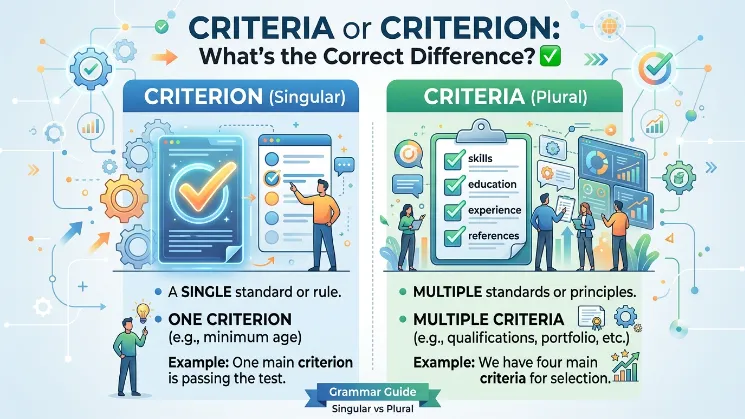
“Criterion” is singular, while “criteria” is plural. Use criterion for one standard and criteria for multiple standards.
You’re writing an email about job requirements and type, “The main criteria is experience.” Suddenly, your grammar checker highlights the sentence. Now you pause and wonder should it be criteria or criterion?
This is one of the most common grammar confusions in English. Many people use criteria when talking about a single condition because it sounds more natural in modern conversation. However, traditional grammar rules treat these two words differently.
People search for “criteria or criterion” because they want to sound correct in academic writing, business communication, exams, and professional discussions. Using the wrong form can make your writing look grammatically weak, especially in formal settings.
The good news is that the rule is actually simple once you understand it. In this complete guide, you’ll learn the exact difference between criteria and criterion, their origin, proper grammar usage, common mistakes, real-life examples, and tips to remember them forever.
Criteria or Criterion – Quick Answer
👉 Criterion = Singular
👉 Criteria = Plural
Meaning:
Both words refer to:
👉 A standard, rule, or condition used to judge something
Examples:
- The main criterion is quality. ✅
- The hiring criteria include experience and skills. ✅
✔ One standard → criterion
✔ Multiple standards → criteria
The Origin of Criteria or Criterion
These words come from Greek.
Original Greek Forms:
- Kriterion → singular
- Kriteria → plural
English borrowed both forms directly, which is why they do not follow normal English plural rules like:
- cat → cats
- book → books
Instead:
- criterion → criteria
This pattern is similar to:
- phenomenon → phenomena
- datum → data
Because “criteria” is heard more often in modern speech, many people mistakenly use it as singular too.
Criteria vs Criterion – Grammar Rule Explained
The difference depends on number.
Use “criterion” when talking about ONE condition:
- Price is an important criterion.
Use “criteria” when talking about MORE THAN ONE condition:
- The selection criteria include education and experience.
Easy Memory Trick:
👉 Criterion = one
👉 Criteria = many
British English vs American English Usage
Unlike spelling differences, this is a grammar rule, not a regional difference.
Key Point:
👉 Both British and American English follow the same rule.
Comparison Table
| Form | Meaning | Usage Type |
|---|---|---|
| Criterion | One standard | Singular |
| Criteria | Multiple standards | Plural |
✔ Same rule worldwide
Which One Should You Use?
Choosing between criteria or criterion depends on quantity.
Use “criterion” when:
- Referring to one condition
- Mentioning a single requirement
Use “criteria” when:
- Referring to several conditions
- Listing multiple standards
Examples:
- Communication is an important criterion.
- The admission criteria are strict.
Pro Tip:
👉 If you can replace it with “standard,” use criterion.
👉 If you can replace it with “standards,” use criteria.
Common Mistakes with Criteria or Criterion
Mistake 1:
❌ The main criteria is quality
✔️ The main criterion is quality
Mistake 2:
❌ One of the criterion
✔️ One of the criteria
Mistake 3:
❌ These criterion are important
✔️ These criteria are important
Mistake 4:
❌ Mixing singular and plural verbs
✔️ The criterion is
✔️ The criteria are
Criteria or Criterion in Everyday Examples
In Education:
- Attendance is an important criterion
- Admission criteria include grades and interviews
In Business:
- Cost is a major criterion
- Hiring criteria vary by company
In Healthcare:
- Age may be a treatment criterion
- Eligibility criteria are listed online
In Daily Life:
- Trust is my main friendship criterion
- House-buying criteria differ for everyone
Criteria or Criterion – Google Trends & Usage Data
Usage patterns show:
- Criteria is searched far more often
- Many people incorrectly use “criteria” as singular
Key Insight:
👉 “Criteria” dominates everyday usage
👉 “Criterion” appears more in formal and academic writing
Why the Confusion Happens:
- “Criteria” sounds more natural in conversation
- People rarely hear “criterion” in casual speech
Comparison Table: Criteria vs Criterion
| Feature | Criterion | Criteria |
|---|---|---|
| Number | Singular | Plural |
| Meaning | One standard | Multiple standards |
| Grammar | Takes singular verb | Takes plural verb |
| Example | One hiring criterion | Hiring criteria |
| Usage Frequency | Less common | More common |
Criteria vs Criterion in Professional Writing
Academic Writing:
Correct grammar matters strongly.
✔️ Research criteria were clearly defined
✔️ Accuracy was the main criterion
Job Applications:
- Selection criteria must be met
- Experience is a key criterion
Business Communication:
Using the correct form improves professionalism and credibility.
Why People Incorrectly Use “Criteria” as Singular
Modern spoken English often treats “criteria” like a singular collective word.
Example:
❌ The criteria is simple
People say this because:
- “Criteria” sounds natural
- It is more commonly heard
However, formal grammar still treats:
- criterion = singular
- criteria = plural
Simple Trick to Remember the Difference
Think of Similar Words:
| Singular | Plural |
|---|---|
| Criterion | Criteria |
| Phenomenon | Phenomena |
| Datum | Data |
Easy Rule:
👉 Ends in -on = singular
👉 Ends in -a = plural
This trick helps you remember quickly during writing.
FAQs
1. Is it criteria or criterion?
Use criterion for one standard and criteria for multiple standards.
2. Is criteria singular or plural?
“Criteria” is plural.
3. Can criteria be used as singular?
In casual speech, some people do, but formal grammar considers it incorrect.
4. What does criterion mean?
It means a standard or condition used to judge something.
5. Why is criterion less common?
Because “criteria” is heard more often in everyday conversation.
6. Which should I use in academic writing?
Use the traditional grammar rule:
- criterion = singular
- criteria = plural
7. Are British and American rules different?
No, both follow the same grammar rule.
Conclusion
The confusion between criteria or criterion is very common, especially because modern conversation often uses “criteria” for both singular and plural situations. However, traditional grammar rules are still clear and important in formal writing.
Use criterion when referring to one standard, condition, or requirement. Use criteria when talking about multiple standards or conditions. The difference is purely grammatical and applies equally in British and American English.
Understanding this rule improves your writing quality, especially in academic, professional, and business contexts. Small grammar details like this help your communication sound more polished, accurate, and trustworthy.
The easiest way to remember is simple:
👉 One standard = criterion
👉 Many standards = criteria
Now you can confidently choose the correct word every time without confusion.

James L. Morrison is a content writer focused on English grammar, word meanings, and usage differences. He enjoys breaking down complex language rules into simple explanations. His work is designed to help readers quickly understand the correct word choice in everyday writing and professional communication.