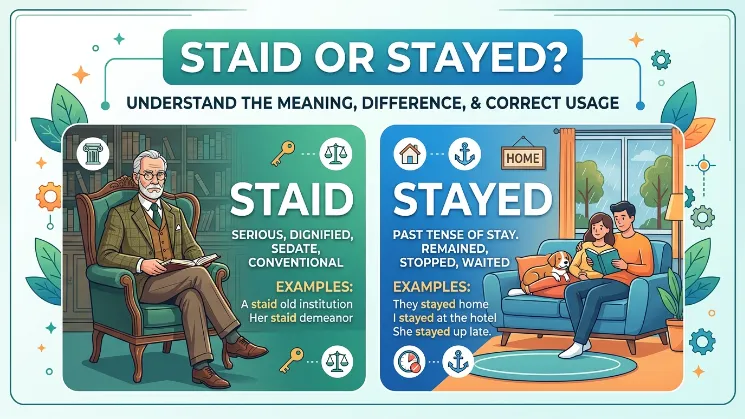
“Stayed” is the correct past tense of “stay.” “Staid” is a separate adjective meaning serious or dull, not a verb.
You write a sentence like “I stayed at home yesterday”, but suddenly you hesitate. Should it be staid or stayed? The words look similar, and at first glance they even feel like they could be variations of the same verb.
This confusion is common among English learners because many words in English change forms in ways that are not always predictable. When two words look almost identical, it is natural to assume they might have the same grammar function. But in this case, that assumption leads to a mistake.
The problem becomes more noticeable in exams, formal writing, and emails, where even a small spelling error can affect clarity and correctness. Many learners also confuse these words because they sound similar when spoken quickly.
The truth is simple but important: “stayed” and “staid” are not related verb forms. One is a standard verb used in daily communication, while the other is an adjective with a completely different meaning.
In this article, you will learn the exact difference between staid and stayed, their meanings, grammar roles, usage rules, examples, and simple memory tricks to avoid confusion permanently.
Staid or Stayed – Quick Answer
👉 Stayed = Correct past tense of “stay” (verb)
👉 Staid = Adjective meaning serious, calm, or dull
Examples: Stayed or Staid
- I stayed at home yesterday. ✔
- He is a very staid person. ✔
- I staid at home yesterday. ✘
✔ They are not interchangeable
Meaning of Stayed
Stayed is the simple past tense and past participle of the verb “stay.”
Meaning:
To remain in a place, not leave, or continue to be somewhere for a period of time.
Usage:
- I stayed in London for a week.
- She stayed with her relatives.
- They stayed after the meeting ended.
Grammar form:
- Base form: stay
- Past tense: stayed
- Past participle: stayed
👉 This is a standard verb used in everyday English.
Meaning of Staid
Staid is NOT a verb. It is an adjective.
Meaning:
Serious, calm, formal, or slightly boring in personality or behavior.
Usage:
- He is a staid businessman.
- The event felt staid and quiet.
- She has a staid personality.
👉 It is rarely used in modern casual English but still appears in formal writing.
Why People Confuse Staid and Stayed
This confusion happens due to several reasons:
1. Similar spelling
Both words contain:
- s-t-a-i-d / s-t-a-y-e-d
The structure looks almost identical.
2. Sound similarity
When spoken quickly, both words sound close.
3. Assumption of grammar pattern
Learners assume:
stay → staid (like play → played logic)
But this is incorrect.
4. Lack of exposure
“Staid” is less common in modern speech, so people misinterpret it.
Staid vs Stayed – Key Differences
| Feature | Stayed | Staid |
|---|---|---|
| Word type | Verb (past tense) | Adjective |
| Base word | Stay | No verb form |
| Meaning | Remain somewhere | Serious or dull |
| Usage | Action | Description |
| Example | I stayed home | He is staid |
| Frequency | Very common | Rare |
British vs American English
There is no difference between British and American English for these words.
Both use:
- Stayed (verb)
- Staid (adjective)
👉 The confusion is universal, not regional.
When to Use Stayed
Use stayed when describing an action in time.
Daily life examples:
- I stayed at home
- She stayed late at work
- We stayed in a hotel
Travel:
- They stayed in Paris for two days
Time duration:
- He stayed for a long meeting
👉 Always refers to an action or event.
When to Use Staid
Use staid when describing character or mood.
Personality:
- He is a staid person
Environment:
- The room felt staid and quiet
Formal tone:
- The discussion was staid and serious
👉 It is descriptive, not action-based.
Common Mistakes
Mistake 1:
❌ I staid at home yesterday
✔ I stayed at home yesterday
Mistake 2:
❌ He stayed personality
✔ He is a staid person
Mistake 3:
❌ Treating both as verbs
✔ Only “stayed” is a verb
Mistake 4:
❌ Using “staid” in casual action sentences
✔ Use “stayed” for actions only
Real-Life Usage Examples
Stayed:
- I stayed at my friend’s house last night
- She stayed calm during the exam
- They stayed in the city for work
Staid:
- The professor has a staid manner
- The meeting was staid and formal
- His expression remained staid
Simple Memory Trick
To avoid confusion:
👉 Stayed = Action (stay → stayed)
👉 Staid = State (description of person/thing)
Shortcut:
- Stayed = “I stayed here” (doing something)
- Staid = “He is staid” (describing someone)
Why This Difference Matters
Understanding this difference is important because:
- It improves grammar accuracy
- It avoids exam mistakes
- It makes writing more professional
- It prevents meaning confusion
Even a small error can change clarity in formal communication.
FAQs
1. Is it staid or stayed?
“Stayed” is correct for the verb “stay.”
2. What does staid mean?
It means serious, calm, or slightly dull.
3. Is staid a verb?
No, it is an adjective.
4. Can I use staid instead of stayed?
No, they have different meanings.
5. Why do people confuse them?
Because they look and sound similar.
6. Is stayed used in both US and UK English?
Yes, it is universal.
7. What is the base word of stayed?
The base word is “stay.”
Conclusion
The confusion between staid or stayed is understandable because the words look almost identical. However, their grammar roles and meanings are completely different.
Stayed is a verb used to describe an action of remaining somewhere or not leaving. It is commonly used in daily communication, writing, and speech. On the other hand, staid is an adjective used to describe someone or something as serious, calm, or dull in nature.
They are not variations of the same word and should never be used interchangeably. Mixing them can change the meaning of a sentence or make it grammatically incorrect.
The easiest way to remember is simple:
👉 If it’s an action, use stayed
👉 If it’s a description, use staid
Once you understand this rule, you will never confuse them again in writing or speaking.

James L. Morrison is a content writer focused on English grammar, word meanings, and usage differences. He enjoys breaking down complex language rules into simple explanations. His work is designed to help readers quickly understand the correct word choice in everyday writing and professional communication.