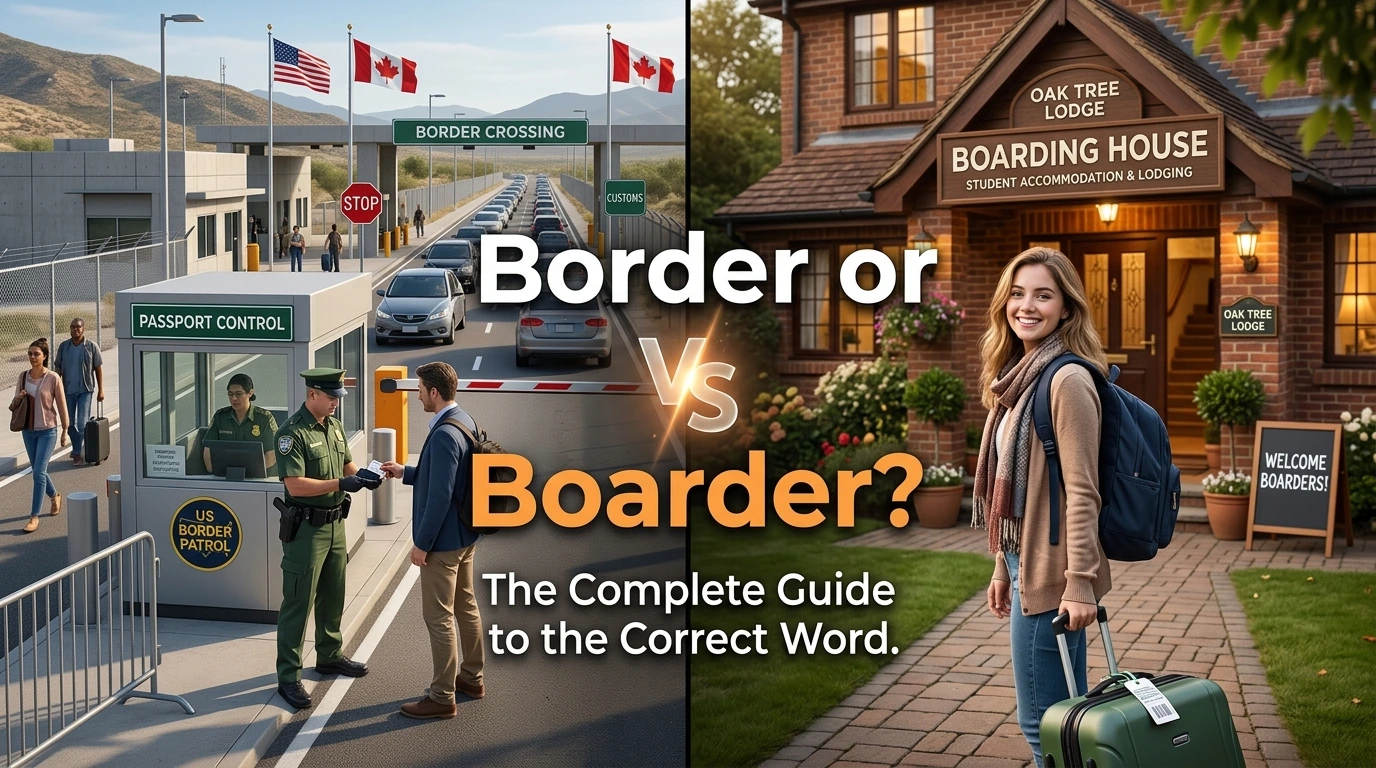
- Border = a line, edge, boundary, or decorative trim.
- Boarder = a person who lives somewhere and pays for meals and lodging.
Border is the correct word for a boundary, edge, or decorative trim. Boarder means a person who receives meals and lodging, usually by paying to stay somewhere.
I still remember editing a student’s essay that said, “The soldiers protected the country’s boarder.” At first glance, it looked fine. Then I realized one small letter had completely changed the meaning. Instead of talking about a country’s boundary, the sentence was talking about a person staying in a house!
Mistakes like border and boarder are common because the words sound almost the same. Even confident English writers pause to check which one fits. The confusion becomes even greater when writing emails, school assignments, travel blogs, or news articles.
If you’ve ever wondered which spelling is correct, you’re in the right place. This guide explains the meaning of both words in simple English. You’ll learn when to use each one, how to avoid common mistakes, and how to remember the difference forever. By the end, you’ll feel confident every time you write border or boarder.
Border or Boarder: Quick Answer
Although they sound alike, border and boarder have different meanings.
Simple Examples
✅ The river forms the border between the two countries.
✅ We planted flowers along the garden border.
Quick Memory Trick
Think of boarder as containing the word board, which reminds you of room and board (food and lodging).
If you’re talking about a place, edge, or boundary, choose border.
If you’re talking about a person staying in a home, school, or hostel, choose boarder.
The Origin and Background of Border or Boarder
Learning where these words came from makes them much easier to remember.
Origin of Border
The word border comes from an old French word meaning edge or boundary. Over time, English speakers used it to describe:
- the edge of land
- the line between countries
- the edge of clothing
- decorative designs around objects
Today, border is one of the most common English words.
Examples:
- state border
- national border
- page border
- flower border
Origin of Boarder
The word boarder comes from the word board.
Many years ago, the phrase room and board meant a place to sleep and meals to eat. A person who paid for these services became known as a boarder.
Today, the word is still used for people who live in:
- boarding schools
- hostels
- guest houses
- rented homes with meals included
Although boarder is less common than border, it is still the correct word in these situations.
Border or Boarder Explained: Key Differences
The biggest difference is simple.

A border is a thing or place.
A boarder is a person.
| Term | Meaning | When to Use | Region/Context |
| Border | A boundary, edge, or decorative trim | Geography, design, writing, gardens, clothing | Used worldwide |
| Boarder | A person paying for lodging and meals | Boarding schools, hostels, guest houses | Used worldwide |
Compare These Sentences
Border
- Canada shares a border with the United States.
- Add a blue border around the picture.
- The fence marks the property border.
Boarder
- The new boarder arrived on Monday.
- Every boarder has a private room.
- The landlady welcomed another boarder.
Notice how border never refers to a person, while boarder always refers to someone staying somewhere.
Why People Confuse Border and Boarder
There are three main reasons.
1. They Sound Almost the Same
When spoken quickly, the pronunciation is very similar.
2. Only One Letter Is Different
The extra a in boarder is easy to miss while typing.
3. Spell Check Doesn’t Always Help
Both words are real English words. Your computer may not detect the mistake if you choose the wrong one.
For example:
❌ The boarder between the countries is closed.
The spelling is correct, but the meaning is wrong.
✅ The border between the countries is closed.
Quick Tips to Remember Forever
- Border = Boundary
- Boarder = Boarding house
- Border = Edge
- Boarder = Person
- Border = Countries
- Boarder = Room and board
A simple trick is to remember:
People are boarders. Places have borders.
That one sentence can save you from making this mistake again.
Here is Part 2 of your article.
Which Version Should You Use?
Choosing between border and boarder is easy once you know what each word means. Ask yourself one simple question:
Are you talking about a place or a person?
If it’s a place, edge, or boundary, use border.
If it’s a person who pays to live somewhere, use boarder.
Recommendations for Different Readers
For Students
Use border when writing about:
- Maps
- Geography
- Countries
- Art projects
- School notebooks
Use boarder when writing about:
- Boarding schools
- School hostels
- Student housing
For Business Professionals
Choose border for reports, emails, and presentations about:
- International trade
- Country boundaries
- Graphic design
- Website layouts
- Document formatting
Use boarder only when discussing:
- Hotels
- Guest houses
- Boarding facilities
- Property rentals
For Content Writers and Bloggers
Most articles need border, especially if you write about:
- Travel
- Politics
- Geography
- Design
- Gardening
- Fashion
Use boarder only when your topic involves people staying in paid accommodation.
Best Choice for General Writing
For most everyday situations, border is the word you need.
Only use boarder when referring to a person.
Common Mistakes with Border or Boarder
Many writers mix these words because they sound alike. Here are the mistakes you should avoid.
| ❌ Mistake | ✅ Correct Version | Why? |
| The boarder between France and Spain. | The border between France and Spain. | Countries have borders, not boarders. |
| Add a red boarder around the page. | Add a red border around the page. | Decorative edges are borders. |
| Every border gets free breakfast. | Every boarder gets free breakfast. | People staying at a guest house are boarders. |
| The hotel welcomed five new borders. | The hotel welcomed five new boarders. | Guests are boarders. |
| Draw a flower boarder. | Draw a flower border. | Designs around objects are borders. |
Why These Mistakes Happen
- The words sound almost identical.
- Auto-correct often misses the error.
- Many people have never used boarder before.
- Writers focus on spelling instead of meaning.
The easiest solution is to remember what the word represents:
Border = Place
Boarder = Person
Border or Boarder in Real-World Examples
Seeing the words in real situations makes them much easier to remember.
Professional Email
We will inspect the border crossing before approving the shipment.
News Headline
Officials increased security along the northern border.
Social Media Post
Finally crossed the border after a long road trip. What an amazing experience!
Formal Report
The report recommends stronger monitoring at the international border.
Guest House Advertisement
Every boarder receives free Wi-Fi, breakfast, and laundry service.
Boarding School Notice
Each boarder must return to the dormitory before 9:00 PM.
Everyday Conversation
“My cousin is a boarder at a boarding school.”
“We walked to the border between the two parks.”
Border or Boarder: Data, Trends & Usage
People search for border or boarder because they want the correct spelling.
Search Intent
Primary intent: Informational
Readers usually want to know:
- Which spelling is correct
- The difference between the two words
- When to use each one
- Example sentences
- Easy memory tricks
Who Searches This Topic Most?
The topic is popular among:
- English learners
- Students
- Teachers
- Bloggers
- Copywriters
- Editors
- Business professionals
Where Is It Most Common?
Interest comes from English-speaking countries such as:
- United States
- United Kingdom
- Canada
- Australia
- India
- Pakistan
It is also common among people learning English as a second language.
Why This Topic Matters Today
Clear writing builds trust.
Using the wrong word in an email, article, school assignment, or report can confuse readers and make your writing look less professional.
Learning the difference between border and boarder takes only a few minutes, but it improves your writing for years.
Read more: Stem or Steam: Explained with Examples (2026)
Border or Boarder: Standalone Comparison Table
| Term/Variant | Meaning | Region/Context | Best Used When |
| Border | A boundary, edge, or decorative line | Worldwide | Talking about countries, maps, gardens, pages, clothing, or designs |
| Boarder | A person who pays for meals and lodging | Worldwide | Talking about boarding schools, hostels, guest houses, or rented accommodation |
Final Memory Tip Before Moving On
Remember this simple sentence:
A border is a place. A boarder is a person.
If you can remember that one rule, you’ll almost never choose the wrong word again.
Frequently Asked Questions (FAQs)
Q1: What is the difference between border and boarder?
Border is a boundary, edge, or decorative line. Boarder is a person who pays to stay somewhere and usually receives meals and lodging. The two words sound alike but have different meanings.
Q2: How do you use border correctly?
Use border whenever you are talking about an edge or boundary.
Examples:
- The river forms the border between the two countries.
- Add a black border around the picture.
- Roses grow along the garden border.
Q3: How do you use boarder correctly?
Use boarder when referring to a person living somewhere for payment.
Examples:
- The new boarder arrived yesterday.
- Every boarder receives breakfast.
- She was a boarder at a private school.
Q4: Which is correct: border or boarder?
Both words are correct, but they are used in different situations.
Choose border for boundaries, edges, and decorative lines.
Choose boarder for a person staying in a boarding house, hostel, or boarding school.
Q5: Is boarder commonly used in everyday English?
Not as often as border.
Most people use border much more because it appears in geography, travel, politics, design, and everyday conversations. Boarder is mainly used when talking about accommodation or boarding schools.
Q6: Is border acceptable in formal writing?
Yes. Border is perfectly acceptable in formal writing.
It is commonly used in:
- Business reports
- Academic papers
- Government documents
- News articles
- Legal writing
Q7: How can I remember the difference between border and boarder?
Use this simple memory trick:
- Border = Boundary
- Boarder = Room and board
Another easy rule is:
Places have borders. People are boarders.
This trick helps many learners remember the correct spelling instantly.
Final Comparison Table
| Word | Meaning | Example | Easy Memory Trick |
| Border | A boundary or edge | The border between two countries is closed. | Border = Boundary |
| Boarder | A person paying for lodging and meals | The new boarder moved into the hostel. | Boarder = Room and board |
Conclusion
Small spelling differences can completely change the meaning of a sentence, and border and boarder are a perfect example. Although they sound almost the same, they are used in very different ways.
Remember these key points:
- Border means a boundary, edge, or decorative line.
- Boarder means a person who pays for lodging and meals.
- Border is far more common in everyday writing.
- A quick memory trick, “Places have borders. People are boarders.”, can help you choose the correct word every time.
The next time you write about countries, gardens, pages, or clothing, use border. If you’re describing someone who lives at a boarding school, hostel, or guest house, use boarder.
Correct word choice makes your writing clearer and more professional. Even one small spelling change can improve your message and help readers understand you instantly.
Now you know exactly how to use border and boarder. Bookmark this guide so you never second-guess these words again, and share it with someone who often confuses them.
Read more: Waisted vs Wasted: What’s the Real Difference?

Passionate about language and clear communication, I explore the subtle differences between words and expressions through well-researched, practical content. My goal is to help readers write with greater clarity, confidence, and precision by making complex language concepts easy to understand.