When writing about money, contracts, loans, or promises, many people ask: guaranty or guarantee? These words look almost the same, but they are not always used in the same way. The confusion is common because both words relate to a promise or assurance. However, guarantee is much more common in everyday English, while guaranty is often used in legal and financial contexts.
Knowing the difference can help you choose the right word in emails, contracts, business documents, and general writing. A small spelling difference can also change the meaning or legal sense of a sentence. For example, a company may guarantee that a product will work, while a guaranty may refer to a formal promise to pay another person’s debt.
This guide explains guaranty or guarantee, including their meanings, origins, spelling differences, common mistakes, and everyday examples. It also compares British and American English and explains which spelling you should use in different situations.
Guaranty or Guarantee : Quick Answer
Guarantee is the standard and much more common spelling. It means a promise that something will happen or that a product, service, or payment will meet a certain condition.
Guaranty is a less common word. It is mainly used in legal, financial, and business contexts to describe a formal promise, especially a promise to pay or perform an obligation.
Examples:
- The company guarantees a full refund.
- The product comes with a money back guarantee.
- The bank required a personal guaranty.
- His guaranty covered the borrower’s debt.
Read More!
1099 or W9: What Is the Difference and Which One Do You Need?
Guaranty vs Guarantee Comparison
| Word | Main Use | Example |
| Guarantee | General promise or assurance | We guarantee your satisfaction. |
| Guaranty | Legal or financial promise | He signed a guaranty for the loan. |
For most everyday writing, guarantee is the safer choice.
The Origin of Guaranty or Guarantee
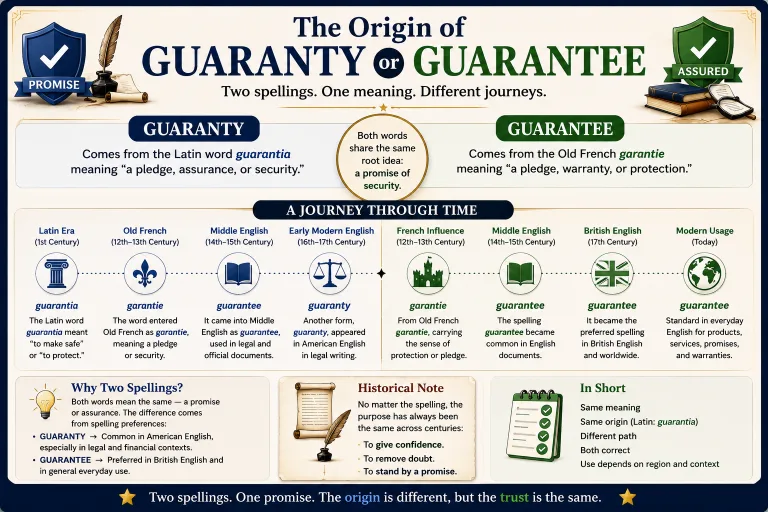
Both guarantee and guaranty are connected to words that entered English through French. Their history is linked to the idea of protecting, assuring, or promising something.
The word guarantee developed as a verb and noun in English. Over time, it became the normal word for a promise that something will happen or work as stated.
Guaranty developed as a related noun. It became especially useful in legal and financial language, where one person promises to meet an obligation if another person fails to do so.
The spelling difference exists because English adopted related forms from different stages and uses of the word. Today, guarantee is far more common, while guaranty has a more specialized meaning.
Read More!
Bash OR Operator: Syntax, Examples, Uses, and Mistakes
British English vs American English Spelling
Both guarantee and guaranty can appear in English speaking countries. The key difference is usually meaning and context, not a simple British versus American spelling rule.
In both American and British English, guarantee is the normal word for a general promise.
Guaranty is more often found in legal, banking, insurance, and financial documents.

| Context | Common Word | Example |
| Product promise | Guarantee | We offer a one year guarantee. |
| Money back promise | Guarantee | You get a money back guarantee. |
| General assurance | Guarantee | I guarantee it will work. |
| Loan agreement | Guaranty | He signed a loan guaranty. |
| Legal document | Guaranty | The guaranty covers the debt. |
| Business contract | Either, depending on meaning | Check the legal definition. |
So, do not assume that guaranty is simply the American spelling of guarantee. They can serve different purposes.
Which Spelling Should You Use?
For most readers, use guarantee.
For US English
Use guarantee in normal writing, business communication, websites, advertising, and general explanations.
Use guaranty when it is the established legal or financial term in a specific document.
For UK and Commonwealth English
Guarantee is also the normal spelling in everyday writing. It is widely understood in business, education, and general communication.
For Global English
If your audience is international, guarantee is usually the best choice because it is more familiar and widely used.
If you are working with a legal contract, however, do not replace guaranty with guarantee without checking the intended legal meaning.
Common Mistakes with Guaranty or Guarantee
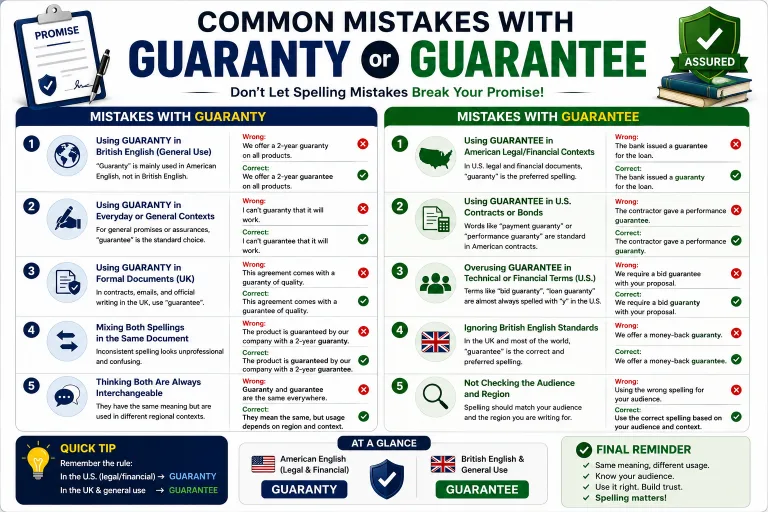
Mistake 1: Treating them as exact synonyms
Although they are related, they can have different meanings.
Incorrect assumption:
Guaranty and guarantee always mean exactly the same thing.
Better:
Use guarantee for a general promise and guaranty when a formal legal or financial promise is intended.
Mistake 2: Using guaranty in everyday writing
Less natural:
Our store offers a 30 day guaranty.
Better:
Our store offers a 30 day guarantee.
Mistake 3: Thinking guaranty is only a spelling error
Guaranty is a real English word. It has a specialized use and should not automatically be treated as a misspelling.
Mistake 4: Using guarantee in a legal document without checking
Legal documents may use guaranty as a defined term. Changing the word can affect the intended meaning.
Read More!
Steam or Sauna: Which Is Better for Relaxation, Heal, and Health?
In Emails
We guarantee that your order will arrive within five business days.
This is a normal business use of guarantee.
In News
The company announced a new guarantee for customers.
News writing commonly uses guarantee when discussing promises or policies.
On Social Media
We guarantee you will love our new collection!
This is a natural promotional use.
In Formal Writing
The manufacturer guarantees that the equipment meets the required standards.
This use is clear and professional.
In Legal or Financial Writing
The borrower provided a personal guaranty for the loan.
Guaranty or Guarantee : Google Trends & Usage Data
Search interest can vary by country, industry, and context. Guarantee is much more familiar to general English users and appears widely in searches about products, services, refunds, warranties, promises, and business policies.
Guaranty has a narrower audience. It is more likely to appear in searches related to loans, contracts, banking, debt, legal documents, and financial agreements.
This difference explains why someone searching the phrase “guaranty or guarantee” may see many more examples of guarantee in normal English.
For content, guarantee is generally the stronger general language term. However, guaranty can be useful when creating content for legal, banking, or financial audiences.
Guaranty vs Guarantee: Variations Side by Side
| Variation | Correct? | Typical Use |
| Guarantee | Yes | General English |
| Guaranty | Yes | Legal and financial contexts |
| Guarantee or guaranty | Yes | Comparison phrase |
| Guarentee | No | Common misspelling |
| Guarentee | No | Common spelling error |
| Garanty | Sometimes historical/variant | Rare modern use |
The most important rule is simple: choose guarantee for normal writing unless a legal or financial context specifically calls for guaranty.
FAQs About Guaranty or Guarantee

1. Is guaranty a correct word?
Yes. Guaranty is a correct English word. It is often used in legal and financial contexts.
2. Which is more common, guaranty or guarantee?
Guarantee is much more common in everyday English.
3. Is guaranty the American spelling of guarantee?
No. They are not simply American and British spellings of the same word. Guaranty can have a more specialized legal or financial meaning.
4. Should I use guarantee in everyday writing?
Yes. Guarantee is normally the best choice for emails, websites, social media, general business writing, and everyday communication.
5. What does guaranty mean in law?
A guaranty can refer to a formal promise in which one party agrees to meet an obligation if another party fails to do so.
6. Can guarantee be used as a verb?
Yes. For example: “We guarantee your satisfaction.”
7. Is “guarentee” correct?
No. Guarentee is a common misspelling. The correct spelling is guarantee.
Conclusion
The difference between guaranty or guarantee is mainly about usage and context. Guarantee is the common word used for promises, assurances, product protection, refunds, and general business communication. Guaranty is a valid word, but it is less common and is often found in legal, banking, lending, and financial documents.
If you are writing a normal email, website page, advertisement, social media post, or general article, guarantee is usually the right choice. If you are reading or writing a legal or financial document, pay closer attention to the exact term being used. In those situations, guaranty may have a specific meaning.
The easiest rule to remember is: use guarantee for general promises and guaranty for specialized legal or financial promises. When in doubt, check the context rather than treating one spelling as simply wrong.
Discover More Articles!
Steam or Sauna: Which Is Better for Relaxation, Heal, and Health?
Bash OR Operator: Syntax, Examples, Uses, and Mistakes
1099 or W9: What Is the Difference and Which One Do You Need?
Related articles: Site or Cite: Website and Location Examples, Bellys or Bellies: Which Spelling Is Correct?, Donkey or Mule Explained in Easy Words.
See the dictionary definitions for guaranty and guarantee.

Passionate about language and clear communication, I explore the subtle differences between words and expressions through well-researched, practical content. My goal is to help readers write with greater clarity, confidence, and precision by making complex language concepts easy to understand.