Have you ever seen the words slew and slough and wondered if they mean the same thing? You’re not alone. Many English learners and even native speakers search for “slew or slough” because the words look similar and sometimes sound alike. However, they have very different meanings and are used in different situations.
The confusion becomes even greater because slough has more than one pronunciation and several meanings.
Meanwhile, slew is commonly used as both a noun and a verb. Choosing the wrong word can change the meaning of your sentence and make your writing unclear.
This guide explains the difference between slew or slough in simple language. You’ll learn what each word means, where it came from, how to use it correctly, and which one fits your sentence.
You’ll also find comparison tables, real life examples, Google Trends insights, and answers to common questions. By the end, you’ll know exactly when to use slew and when to use slough with confidence.
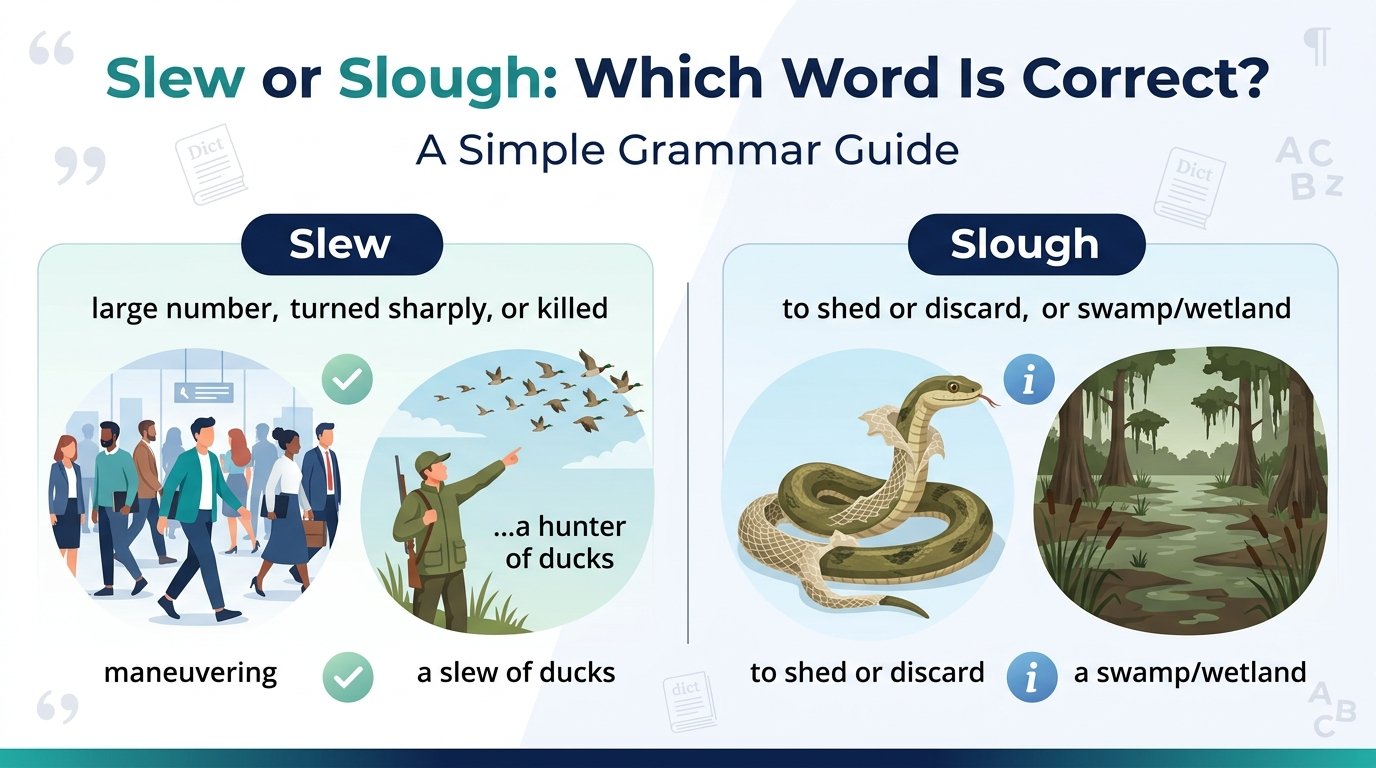
Slew or Slough Quick Answer
| Word | Meaning | Example |
| Slew | A large number of something, or to turn sharply | She received a slew of emails. |
| Slough | To shed, remove, or a swamp like area | Snakes slough their skin. |
Quick Rule
- Use slew when talking about many things or turning sharply.
- Use slough when talking about shedding, discarding, or a marshy place.
Examples
The company received a slew of applications.
The snake will slough its skin.
The car slewed across the icy road.
Dead skin begins to slough off naturally.
The Origin of Slew or Slough
Origin of Slew
The word slew comes from Old Norse and Middle English. It originally meant to turn or slide sideways. Over time, another meaning developed in American English: a large number or quantity.
Examples:
- A slew of updates
- A slew of questions
Origin of Slough
The word slough comes from Old English.
It has several meanings:
- To shed dead skin
- To get rid of something unwanted
- A muddy swamp or wetland
Its pronunciation changes depending on the meaning.
Examples:
- Sluff (to shed skin)
- Sloo (a swamp)
- Slow (the town in England)
Slew or Slough in Everyday Examples
Emails
- We received a slew of customer requests today.
- The damaged tissue will slough off naturally.
News
- A slew of storms affected the region.
- Doctors monitored how the burn tissue would slough away.
Social Media
- I have a slew of photos from vacation!
- Time to slough off bad habits this year.
Formal Writing
- Researchers reviewed a slew of scientific studies.
- The wound may naturally slough dead tissue during healing.
Slew or Slough Comparison Table
| Feature | Slew | Slough |
| Part of Speech | Noun, Verb | Noun, Verb |
| Main Meaning | Large number; turn sharply | Shed; remove; swamp |
| Common Use | Everyday English | Medical, biology, geography |
| Easy to Remember | Many or turning | Shedding or marsh |
| Example | A slew of reports | Slough off dead skin |
Common Mistakes with Slew or Slough
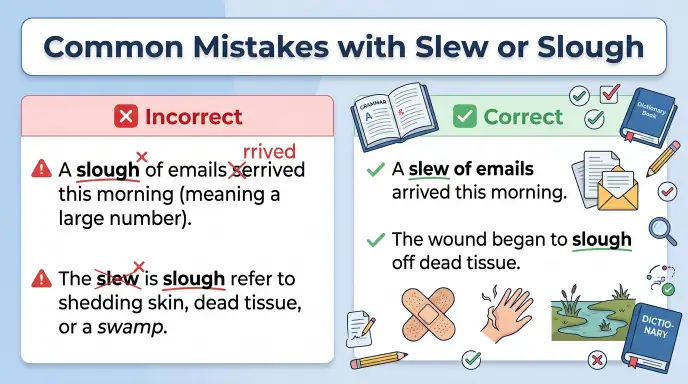
Incorrect
❌ A slough of emails arrived today.
Correct
✅ A slew of emails arrived today.

Incorrect
❌ The snake slew its skin.
Correct
✅ The snake sloughed its skin.
Incorrect
❌ We need to slew off old habits.
Correct
✅ We need to slough off old habits.
Slew or Slough Google Trends & Usage Data
Search interest shows that slew is searched more often in the United States because people commonly use the phrase “a slew of.”
Slough is searched more often in:
- United Kingdom
- Canada
- Australia
This happens because it is used in medicine, biology, geography, and as the name of the English town Slough.
Overall:
- Slew is more common in everyday writing.
- Slough appears more in technical and specialized contexts.
When Should You Use Slew or Slough?

Choose slew if you mean:
- A large number
- Turning sideways
- Sliding across a surface
Choose slough if you mean:
- Shedding skin
- Removing dead tissue
- Getting rid of something unwanted
- Referring to a swamp or marsh
A simple memory tip:
- Slew = Many
- Slough = Shed
FAQs
1. Is it slew or slough of people?
Use slew. Example: A slew of people attended the event.
2. Does slough mean to remove?
Yes. It means to shed or remove unwanted material.
3. Can slew be a verb?
Yes. It means to turn or slide sharply.
4. Why does slough have different pronunciations?
Its pronunciation changes based on its meaning and context.
5. Which word is more common?
Slew is more common in everyday English.
6. Is slough used in medicine?
Yes. Doctors use it to describe dead tissue separating from healthy tissue.
7. Can I use slew instead of slough?
No. They have different meanings and are not interchangeable.

Conclusion
Although slew and slough may look similar, they serve very different purposes in English. Slew usually refers to a large number of things or a sudden sideways movement, making it common in everyday speech and writing.
Slough, on the other hand, is used when talking about shedding skin, removing unwantedmaterial, or describing a marshy area.
Because slough has multiple meanings and pronunciations, it often causes confusion for learners.
The easiest way to remember the difference is this: slew means many, while slough means shed or remove.
Understanding these meanings will help you choose the correct word in emails, conversations, academic writing, and professional documents.
With regular practice and the examples in this guide, using slew or slough correctly will become natural and improve the clarity of your writing.
Read more about!
Related articles: Moz vs SEMrush: Which One Should You Pick in 2026?, CarMax or Carvana: Which Is Better to Buy From?, Norway vs England: Head-to-Head History.
See the dictionary definitions for slew and slough.