Have you ever typed “gage” or “gauge” and wondered which spelling is correct? You are not alone. Many English learners and writers search for this keyword because these two words look similar but are used differently in modern English. The confusion often happens because both spellings exist, but they do not always have the same meaning or usage.
The word gauge is much more common today and is used in everyday writing, science, engineering, measurements, and general communication. However, gage is still a correct spelling in some situations, especially in older English, legal terms, and specific industries.
Understanding the difference between gage and gauge helps writers avoid mistakes and choose the right word for their audience. if you are writing an email, technical document, article, or social media post, using the correct spelling improves clarity and professionalism.
In this guide, you will learn the meaning, history, spelling differences, common mistakes, and examples of gage vs gauge so you can confidently use the right form.
Gage or Gauge :Quick Answer
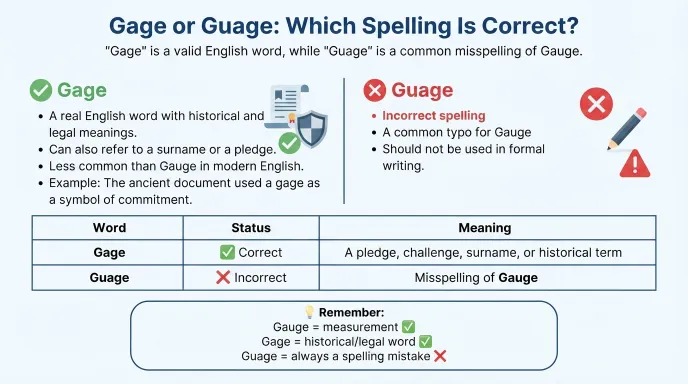
Both gage and gauge are correct spellings, but gauge is the standard and most widely used spelling today.
Gauge:
Gauge means a tool used to measure something or the act of estimating something.
Examples:
- The fuel gauge shows the tank is almost empty.
- Scientists use a pressure gauge to measure air pressure.
- I tried to gauge his reaction before making a decision.
Gage:
Gage is a less common spelling. It can mean a pledge, a challenge, or a measurement tool in some historical or specialized uses.
Examples:
- The knight accepted the gage of battle.
- The company used an old measurement gage.
Quick Comparison Table
| Word | Meaning | Common Usage |
| Gauge | Measure, estimate, measuring device | Modern English, science, business |
| Gage | Pledge, challenge, old spelling of gauge | Historical or specialized contexts |
Simple Tip:
For most writing today, choose gauge. Use gage only when the context specifically requires it.
The Origin of Gauge and Gage
The word gauge comes from Old French “jauge,” meaning a measure or standard. It entered English during the Middle Ages and developed into the modern form used for measuring tools and estimation.
Over time, English spelling changed as languages influenced each other. The spelling gage appeared as a simpler variation and was used in older English texts. In some cases, both spellings continued to exist because English does not always remove older word forms.
Historically, gage had another meaning: a pledge or something given as security. For example, a person could “throw down a gage” as a challenge. This meaning is mostly found in historical writing today.
The spelling gauge became more popular because it was connected with measurement, instruments, and technical fields. Modern dictionaries usually list gauge as the main spelling, while gage is considered less common.
Gage or Gauge: Which Spelling Is Correct?
British English vs American English Spelling
Unlike many English words, gage vs gauge is not mainly a British English vs American English spelling difference. Both forms have appeared in English, but gauge is the preferred spelling in both the UK and the US today.
British and American writers usually follow the same rule:
- Use gauge for measurement, tools, and estimation.
- Use gage only in rare historical or special contexts.
Examples:
American English:
- The pressure gauge is broken.
- We need to gauge customer interest.
British English:
- The fuel gauge needs repair.
- It is difficult to gauge public opinion.
British vs American Comparison Table
| Usage | British English | American English |
| Measuring device | Gauge | Gauge |
| Estimate or judge | Gauge | Gauge |
| Historical pledge/challenge | Gage | Gage |
| Common modern spelling | Gauge | Gauge |
Why Does Confusion Exist?
The confusion exists because English has kept some older spellings. Gage was once used more often, but gauge became the accepted spelling in modern English. Many people still see “gage” in older books, technical names, or specific industries, which creates uncertainty.
Gage vs Gauge Comparison Table
| Feature | Gauge | Gage |
| Correct spelling | ✅ Yes | ✅ Yes |
| Modern usage | Very common | Rare |
| Meaning | Measure, tool, estimate | Pledge, challenge, old spelling |
| Used in science | Yes | Rare |
| Used in engineering | Yes | Sometimes |
| Recommended for general writing | Yes | No |
Which Spelling Should You Use?
Choosing between gage and gauge depends on your audience and writing purpose.
For American English:
Use gauge in almost all situations.
Examples:
- Temperature gauge
- Pressure gauge
- Gauge performance
The word gage may appear only in historical or specific terms.
For British English:
Use gauge as the standard spelling.
Examples:
- Railway gauge
- Fuel gauge
- Gauge measurements
For Global English:
If you write for an international audience, gauge is the safest choice. It is recognized worldwide and used in professional, academic, and technical writing.
Professional Advice:
When writing:
- Articles
- Emails
- Reports
- Business documents
- Educational content
Always choose gauge unless you are discussing an old term or a specific name that uses gage.
Common Mistakes with Gage and Gauge
Mistake 1: Using “gage” for everyday measurements
❌ Incorrect:
- Check the water gage before starting the machine.
✅ Correct:
- Check the water gauge before starting the machine.
Mistake 2: Thinking “gage” is the American spelling
Some writers believe gage is the American version and gauge is British. This is incorrect.
✅ Both countries use gauge as the standard spelling.
Mistake 3: Replacing “gauge” in technical writing
In engineering and science, accuracy matters. Using gage instead of gauge may look outdated or incorrect.
✅ Correct:
- The pressure gauge measures the system’s pressure.
Mistake 4: Ignoring context
The meaning changes depending on the sentence.
Example:
- The machine has a temperature gauge. (measurement tool)
- The soldier offered his gage as a challenge. (historical meaning)
Understanding context helps you select the right word.
Gage or Gauge: Which Spelling Is Correct?
Gage or Gauge in Everyday Examples
Understanding how gage and gauge appear in realiflife writing makes it easier to choose the correct spelling.
1. In Emails
Correct:
- Please check the pressure gauge before operating the equipment.
- We need to gauge customer feedback before launching the product.
Incorrect:

- Please check the pressure gage before operating the equipment.
In professional emails, gauge is the preferred choice because it looks more modern and standard.
2. In News Writin
News articles usually use gauge when discussing measurements or opinions.
Examples:
- Experts are trying to gauge the impact of the new policy.
- The fuel gauge showed that the vehicle needed more gas.
The word gage is rarely used in modern news unless the topic involves history or a specific name.
3. In Social Media
People commonly use gauge in everyday posts.
Examples:
- “Trying to gauge everyone’s opinion about this idea.”
- “My car’s fuel gauge is not working.”
Using gage in casual writing may confuse readers because most people expect the spelling gauge.
4. In Formal Writing
Academic, business, and technical writing prefer gauge.
Examples:
- Researchers used surveys to gauge public opinion.
- The device contains a digital pressure gauge.
Gage or Gauge:Google Trends & Usage Data
Search interest shows that gauge is far more popular than gage worldwide.
Usage Comparison:
| Keyword | Popularity | Common Search Intent |
| Gauge | High | Meaning, spelling, measurement tools |
| Gage | Low | Historical meaning, names, rare usage |
Countries Searching for “Gauge”
The word gauge is commonly searched in countries where English is widely used, including:
- United States
- United Kingdom
- Canada
- Australia
- India
People usually search for:
- “Gauge meaning”
- “Gauge vs gage”
- “How to use gauge”
- “Pressure gauge”
Why Is Gauge More Popular?
The main reasons are:
- It is used in engineering and science.
- It appears in everyday objects like fuel gauges.
- It is the accepted spelling in modern dictionaries.
- It is used in professional communication.
Frequently Asked Questions
1. Is gage or gauge correct?
Both spellings are correct, but gauge is the standard spelling used in modern English.
2. Is gage the American spelling of gauge?
No. Gage is not the American spelling of gauge. Both American and British English use gauge as the common form.
3. What does gauge mean?
Gauge means to measure, estimate, or judge something.
Examples:
- I need to gauge the situation.
- The fuel gauge is empty.
4. What does gage mean?
Gage can mean a pledge or challenge, especially in historical writing. It can also be a rare spelling of gauge.
5. Should I use gauge in professional writing?
Yes. Gauge is the best choice for emails, reports, articles, and academic writing.
6. Why are there two spellings?
English developed from many languages, and older spellings often remained. Over time, gauge became the preferred modern spelling.
7. How can I remember the difference?
A simple trick:
Gauge = General modern use
Gage = Generally oldiffashioned
Conclusion
The words gage and gauge create confusion because both spellings exist in English. However, their modern usage is very different. Gauge is the correct choice for almost all everyday situations, including measurements, tools, estimates, business writing, and technical communication.
The spelling gage is much less common and is mainly found in historical contexts, old documents, or specific terms. While it is not always wrong, it can look outdated when used in normal writing.
Continue Reading!
Usage or Useage: Which Spelling Is Correct?
Related articles: Endeavour vs Endeavor: Meaning, Examples, and Usage Guide, Comparable or Comprable: Which Spelling Is Correct?, Bareable or Bearable: Which Spelling Is Correct?.
See the dictionary definitions for gage and gauge.