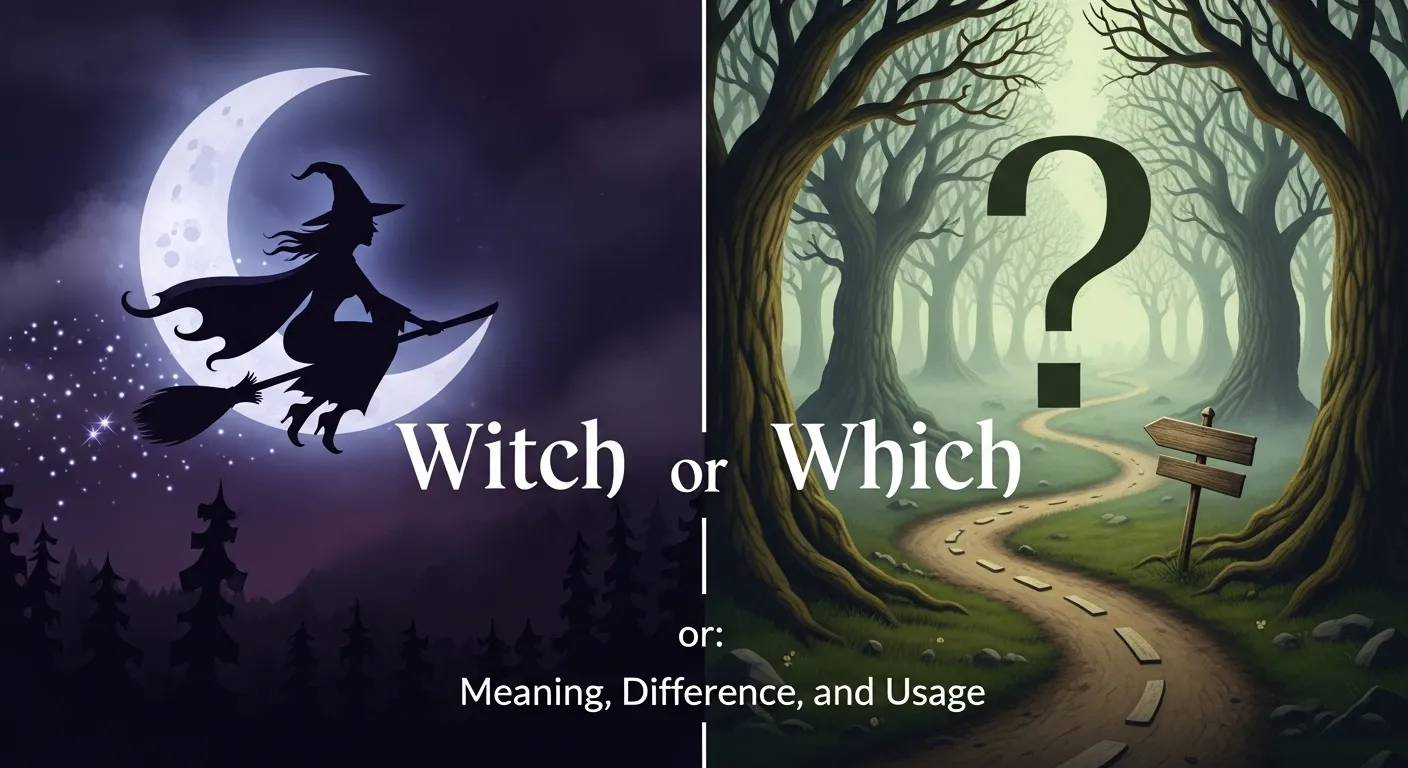
“Witch” is a noun linked to magic, while “which” is a grammar word used for questions and choices.
Have you ever typed witch when you meant which, or paused mid-sentence trying to remember the difference? You’re not alone. This is one of the most common English word confusions, especially for learners, students, bloggers, and even native speakers. Because both words sound exactly the same, they often get mixed up in writing.
People search for witch or which because spellcheck does not always catch the mistake, yet using the wrong word can completely change the meaning of a sentence. Imagine writing “Which is flying on a broom” instead of “Witch is flying on a broom.” Small error, big confusion.
This article clears it up in a simple, practical way. You’ll learn the meaning, origin, usage rules, common mistakes, real-life examples, and exactly when to use witch or which with confidence.
Witch or Which – Quick Answer
- Witch → A person believed to have magical powers.
- Which → A word used to ask questions or give more information.
Simple Examples
- The witch cast a spell.
- Which book do you like?
They sound the same, but their meanings are completely different.
The Origin of Witch and Which
Understanding word origins makes the difference easier to remember.
Origin of Witch
- Comes from Old English wicce
- Referred to a woman believed to practice magic or sorcery
- Used in stories, myths, and folklore for centuries
Origin of Which
- Comes from Old English hwilc
- Meant “what kind” or “what one”
- Has always been a grammar-related word
Their similar pronunciation is accidental. Their histories and purposes are not related at all.
British English vs American English Spelling
Good news: there is no spelling difference between British and American English for these words.
| Word | British English | American English |
| witch | witch | witch |
| which | which | which |
The confusion exists only because of pronunciation, not spelling rules.
Which Spelling Should You Use?
This depends on meaning, not location.
Use Witch if:
- You are talking about magic, spells, or fantasy
- The sentence refers to a person
Example:
The witch lived alone in the forest.
Use Which if:
- You are asking a question
- You are giving extra information
- You are choosing between options
Example:
Which movie should we watch?
Common Mistakes with Witch or Which
Mistake 1: Using “witch” in questions
❌ Witch one do you prefer?
✅ Which one do you prefer?
Mistake 2: Using “which” for magical characters
❌ The which flew on a broom.
✅ The witch flew on a broom.
Mistake 3: Relying only on sound
These are homophones. Always check meaning, not pronunciation.
Witch or Which in Everyday Examples
Emails
- Please tell me which date works best.
- The story mentions a powerful witch.
News
- The novel features a mysterious witch.
- The report explains which areas need support.
Social Media
- Which coffee is better?
- Watching a movie about a witch tonight.
Formal Writing
- The researcher explains which method was chosen.
- The play centers on a tragic witch figure.
Witch or Which – Google Trends & Usage Data
Search behavior shows:
- “Which” is searched more often due to daily grammar use
- “Witch” spikes during Halloween, movies, and fantasy trends
- Both keywords are popular but used in very different contexts
From an SEO point of view, “which” appears more frequently in educational and informational content, while “witch” is common in entertainment and storytelling.
Comparison Table: Witch vs Which
| Feature | Witch | Which |
| Part of speech | Noun | Pronoun / Determiner |
| Meaning | Magical person | Question or choice word |
| Usage | Stories, myths | Grammar, questions |
| British vs American | Same | Same |
| Pronunciation | Same | Same |
FAQs: Witch or Which
1. Is “witch” ever used in questions?
Rarely. Only if the question is about a magical person.
2. Is “which” a noun?
No. It is a pronoun or determiner.
3. Why do people confuse witch and which?
Because they sound exactly the same.
4. Can spellcheck catch this mistake?
Sometimes not, because both words are correct.
5. Is “which” more common than “witch”?
Yes, because it is used in everyday language.
6. Are witch and which interchangeable?
No. Using the wrong one changes the meaning.
7. How can I remember the difference?
Think witch = magic, which = choice.
Conclusion
The difference between witch and which is easy once you focus on meaning instead of sound. A witch is a person, usually linked to magic, stories, or folklore. Which is a grammar word used to ask questions, give details, or make choices.
Because they sound the same, writers often confuse them, especially in fast typing or casual writing. But using the wrong word can make your sentence confusing or even funny in the wrong way. The solution is simple: pause, check the meaning, and choose the correct word.
Now that you understand this difference clearly, you can write emails, articles, and posts with confidence without second-guessing yourself.
👉Likable or Likeable: Which Spelling Is Correct? UK vs USA

Samuel A. Whitmore an English language writer and editor , specializes in spelling, grammar, and usage differences between British and American English. Focuses on helping readers avoid common writing mistakes through clear explanations, practical examples, and easy-to-follow comparisons. My work aims to make English spelling rules simple and accessible for students, professionals, and everyday writers.