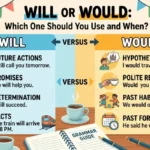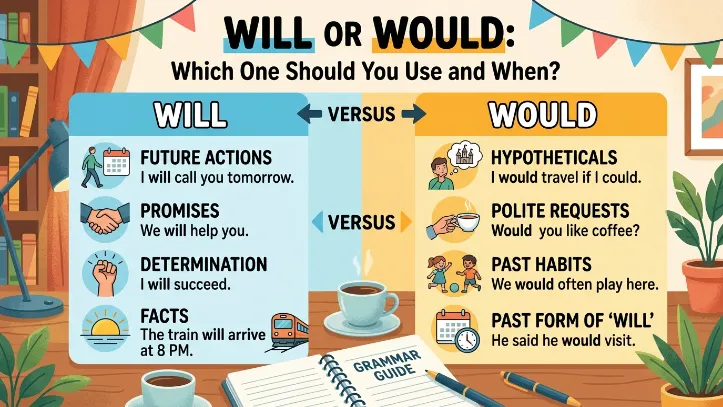
“Will” indicates certainty or future action, while “would” expresses possibility, hypothetical situations, or politeness.
During a casual conversation, a friend said, “I will help you with your project tomorrow.” Another friend asked, “I thought you would help?” The subtle difference between will and would can confuse many English learners.
People frequently search for “will or would” because these auxiliary verbs are essential in expressing the future, possibilities, and hypothetical situations. Choosing the wrong one can change the meaning of a sentence entirely.
Both words are closely related but serve different functions in English grammar. Will conveys certainty or definite plans, while would often refers to hypotheticals, polite requests, or conditional statements. Misusing them can make sentences sound awkward or unclear.
This article will explore the meaning, origin, usage rules, common mistakes, examples, and practical tips for using will and would, helping you write and speak English more confidently.
Will or Would – Quick Answer
| Word | Meaning | Usage Example |
| Will | Indicates certainty, future actions | I will call you tomorrow. |
| Would | Expresses possibility, hypothetical situations, or politeness | I would go if I had time. |
Simple Explanation
- Will → certain future or promise
- Would → hypothetical, polite, or conditional situations
The Origin of Will and Would
Will
The word will comes from the Old English “willan”, meaning to wish, desire, or intend. Over time, it evolved to indicate future actions, promises, and intentions.
Examples:
- I will complete the project.
- She will join us later.
Would
Would is the past tense form of will in English grammar. Historically, it was used to refer to past intentions or hypothetical situations, but modern English uses it widely for:
- Polite requests
- Conditional sentences
- Hypothetical scenarios
Examples:
- I would help if I could.
- Would you like some coffee?
British English vs American English Usage
Both British and American English use will and would, but there are subtle style differences in formality and frequency.
Comparison Table
| Word | US English | UK English | Notes |
| Will | ✔ Common | ✔ Common | Expresses future certainty |
| Would | ✔ Common | ✔ Common | Expresses hypotheticals, politeness, or conditional actions |
The rules are the same, but British English often favors would slightly more in polite requests.
Which Word Should You Use?
Use “Will” When
- Talking about future certainty
- Making promises or commitments
- Predicting events
Examples:
- I will finish this by 5 PM.
- She will arrive soon.
- It will rain tomorrow.
Use “Would” When
- Expressing hypotheticals or conditional situations
- Making polite requests or offers
- Talking about past habits
Examples:
- I would go if I had more time.
- Would you pass the salt, please?
- When I was young, I would visit my grandparents every summer.
Common Mistakes with Will and Would
Mistake 1: Using Will in Hypotheticals
Incorrect:
- I will go if I had time.
Correct:
- I would go if I had time.
Mistake 2: Using Would for Certainty
Incorrect:
- She would arrive at 5 PM tomorrow.
Correct:
- She will arrive at 5 PM tomorrow.
Mistake 3: Mixing Politeness
Incorrect:
- I will like some tea, please.
Correct:
- I would like some tea, please.
Will and Would in Everyday Examples
In Conversations
- Will: “I will meet you at the cafe.”
- Would: “I would help you if I weren’t busy.”
In Emails
- Will: “I will send the report by Monday.”
- Would: “I would appreciate your feedback on this draft.”
In News or Predictions
- Will: “Experts say the stock market will rise next week.”
- Would: “Analysts predicted the market would recover after the downturn.”
In Social Media
- Will: “I will post the pictures soon.”
- Would: “I would love to join you if I weren’t out of town.”
Google Trends & Usage Data
- Will is used widely for future statements, predictions, and guarantees.
- Would is heavily searched for conditional grammar rules, polite expressions, and hypothetical scenarios.
- English learners often confuse them because both relate to the concept of “future intention” in some way.
Globally, will appears more in statements of certainty, while would dominates in tutorials and grammar guides.
Comparison Table: Will vs Would
| Feature | Will | Would |
| Meaning | Certainty, future actions | Hypothetical, conditional, polite |
| Past tense | No | Past tense of will in conditional sentences |
| Politeness | Neutral | Polite, formal |
| Usage frequency | High | High, context-specific |
| Common mistakes | Using in hypotheticals | Using for future certainty |
FAQs
1. Can will and would be used interchangeably?
No. They have related meanings but serve different grammatical purposes.
2. Is would the past tense of will?
Yes, in conditional or hypothetical contexts.
3. When should I use will?
For definite future actions, promises, or predictions.
4. When should I use would?
For hypothetical situations, polite requests, or past habits.
5. Is would more polite than will?
Yes, would is commonly used in polite requests.
6. Can will be used for hypothetical situations?
No, will expresses certainty, not hypothetical scenarios.
7. Do British and American English use them differently?
Usage is similar, but British English often favors would in polite forms slightly more.
Conclusion
Understanding the difference between will and would is crucial for clear communication. Will shows certainty and definite future actions, while would covers hypotheticals, polite expressions, and past habits.
Choosing the correct auxiliary verb ensures your sentences convey the intended meaning, whether in professional emails, casual conversations, or academic writing. Remember: use will for certainty and would for possibility or politeness, and maintain consistency throughout your writing.
Mastering this distinction will make your English sound more fluent, professional, and precise.
Nap or Nothing:What Do These Words Mean and When Should You Use Them?

Samuel A. Whitmore an English language writer and editor , specializes in spelling, grammar, and usage differences between British and American English. Focuses on helping readers avoid common writing mistakes through clear explanations, practical examples, and easy-to-follow comparisons. My work aims to make English spelling rules simple and accessible for students, professionals, and everyday writers.