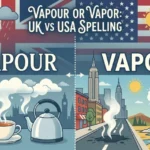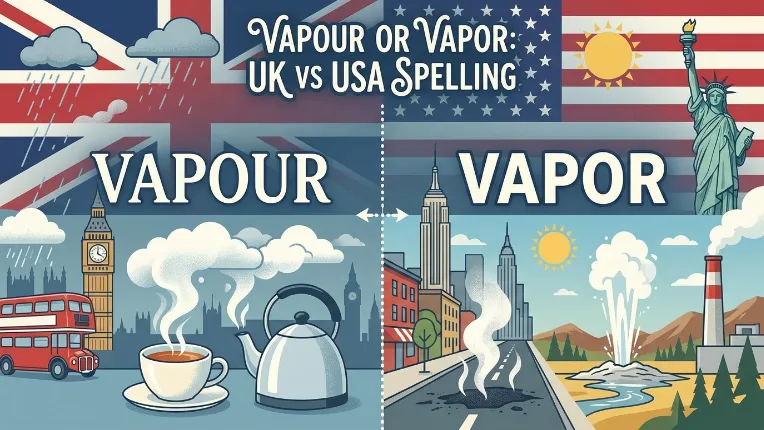
“Vapor” is American English, while “vapour” is British English both mean the same substance in gas form.
Bilal was writing a science assignment and typed, “Water turns into vapor when heated.” Later, he checked a British website and saw the same sentence written as “vapour.” Now he was unsure had he made a mistake, or were both correct?
This is exactly why people search for “vapour or vapor.” The confusion comes from differences between British and American English spelling. Both words sound the same and carry the same meaning, but their spellings change depending on the region.
Such variations are common in English and can affect writing style, especially in academic work, professional communication, or online content. Choosing the wrong version for your audience can make your writing seem inconsistent.
In this guide, you will clearly understand the difference between vapour and vapor, where each is used, and how to choose the right spelling based on your audience.
Vapour or Vapor – Quick Answer
- Vapor = American English spelling
- Vapour = British English spelling
Meaning:
Both words mean a substance in gas form, usually formed from a liquid or solid.
Examples:
- Water turns into vapor when heated. (US)
- Water turns into vapour when heated. (UK)
👉 The meaning is identical; only the spelling changes.
The Origin of Vapour or Vapor
The word comes from the Latin “vapor,” meaning steam or mist. As English evolved, British spelling retained the “ou” form (vapour), influenced by French.
American English later simplified many words by removing extra letters. This is why:
- Colour → Color
- Honour → Honor
- Vapour → Vapor
This simplification made spelling shorter and easier in American usage.
British English vs American English Spelling
This is a classic example of spelling variation between regions.
Key Difference:
- British English → vapour
- American English → vapor
Comparison Table
| Feature | British English | American English |
|---|---|---|
| Spelling | Vapour | Vapor |
| Meaning | Same | Same |
| Usage Region | UK, Pakistan, etc. | USA |
More Examples:
| British | American |
|---|---|
| Colour | Color |
| Honour | Honor |
| Vapour | Vapor |
Which Spelling Should You Use?
Choosing the right spelling depends on your audience.
Use “vapor” if:
- You are writing for an American audience
- Your content follows US English style
Use “vapour” if:
- You are writing in British English
- Your audience is in the UK, Pakistan, or Commonwealth countries
For global writing:
- Stay consistent—choose one style and use it throughout
Pro Tip:
If your school or workplace follows British English, prefer vapour.
Common Mistakes with Vapour or Vapor
Mistake 1:
❌ Mixing both spellings in one document
✔️ Choose one style and stay consistent
Mistake 2:
❌ Thinking they have different meanings
✔️ Both words mean the same
Mistake 3:
❌ Using American spelling in British exams
✔️ Follow your required language style
Mistake 4:
❌ Assuming one is wrong
✔️ Both are correct depending on region
Vapour or Vapor in Everyday Examples
In Science:
- Water changes into vapour during evaporation
- Steam is a form of vapor
In Daily Life:
- Hot tea releases vapour
- The air was filled with vapor
In Writing:
- The experiment produced visible vapour
- The machine emitted chemical vapor
Vapour or Vapor – Google Trends & Usage Data
Search patterns show:
- Vapor is more common in the United States
- Vapour is widely used in the UK and Commonwealth countries
- Both are frequently searched together due to spelling confusion
Insight:
- Scientific and global platforms often use vapor
- Educational systems in many countries prefer vapour
Comparison Table: Vapour vs Vapor
| Feature | Vapour | Vapor |
|---|---|---|
| Spelling Type | British English | American English |
| Meaning | Gas form of substance | Same |
| Usage | UK, Pakistan, etc. | USA |
| Example | Water vapour | Water vapor |
| Correctness | Correct | Correct |
FAQs
1. Is it vapour or vapor?
Both are correct. Use vapour in British English and vapor in American English.
2. Do vapour and vapor mean the same?
Yes, they have exactly the same meaning.
3. Which spelling is used in Pakistan?
British English is common, so vapour is preferred.
4. Is vapor wrong?
No, it is correct in American English.
5. Why do British words have “ou”?
They are influenced by French spelling traditions.
6. Can I use both in one article?
No, you should stay consistent with one style.
7. Which spelling is better for exams?
Use the spelling style required by your board or institution.
Conclusion
The difference between vapour or vapor is not about meaning but about spelling style. Both words refer to the same thing a substance in gas form but their usage depends on regional preferences. British English keeps the traditional spelling vapour, while American English simplifies it to vapor.
Understanding this difference helps you write more clearly and professionally. It also ensures your content matches the expectations of your audience, whether academic, professional, or casual.
The most important rule is consistency. Once you choose a spelling style, stick with it throughout your writing. This small detail can make a big difference in how your work is perceived.
By mastering these variations, you improve your overall writing accuracy and confidence. Now, choosing between vapour or vapor will always be simple and correct.

Miles Thornton is a seasoned author and content specialist with a knack for simplifying complex topics. Passionate about clear, engaging writing, creates articles that inform and inspire readers. With years of experience in digital publishing, Miles combines professionalism with creativity, delivering insightful content for diverse audiences