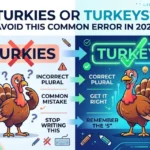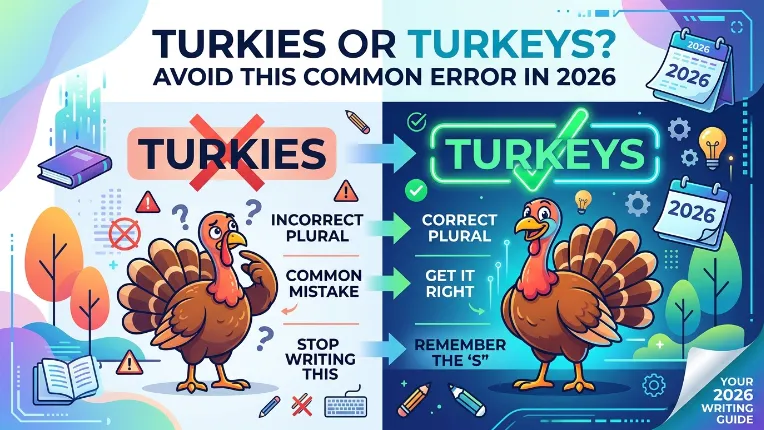
Turkeys is the correct spelling. “Turkies” is incorrect and should not be used.
A student once wrote, “We saw many wild turkies in the field.” The sentence was simple, but one small spelling mistake made it look unprofessional. This confusion is very common, especially for learners of English.
The problem comes from how English handles words ending in “-y.” Sometimes we change the spelling, and sometimes we don’t. This creates doubt in words like turkies and turkeys. Many people think both are correct, but only one follows proper grammar rules.
If you write emails, exams, or content, this small mistake can affect your credibility. That’s why understanding the correct form is important.
In this article, you will learn the correct spelling, the rule behind it, real-life examples, and expert advice. By the end, you will never confuse turkies and turkeys again.
Turkies or Turkeys – Quick Answer
The correct spelling is turkeys.
- ✅ Correct: We saw three wild turkeys.
- ❌ Incorrect: We saw three wild turkies.
Meaning:
“Turkeys” is the plural form of “turkey,” a large bird often eaten on special occasions.
- Example: The farm has many turkeys.
- Example: They cooked two turkeys for dinner.
👉 Turkies is not a correct English word.
The Origin of Turkies or Turkeys
The word turkey comes from the name of the country Turkey. Early European traders thought the bird came from that region, so they gave it this name.
The Plural Rule
👉 When a word ends in vowel + y, we simply add “s” to make it plural.
- Turkey → Turkeys
- Monkey → Monkeys
- Donkey → Donkeys
👉 When a word ends in consonant + y, we change “y” to “ies.”
- Baby → Babies
- City → Cities
Since “turkey” ends with a vowel (e) + y, we add only “s”.
This is why turkeys is correct and turkies is wrong.
British English vs American English Spelling
There is no difference between British and American English for this word.
Comparison Table
| Feature | British English | American English | Correct Form |
|---|---|---|---|
| Singular | Turkey | Turkey | ✅ Turkey |
| Plural | Turkeys | Turkeys | ✅ Turkeys |
| Incorrect variant | Turkies | Turkies | ❌ Avoid |
| Usage | Standard | Standard | ✅ Turkeys |
👉 Both regions follow the same grammar rule here.
Which Spelling Should You Use?
Always use turkeys.
Audience-Based Advice:
- USA: Use turkeys
- UK: Use turkeys
- Pakistan / India: Use turkeys
- Global writing: Use turkeys
Professional Tip:
- Exams → ✅ Turkeys
- Emails → ✅ Turkeys
- Articles → ✅ Turkeys
- Social media → Avoid turkies
👉 Using the correct plural shows strong grammar skills.
Common Mistakes with Turkies or Turkeys
1. Changing “y” to “ies” unnecessarily
- ❌ Turkies
- ✅ Turkeys
👉 Only change “y” when there is a consonant before it.
2. Forgetting the vowel rule
People forget that “e” is a vowel.
- ❌ Turkies
- ✅ Turkeys
3. Copying wrong spellings online
- ❌ “I saw wild turkies”
- ✅ “I saw wild turkeys”
👉 Always trust grammar rules, not random posts.
4. Overgeneralizing rules
Some learners apply the same rule to all words.
- Baby → Babies ✅
- Turkey → Turkeys ✅ (different rule)
Turkies or Turkeys in Everyday Examples
1. In Emails
- ✅ “The farm has 20 turkeys.”
- ❌ “The farm has 20 turkies.”
2. In News Writing
- ✅ “Wild turkeys are increasing in number.”
3. On Social Media
- ❌ “Look at those turkies!”
- ✅ “Look at those turkeys!”
4. In Formal Writing
- ✅ “Turkeys are commonly raised for meat production.”
5. In Daily Use
- “We bought two turkeys for Eid dinner.”
Turkies or Turkeys – Google Trends & Usage Data
Search patterns clearly show one winner.
Global Trend:
- Turkeys → Very high usage
- Turkies → Very low and declining
Country Insights:
- USA: Strong use of turkeys
- UK: Only turkeys used
- Pakistan & India: Mostly turkeys
Why is “turkeys” dominant?
- It follows grammar rules
- It is taught in schools
- It appears in dictionaries
👉 “Turkies” exists only due to misunderstanding of plural rules.
Comparison Table: Turkies vs Turkeys
| Aspect | Turkeys (Correct) | Turkies (Incorrect) |
|---|---|---|
| Spelling accuracy | ✅ Correct | ❌ Incorrect |
| Grammar rule | Follows rule | Breaks rule |
| Formal writing | ✅ Accepted | ❌ Avoid |
| Usage frequency | Very high | Very low |
| Dictionary status | Standard | Not accepted |
| Professional use | Yes | No |
FAQs
1. Is “turkies” ever correct?
No. “Turkies” is not correct in standard English. Always use turkeys.
2. Why don’t we write “turkies”?
Because the word ends in a vowel + y, so we only add “s.”
3. What is the rule for words ending in “y”?
- Vowel + y → add “s”
- Consonant + y → change to “ies”
4. Is “turkeys” used worldwide?
Yes. It is the correct form in all English-speaking countries.
5. Does pronunciation change?
No. The pronunciation stays the same. Only spelling differs.
6. Can “turkies” be used in informal writing?
It is still incorrect and should be avoided, even in casual writing.
7. How can I remember the rule?
👉 Remember: “Vowel + Y = Just add S” → Turkey → Turkeys
Conclusion
The confusion between turkies and turkeys comes from misunderstanding a simple grammar rule. Many learners assume that all words ending in “y” change to “ies,” but this is not always true. The correct rule depends on the letter before “y.”
Since “turkey” ends with a vowel + y, we simply add “s” to form the plural. This makes turkeys the only correct spelling. The form “turkies” breaks this rule and is not accepted in standard English.
Using the correct spelling may seem like a small detail, but it has a big impact on your writing. It improves clarity, builds trust, and shows that you understand grammar rules.
Whether you are writing for school, work, or online, always choose turkeys. Simple, correct, and professional that is the key to strong English writing.

Samantha Harvey is an English language writer specializing in English spelling, grammar, and usage comparisons. She creates clear, search-friendly content that helps readers understand common word confusions with practical examples. Her work focuses on UK and US English differences for learners and online publishers.