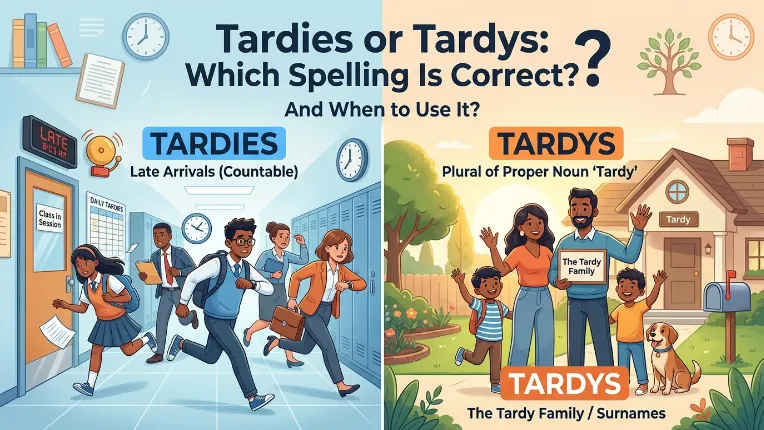
“Tardies” is the correct plural spelling of “tardy,” while “tardys” is incorrect according to standard English spelling rules.
During a school meeting, a teacher reviewed the attendance report and mentioned that several students had multiple tardies that month. A parent reading the report later wondered whether the word should actually be spelled tardys instead. This small spelling question appears frequently in school settings.
Many people search for “tardies or tardys” because English plural rules can sometimes feel confusing. When a word ends in “y,” the plural form does not always follow the simple rule of adding “s.” Instead, the spelling often changes depending on the letter before the y.
The correct plural form of tardy is tardies, where the y changes to “ies.” The spelling tardys does not follow standard grammar rules and is considered incorrect in formal writing.
In this article, we will explore the meaning, origin, plural spelling rule, common mistakes, examples, and usage of tardies, helping you understand why it is the correct form.
Tardies or Tardys – Quick Answer
| Word | Correct? | Meaning |
| Tardies | ✔ Correct | Plural of tardy (late arrival) |
| Tardys | ✖ Incorrect | Misspelling |
Example Sentences
Correct:
- The student received three tardies this week.
Incorrect:
- The student received three tardys this week.
The Origin of the Word “Tardy”
The word tardy comes from the Latin word “tardus,” which means slow or late. Over time, it entered Middle English and came to describe someone who arrives later than expected.
Today, tardy is commonly used in schools and workplaces to refer to late attendance.
Examples:
- She was tardy to class.
- The employee received a warning for being tardy.
When referring to more than one late arrival, the plural form tardies is used.
British English vs American English Usage
The spelling rule for tardy → tardies is the same in both British and American English.
Comparison Table
| Word | US English | UK English | Status |
| Tardy | ✔ Standard | ✔ Standard | Singular |
| Tardies | ✔ Standard | ✔ Standard | Correct plural |
| Tardys | ✖ Incorrect | ✖ Incorrect | Misspelling |
The grammar rule does not change between English varieties.
Why the Plural Is “Tardies”
English has a common spelling rule for nouns ending in consonant + y.
Rule:
When a word ends with consonant + y, the y changes to “ies” in the plural.
Examples:
| Singular | Plural |
| Tardy | Tardies |
| City | Cities |
| Baby | Babies |
| Party | Parties |
| Lady | Ladies |
Because tardy ends with dy, the correct plural becomes tardies.
Which Spelling Should You Use?
Use “Tardies”
Use tardies whenever referring to multiple late arrivals.
Examples:
- The teacher recorded five tardies for the student.
- Too many tardies may affect attendance records.
- The school policy limits the number of tardies allowed each semester.
Avoid “Tardys”
The spelling tardys breaks the y → ies plural rule and is not accepted in standard English.
Incorrect:
- He has three tardys this week.
Correct:
- He has three tardies this week.
Common Mistakes with Tardies
Mistake 1: Adding Only “S”
Incorrect:
- The report shows four tardys.
Correct:
- The report shows four tardies.
Mistake 2: Confusing “Tardy” with “Late”
Some writers replace tardy with late, but the words are used differently in certain contexts.
Example:
- The student was tardy to class.
- The train arrived late.
Mistake 3: Using Tardies as an Adjective
Incorrect:
- The tardies student missed the lesson.
Correct:
- The tardy student missed the lesson.
Tardies in Everyday Examples
In Schools
- The teacher tracks tardies to monitor attendance.
In School Policies
- Students with excessive tardies may receive warnings.
In Attendance Reports
- The report shows three tardies and one absence.
In Parent Meetings
- Parents are informed when students accumulate too many tardies.
These examples show that tardies is mainly used in academic or attendance contexts.
Google Trends & Usage Data
Search data shows that many users type “tardys” because they assume the plural simply adds “s.” However, English spelling rules require “ies” for words ending in consonant + y.
Usage patterns indicate:
- Tardies appears in school attendance policies and educational documents.
- Tardys appears mostly as a spelling mistake in search queries.
Search engines often suggest tardies as the correct spelling.
Comparison Table: Tardies vs Tardys
| Feature | Tardies | Tardys |
| Correct spelling | ✔ Yes | ✖ No |
| Plural of tardy | ✔ Yes | ✖ No |
| Grammar rule | Follows y → ies rule | Breaks rule |
| Common usage | Schools, attendance | Rare |
| Recommended spelling | ✔ Yes | ✖ No |
FAQs
1. What is the plural of tardy?
The correct plural form is tardies.
2. Is “tardys” ever correct?
No. It does not follow standard English spelling rules.
3. Why does tardy become tardies?
Because nouns ending in consonant + y change y to ies in the plural.
4. Is tardy used outside schools?
Yes, but it is most commonly used in school attendance contexts.
5. Can tardy be used as an adjective?
Yes. Example: “He was tardy to class.”
6. Is the rule the same in British and American English?
Yes. Both use tardies as the plural.
7. Why do people search for “tardys”?
Because many assume plural words simply add s, which is not always correct.
Conclusion
The difference between tardies and tardys comes down to a simple English spelling rule. When a word ends in consonant + y, the y changes to “ies” in the plural form. Because tardy follows this pattern, the correct plural spelling is tardies.
Although tardys may appear in casual writing or online searches, it does not follow proper grammar rules and should be avoided in formal communication. Schools, attendance records, and official documents consistently use tardies as the correct term.
Remember the simple rule: tardy becomes tardies, just like city becomes cities. Following this rule will help you write accurately and avoid a common spelling mistake.
Dell vs HP: Which Laptop Brand Is Better? Analysis For 2026

Samuel A. Whitmore an English language writer and editor , specializes in spelling, grammar, and usage differences between British and American English. Focuses on helping readers avoid common writing mistakes through clear explanations, practical examples, and easy-to-follow comparisons. My work aims to make English spelling rules simple and accessible for students, professionals, and everyday writers.