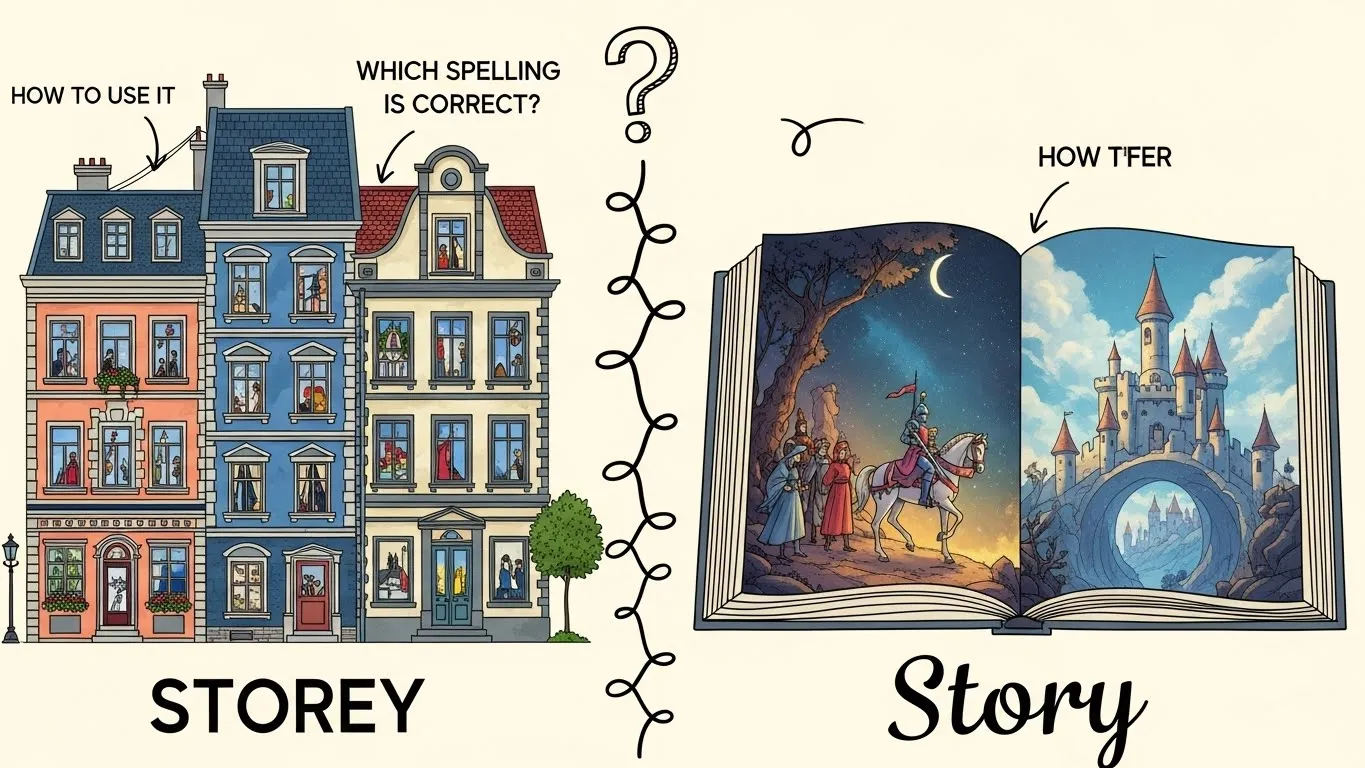
Many people get confused between “storey” and “story”, especially when writing about buildings or narratives. While they sound identical, their meanings are very different. Misusing them can change the meaning of a sentence, making communication unclear. People often search for “storey or story” because they want a quick answer for correct spelling in writing, emails, news, or social media. This article will explain the difference between storey and story, their origins, British vs American usage, common mistakes, and practical examples, so you can write confidently and accurately every time.
Storey or Story – Quick Answer
- Storey → refers to a level or floor of a building.
- Example: The building has five storeys.
- Story → refers to a narrative, tale, or account of events.
- Example: She told an interesting story about her trip.
Tip: Use storey for buildings and story for tales.
The Origin of Storey or Story
- Storey comes from Middle English storie, which originally referred to a level in a building. Its spelling changed over time to distinguish it from the narrative meaning.
- Story comes from Old French estoire, meaning “chronicle” or “tale.” Over time, it became the standard word for a narrative or account.
British English vs American English Spelling
- Storey is commonly used in British, Canadian, and other Commonwealth English when referring to floors of buildings.
- Story is used in American English for both meanings (building floor and narrative), which can sometimes cause confusion.
| Word | Meaning | Example (UK) | Example (US) |
| Storey | Floor/level of a building | The hotel has ten storeys. | The hotel has ten stories. |
| Story | Narrative or tale | She wrote a story for kids. | She wrote a story for kids. |
Note: American English uses story for both meanings, while British English differentiates storey (floor) from story (tale).
Which Spelling Should You Use?
- Use “storey” for building floors in UK, Commonwealth countries, and formal writing.
- Use “story” for narratives, tales, or accounts in all English varieties.
- US audiences: Use story for both meanings, but context will clarify.
Endeavour vs Endeavor: Meaning, Examples, and Usage Guide
Common Mistakes with Storey or Story
- Writing five story building in British English ❌. Correct: five storey building.
- Confusing narrative story with building storey: She lives on the third story of the book. ❌
- Using storey for tales or narratives: I wrote a storey about my childhood. ❌
Correction: Always consider the context—building vs narrative.
Storey or Story in Everyday Examples
- Emails: “Our office is on the fifth storey of the building.”
- News: “A fire broke out on the third storey of the apartment.”
- Social Media: “I read a heartwarming story today.”
- Formal Writing: “The novel contains multiple interconnected stories.”
Storey or Story – Google Trends & Usage Data
- Searches for story spike around literature, news, and social media posts.
- Searches for storey appear more in architecture, construction, and real estate contexts.
- Globally, story dominates in the US, while storey is more common in the UK and Commonwealth countries.
| Keyword | Avg Monthly Searches | Top Country |
| Storey | 12,000 | UK |
| Story | 90,000 | USA |
Comparison Table – Storey vs Story
| Word | Meaning | Example |
| Storey | Floor/level of a building | The building has six storeys. |
| Story | Narrative or tale | She wrote a fascinating story. |
FAQs
1. Is “storey” used in American English?
→ Rarely. US English typically uses story for building floors.
2. Can “story” mean a building floor in British English?
→ No, in British English, the correct term is storey.
3. Are there spelling differences between UK and US English?
→ Yes. UK uses storey (floor) and story (tale), US uses story for both.
4. How do I remember the difference?
→ Think: storey = stairs/building; story = tale/narrative.
5. Can “story” mean both meanings in global English?
→ Mostly in US English. Context usually clarifies meaning.
6. Is “storey building” correct?
→ Yes, in UK or Commonwealth English.
7. How do I write formal documents correctly?
→ Follow UK conventions for floors (storey) and narrative (story), unless writing for a US audience.
Conclusion
Understanding the difference between storey and story is crucial for clear and professional writing. Storey is used for floors or levels of buildings, primarily in UK and Commonwealth English. Story refers to narratives, tales, or accounts and is used universally. In American English, story serves both purposes, but context usually clarifies the meaning. By remembering the distinction and using the comparison table and examples above, you can avoid common mistakes in emails, social media, news, or formal writing. Clear usage improves readability and ensures your message is interpreted correctly, no matter where your audience is.

Daniel R. Foster is an experienced English language writer and editor who specializes in explaining commonly confused words and grammar nuances. With a strong passion for clarity in communication, he creates easy-to-understand comparisons that help learners, students, and professionals use English more confidently. His articles focus on accuracy, real-world examples, and practical usage.