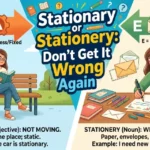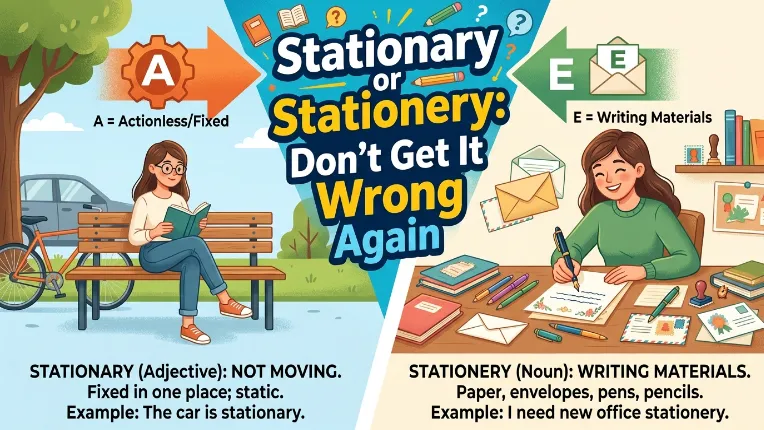
“Stationary” means not moving, while “stationery” refers to writing materials like paper, pens, and envelopes.
A student wrote an email to his teacher: “I forgot my stationary at home.” The teacher smiled but noticed the mistake. The student was talking about notebooks and pens, yet he used the wrong word. It should have been stationery, not stationary.
This is a very common confusion. Many people search for “stationary or stationery” because both words sound exactly the same. They look similar too, with just one extra “e” making the difference. But their meanings are completely different.
One word describes something that does not move, while the other is about school and office supplies. Using the wrong spelling can change your sentence and make your writing look unprofessional.
In exams, emails, or even social media posts, this small mistake appears often. That is why it is important to understand the correct usage. This guide will help you learn the difference clearly, remember it easily, and use both words with confidence in everyday writing.
Stationary or Stationery – Quick Answer
- Stationary = not moving, fixed in one place
- Stationery = writing materials (paper, pens, envelopes)
Examples:
- The car remained stationary during the signal.
- I bought new stationery for school.
Easy Trick:
- Stationery has “e” for envelope
- Stationary has “a” for at rest
The Origin of Stationary or Stationery
Both words come from the same root, which is why they confuse people.
The base word is “station,” meaning a fixed place. From this:
- Stationary developed to describe something that does not move
- Stationery came from the idea of people who worked at fixed stations selling writing materials
In history, booksellers and paper sellers stayed in one place. They were called stationers, and their goods became known as stationery.
So:
- Stationary kept the meaning of “not moving”
- Stationery became linked to writing supplies
This shared origin explains why the spellings are so close.
British English vs American English Spelling
There is no difference between British and American English for these words.
Both regions use:
- Stationary for “not moving”
- Stationery for writing materials
Comparison Table
| Word | Meaning | British English | American English |
|---|---|---|---|
| Stationary | Not moving | Stationary | Stationary |
| Stationery | Writing materials | Stationery | Stationery |
Examples:
- UK: The train was stationary
- US: He bought office stationery
The spelling remains the same globally, so the confusion is not regional—it is about meaning.
Which Spelling Should You Use?
The correct spelling depends on what you want to say.
Use “Stationary” when:
- Talking about something that does not move
- Example: The bike remained stationary
Use “Stationery” when:
- Referring to office or school supplies
- Example: She purchased new stationery
For Global Use:
- Always choose based on meaning, not location
- These words do not change with region
Simple Check:
Ask yourself:
- Is it about movement? → Stationary
- Is it about paper or pens? → Stationery
Common Mistakes with Stationary or Stationery
Mistake 1:
❌ I bought new stationary
✔️ I bought new stationery
Mistake 2:
❌ The car was stationery
✔️ The car was stationary
Mistake 3:
❌ Mixing both meanings
✔️ Use each word correctly based on context
Mistake 4:
❌ Ignoring the “e” clue
✔️ Remember: stationery = envelope
Why This Happens:
- Same pronunciation
- Similar spelling
- Lack of grammar awareness
Stationary or Stationery in Everyday Examples
In Emails:
- Please bring your stationery to the meeting
- The machine stayed stationary during testing
In News:
- Traffic remained stationary for hours
- Schools distributed free stationery
On Social Media:
- “Bought cute new stationery today”
- “Stuck in stationary traffic again”
In Formal Writing:
- The object remained stationary
- The company ordered branded stationery
Stationary or Stationery – Google Trends & Usage Data
Search data shows:
- Many users search both words together due to confusion
- Stationery is popular in education and business contexts
- Stationary appears more in technical or descriptive writing
Regional Insight:
- No spelling variation across countries
- Confusion exists globally due to pronunciation
Key Observation:
Most users search this keyword to:
- Confirm correct spelling
- Avoid mistakes in writing
- Understand meaning difference
Comparison Table: Stationary vs Stationery
| Feature | Stationary | Stationery |
|---|---|---|
| Meaning | Not moving | Writing materials |
| Type | Adjective | Noun |
| Usage | Movement or position | School/office supplies |
| Example | Stationary car | Office stationery |
| Trick | “a” = at rest | “e” = envelope |
| Confusion | High | High |
FAQs
1. Is it stationary or stationery?
Both are correct but have different meanings.
2. What does stationary mean?
It means not moving or staying in one place.
3. What is stationery?
It refers to writing materials like paper, pens, and envelopes.
4. Why are these words confusing?
They sound the same but have different meanings and spellings.
5. Is there a spelling difference in US and UK?
No, both use the same spellings.
6. How can I remember the difference?
Think: stationery = envelope, stationary = at rest
7. Which word should I use in exams?
Use the word based on meaning, not guesswork.
Conclusion
The confusion between stationary or stationery is very common, but it becomes easy once you understand the difference. Stationary is used when something is not moving, while stationery refers to writing materials like paper, pens, and envelopes.
These words may sound the same, but they serve completely different purposes in language. Using the wrong one can change the meaning of your sentence and affect your writing quality, especially in formal communication.
The best way to avoid mistakes is to remember simple tricks. Associate stationery with “envelope” and stationary with “at rest.” This small memory tip can help you instantly choose the correct word.
Whether you are writing emails, assignments, or social media posts, using the right spelling shows clarity and professionalism. Once you master this difference, you will never hesitate again when choosing between stationary or stationery.

Miles Thornton is a seasoned author and content specialist with a knack for simplifying complex topics. Passionate about clear, engaging writing, creates articles that inform and inspire readers. With years of experience in digital publishing, Miles combines professionalism with creativity, delivering insightful content for diverse audiences