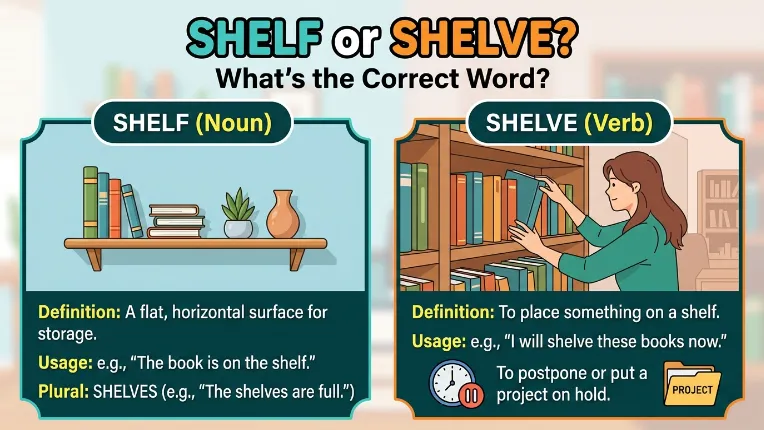
“Shelf” is a noun (a flat surface), while “shelve” is a verb (to put something aside or postpone).
Sara was organizing her room when she told her brother, “I need to shelve these books.” He laughed and replied, “You mean put them on the shelf!” That small moment shows a very common confusion shelf or shelve.
Many people search for this keyword because both words look almost the same. Just one extra letter “e” changes everything. But the real difference is not just spelling it’s grammar and meaning. One is a thing you can touch, and the other is an action you perform.
English learners and even native speakers often mix these up, especially while writing emails, essays, or social media posts. This guide will clear all confusion. You’ll learn the correct usage, differences, and simple tricks to remember them forever.
Shelf or Shelve – Quick Answer
- Shelf = a flat surface used to hold items (noun)
- Shelve = to put something aside or delay (verb)
Examples:
- Put the books on the shelf. ✅
- They decided to shelve the project for now. ✅
👉 Easy rule:
Shelf = thing | Shelve = action
The Origin of Shelf or Shelve
The word shelf comes from Old English “scylfe,” meaning a ledge or flat surface. It was always used to describe something physical like a place to keep objects.
Later, the word shelve developed as a verb form. It originally meant “to place on a shelf.” Over time, its meaning expanded to include putting something aside, delaying, or abandoning a plan.
So:
- Shelf stayed a noun
- Shelve became a verb with broader meanings
This is why both words exist and why they are often confused.
British English vs American English Spelling
Good news there is no spelling difference between British and American English for these words.
Both regions use:
- Shelf (noun)
- Shelve (verb)
Comparison Table
| Function | Word | British English | American English |
| Noun | Shelf | Shelf | Shelf |
| Verb | Shelve | Shelve | Shelve |
Examples:
- UK: Put it on the shelf
- US: They decided to shelve the idea
Which Spelling Should You Use?
This is not about region—it’s about grammar.
Use “Shelf” when:
- You are talking about a physical object
- Example: The book is on the shelf
Use “Shelve” when:
- You are describing an action
- Example: Let’s shelve this discussion
Pro Tip:
If you can add “to” before the word, use shelve
- To shelve the plan ✅
- To shelf the plan ❌
Common Mistakes with Shelf or Shelve
Mistake 1:
❌ I will shelf this idea
✔️ I will shelve this idea
Mistake 2:
❌ Put it on the shelve
✔️ Put it on the shelf
Mistake 3:
❌ They decided to shelf the project
✔️ They decided to shelve the project
Mistake 4:
❌ The shelve is broken
✔️ The shelf is broken
👉 Quick Reminder:
- Shelf = noun
- Shelve = verb
Shelf or Shelve in Everyday Examples
In Emails:
- Please place the files on the shelf
- We may need to shelve this idea
In News:
- The government decided to shelve the policy
- Items were found on a hidden shelf
On Social Media:
- “Finally cleaned my shelf 😍”
- “Time to shelve toxic habits 💪”
In Formal Writing:
- The proposal was shelved due to budget issues
- The documents were stored on a wooden shelf
Shelf or Shelve – Google Trends & Usage Data
Search data shows interesting patterns:
- Shelf is more commonly searched because it’s a daily-use object
- Shelve is often searched in writing or professional contexts
- Both words are equally used worldwide since there is no regional spelling difference
Usage Insight:
- Shelf → common in homes, furniture, daily life
- Shelve → common in business, decisions, and planning
Comparison Table: Shelf vs Shelve
| Feature | Shelf | Shelve |
| Part of Speech | Noun | Verb |
| Meaning | Flat surface for storage | To delay or put aside |
| Usage | Physical object | Action or decision |
| Example | Book on a shelf | Shelve a project |
| Common Error | Used as verb incorrectly | Used as noun incorrectly |
FAQs
1. Is it shelf or shelve?
Both are correct. Shelf is a noun, and shelve is a verb.
2. What does shelve mean?
It means to delay, cancel, or put something aside.
3. Can shelf be used as a verb?
No, standard English uses shelve as the verb.
4. What is a shelf?
A flat surface used to hold items like books or decorations.
5. Why do people confuse shelf and shelve?
They look similar and differ by just one letter, but their meanings are different.
6. Is shelve formal or informal?
It is commonly used in both formal and informal contexts.
7. Which word should I use in writing?
Use shelf for objects and shelve for actions.
Conclusion
The difference between shelf or shelve is simple once you understand their roles. Shelf is something you can see and touch a place where you keep things. Shelve, on the other hand, is an action something you do when you delay or set aside an idea, plan, or task.
This confusion happens because the words look so similar, but their meanings are completely different. Using the wrong one can make your sentence sound unnatural or incorrect, especially in professional writing.
The easiest way to remember is this:
👉 If it’s a thing, use shelf
👉 If it’s an action, use shelve
By keeping this rule in mind, you can avoid common mistakes and improve your English instantly. Whether you’re writing emails, essays, or social media posts, you’ll now use these words with full confidence.

Michael A. Turner is a senior content writer specializing in well-researched, easy-to-understand articles. Helps readers make informed decisions through reliable content.