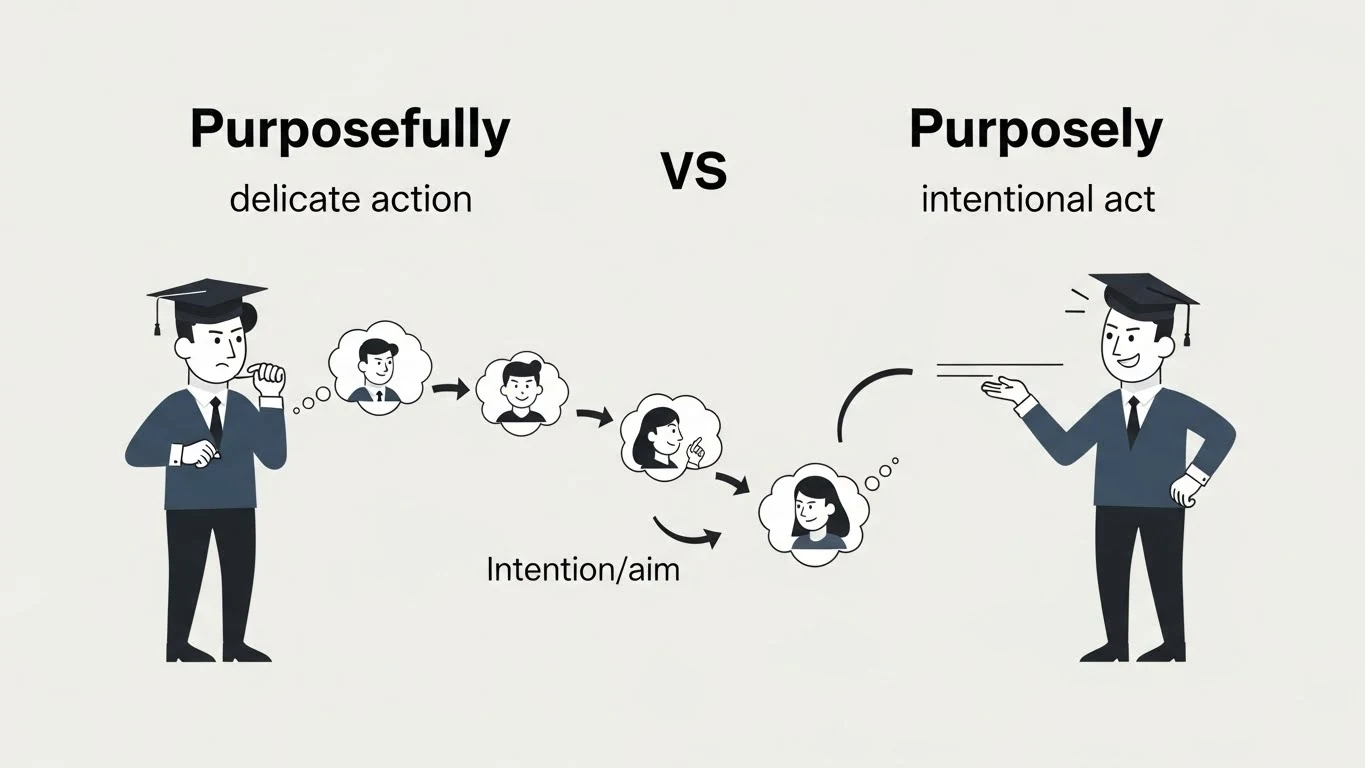
Many people search for “purposefully or purposely” because both words look almost the same. They sound the same. They even appear in similar sentences. This makes writers stop and think: Are these words interchangeable, or do they mean different things?
The confusion is real. Some dictionaries say the words are close in meaning. Others say they are not the same at all. Teachers, editors, and style guides do not always agree. As a result, students, bloggers, and professionals often feel unsure.
This article clears that confusion in a simple way. You will learn the clear meaning of each word. You will see when they overlap and when they do not. You will also learn which word sounds better in formal writing and which one fits everyday speech.
If you want a quick answer, you will get it fast. If you want deeper understanding, examples, and usage advice, this guide gives you that too. By the end, you will use purposefully and purposely with confidence.
Purposefully or Purposely – Quick Answer
- Purposely → done on purpose, not by accident
- Purposefully → done with intention, meaning, or a clear goal
Examples:
- ✅ He broke the glass purposely.
- ✅ She walked purposefully toward the exit.
The Origin of Purposefully or Purposely
Both words come from the noun purpose, from Old French porpos, meaning intention or aim.
- Purposely developed first. It focused on the idea of doing something intentionally.
- Purposefully came later. It added the idea of having a clear goal or sense of direction.
The difference exists because English often creates similar adverbs with slightly different meanings.
British English vs American English Spelling
There is no spelling difference between British and American English.
Both varieties use:
- Purposely
- Purposefully
Comparison Table
| Word | British English | American English |
| purposely | ✔ | ✔ |
| purposefully | ✔ | ✔ |
Which Spelling Should You Use?
Choose based on meaning, not location.
- Use purposely when you mean on purpose
- Use purposefully when you mean with a goal or strong intent
For global audiences:
- Purposely sounds simpler and more direct
- Purposefully sounds more formal and descriptive
Common Mistakes with Purposefully or Purposely
- ❌ He looked purposely confident
✅ He looked purposefully confident - ❌ She ignored the call purposefully
✅ She ignored the call purposely
Tip:
If you can replace the word with “on purpose,” use purposely.
Purposefully or Purposely in Everyday Examples
Emails
- ✅ I did not ignore you purposely.
News
- ✅ The leader spoke purposefully about reform.
Social Media
- ✅ I skipped leg day purposely 😄
Formal Writing
- ✅ The team moved purposefully toward its goals.
Purposefully or Purposely – Google Trends & Usage Data
Search data shows:
- Purposely is more common in casual writing.
- Purposefully appears more in formal and academic texts.
- Searches increase during exam seasons and writing tasks.
Both terms are widely used worldwide.
Comparison Table: Keyword Variations
| Word | Meaning | Tone |
| purposely | on purpose | simple |
| purposefully | with a clear goal | formal |
FAQs
1. Are they interchangeable?
Sometimes, but not always.
2. Which is more formal?
Purposefully.
3. Which means “not by accident”?
Purposely.
4. Can I use purposely in essays?
Yes, if it fits the meaning.
5. Do native speakers mix them up?
Yes, very often.
6. Which is better for exams?
Use the more precise word.
7. Are both grammatically correct?
Yes.
Conclusion
The difference between purposefully or purposely is small but important. Purposely means something was done on purpose. It focuses on intention versus accident. Purposefully goes deeper. It shows direction, meaning, and clear goals.
In casual writing, both words may seem similar. In careful writing, choosing the right one improves clarity. If you mean on purpose, use purposely. If you mean with purpose or intent, use purposefully.
Understanding this difference helps you write with confidence. It also helps you avoid common mistakes that confuse readers. With this simple rule, you will always choose the right word.
Read More:
Sewn or Sewed? The Correct Past Tense Explained Simply
Can or May: Meaning, Rules, and Correct Usage

Daniel R. Foster is an experienced English language writer and editor who specializes in explaining commonly confused words and grammar nuances. With a strong passion for clarity in communication, he creates easy-to-understand comparisons that help learners, students, and professionals use English more confidently. His articles focus on accuracy, real-world examples, and practical usage.