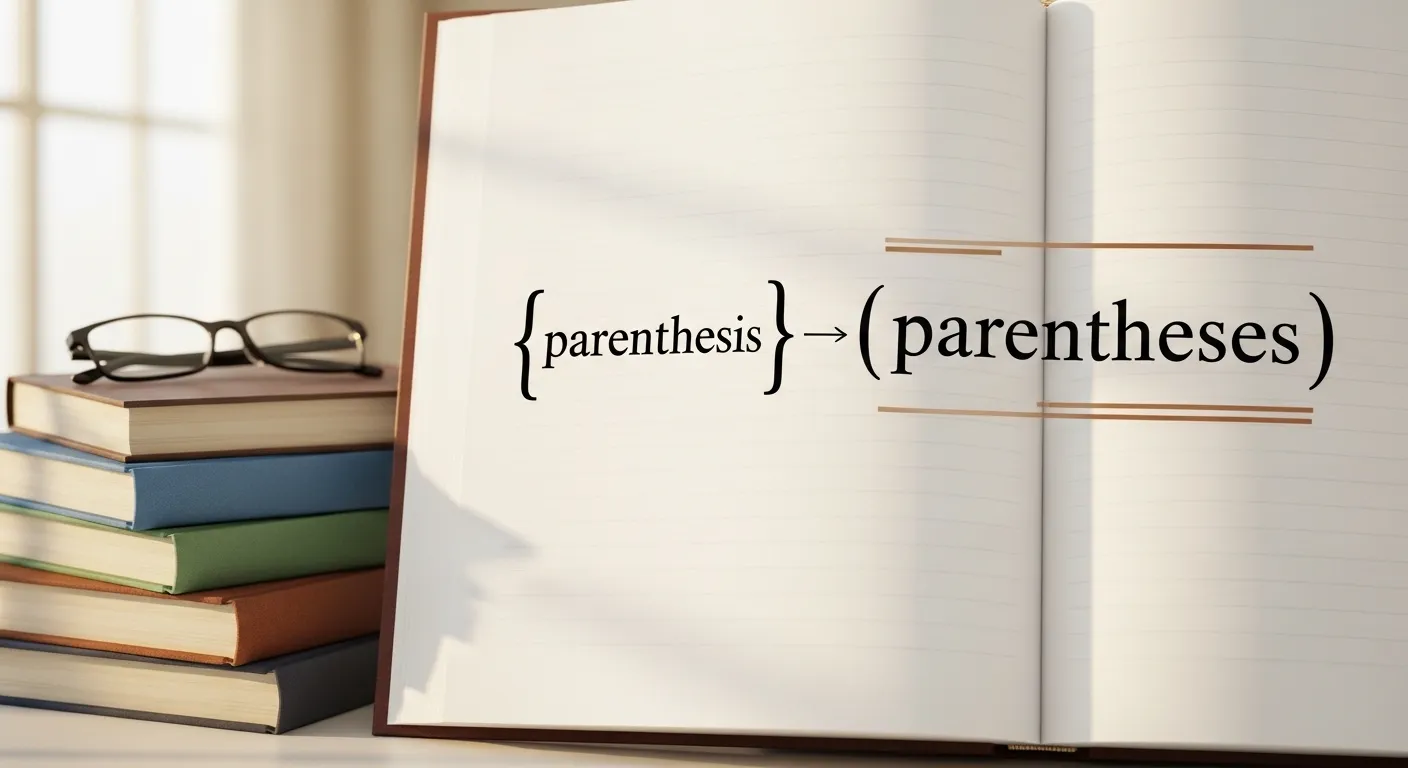
Parenthesis is singular, while parentheses is plural use parenthesis for one bracket and parentheses for two or more.
During a university essay review, a student proudly submitted a research paper. The professor scanned the pages and paused at a note written in the margin: “Check your parenthesis.” The student looked confused. The sentence actually had two brackets around a phrase, not just one.
This small detail highlights why many people search for “parenthesis or parentheses.” The words look nearly identical, yet they serve different grammatical roles. Writers, students, bloggers, and professionals often mix them up because the spelling difference is subtle but important.
Parentheses are one of the most common punctuation tools in English writing. They help add extra information, clarify meaning, and make sentences easier to understand. But when referring to them, the singular and plural forms matter.
This article explains the difference between parenthesis and parentheses, their origin, grammar rules, everyday usage, common mistakes, and global writing trends. By the end, you’ll know exactly when to use each word correctly.
Parenthesis or Parentheses – Quick Answer
The difference is simple.
- Parenthesis → Singular (one bracket)
- Parentheses → Plural (a pair or multiple brackets)
Examples
Singular example:
- The sentence contains one parenthesis.
Plural example:
- The sentence contains two parentheses.
In writing, parentheses usually appear in pairs to enclose additional information.
Example sentence:
- The meeting starts at 10 AM (please arrive early).
Here, the phrase inside the brackets is extra information.
The Origin of Parentheses or Parenthesis
The word parenthesis comes from the Greek word parentithenai, which means “to place beside.” Ancient Greek scholars used this concept when adding extra explanations within sentences.
The term entered Latin and later English during the late Middle Ages. Over time, the punctuation marks “( )” became known as parentheses because they inserted additional thoughts into writing.
English adopted the typical Greek plural form:
- Singular → Parenthesis
- Plural → Parentheses
This pattern is similar to other Greek-origin words in English.
Examples:
- Analysis → Analyses
- Thesis → Theses
- Crisis → Crises
Because the plural ending “-es” changes the pronunciation slightly, many writers accidentally confuse the forms.
British English vs American English Spelling
Unlike many English word pairs, parenthesis and parentheses do not change between British and American English.
Both regions use the same spelling and grammar rules.
Comparison Table
| Form | Type | Usage |
| Parenthesis | Singular | One bracket |
| Parentheses | Plural | Two or more brackets |
Example Sentences
American English:
- The sentence contains a parenthesis.
British English:
- The sentence contains a parenthesis.
Plural form in both regions:
- The sentence contains two parentheses.
This makes the rule simple: the difference is grammatical, not regional.
Which Form Should You Use?
Choosing the correct form depends on whether you are referring to one bracket or multiple brackets.
Use “Parenthesis” When
You are talking about a single bracket.
Example:
- The editor noticed a missing parenthesis in the equation.
Use “Parentheses” When
You are referring to a pair of brackets or several bracketed phrases.
Example:
- The article includes several parentheses for clarification.
In Most Writing
Because parentheses usually appear in pairs, the plural form is more commonly used.
Example:
- Add the reference inside parentheses.
Common Mistakes with Parenthesis or Parentheses
1. Using the Singular for a Pair
Incorrect:
- Add the explanation inside parenthesis.
Correct:
- Add the explanation inside parentheses.
Since brackets usually come in pairs, plural is usually correct.
2. Confusing with Brackets
In American English:
- Parentheses → ( )
- Brackets → [ ]
Example:
- The editor added a note in brackets, not parentheses.
3. Forgetting the Plural Rule
Many writers assume “parenthesis” is the normal form, but parentheses is actually used more often in writing.
4. Misplacing Parentheses in Sentences
Incorrect:
- The meeting starts (at 10 AM.
Correct:
- The meeting starts (at 10 AM).
Both parentheses must appear together.
Parenthesis or Parentheses in Everyday Examples
In Academic Writing
- The formula contains a closing parenthesis.
- The references appear in parentheses.
In Emails
- Please send the report tomorrow (before noon).
In News Articles
- The company reported record profits (up 20% from last year).
In Social Media
- Just finished my workout (finally!).
In each case, parentheses provide extra information that can be removed without changing the main sentence.
Parenthesis or Parentheses – Google Trends & Usage Data
Search data reveals interesting patterns.
Most users search for “parenthesis or parentheses” because they are unsure about the plural form.
Usage patterns show:
- Parentheses appears far more frequently in published writing.
- Parenthesis appears mainly in grammar explanations or when discussing punctuation rules.
Global English usage shows no regional spelling difference, making the rule universal.
Students, bloggers, and content writers are the most common searchers of this keyword because grammar accuracy is essential in formal writing.
Comparison Table: Parenthesis vs Parentheses
| Feature | Parenthesis | Parentheses |
| Form | Singular | Plural |
| Meaning | One bracket | Two or more brackets |
| Pronunciation | /pəˈrenTHəsɪs/ | /pəˈrenTHəˌsiːz/ |
| Grammar Type | Noun | Plural noun |
| Common Usage | Rare | Very common |
This comparison shows that parentheses appears more often in everyday writing.
FAQs
1. What is the difference between parenthesis and parentheses?
Parenthesis is singular, while parentheses is the plural form.
2. Why is the plural “parentheses”?
The word comes from Greek, where nouns ending in “-sis” change to “-ses” in plural form.
3. Do parentheses always appear in pairs?
Yes, they usually appear as a pair to include additional information.
4. Are parentheses the same as brackets?
No. Parentheses use ( ), while brackets use [ ].
5. Is parenthesis used often in writing?
Not very often, because parentheses normally appear as pairs.
6. Can parentheses appear in the middle of a sentence?
Yes. They can appear anywhere in a sentence to add extra information.
7. Are the rules the same in American and British English?
Yes. Both regions use the same grammar rules.
Conclusion
Understanding the difference between parenthesis and parentheses is easier than it first appears. The rule is simple: parenthesis is singular, and parentheses is plural.
In practical writing, parentheses are more commonly used because they appear in pairs to enclose additional information within sentences. These punctuation marks help writers clarify ideas, include side notes, and present extra details without interrupting the main message.
The distinction does not depend on British or American English, making the rule universal across all English-speaking regions. The key is simply recognizing whether you are referring to one bracket or multiple brackets.
Once you remember this singular–plural pattern, using the correct form becomes automatic. Whether you are writing essays, emails, academic papers, or blog posts, mastering this small grammar detail improves clarity and professionalism in your writing.
While or Whilst: What’s the Real Difference? Guide For 2026

I am Oliver Kentwood, an English author fascinated by the quirks of language. I explore correct and incorrect spellings, helping readers navigate common confusions with clarity and style.