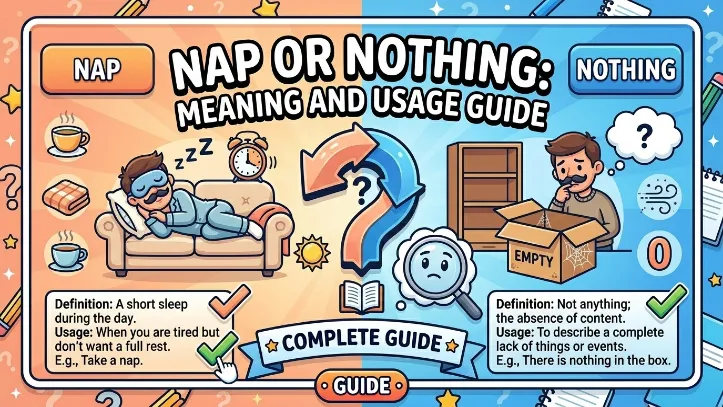
“Nap” means a short sleep, while “nothing” means the absence of anything these words have completely different meanings and are not interchangeable.
Late in the afternoon, a tired employee leans back in the chair and says, “I just need a quick nap before continuing.” At the same moment, a colleague asks if there is any work left to do, and the reply comes: “There’s nothing left for today.”
These two sentences show how different the words nap and nothing really are. One describes a short period of rest, while the other describes the complete absence of something. Yet many people search for “nap or nothing” online because they want to understand whether the words are related or if they can replace one another in sentences.
The confusion usually happens because English learners sometimes encounter both words in casual conversations and assume they might be connected in meaning. In reality, they belong to completely different categories of language.
This article explains the meaning, origin, usage, common mistakes, and real-life examples of nap and nothing. By the end, you will clearly understand when each word should be used and why they should never be confused in writing.
Nap or Nothing – Quick Answer
Here is the simple difference.
| Word | Meaning | Example |
| Nap | A short sleep, usually during the day | I took a quick nap after lunch. |
| Nothing | The absence of anything | There is nothing in the bag. |
Simple Examples
Nap:
- She took a nap after the long meeting.
Nothing:
- I have nothing to add to the discussion.
The two words have completely different meanings and uses.
The Origin of Nap and Nothing
Understanding where these words come from helps explain why their meanings are so different.
Origin of Nap
The word nap comes from the Old English word “hnappian,” which means to doze or sleep lightly. Over time, the spelling simplified to nap, and the meaning became “a short sleep.”
In modern English, the word is commonly used in everyday life, especially when referring to a brief rest during the day.
Examples:
- Afternoon nap
- Power nap
- Quick nap
The concept of taking short daytime naps exists in many cultures around the world.
Origin of Nothing
The word nothing comes from the Old English phrase “nāthing,” which literally meant “not anything.”
It combines two parts:
- No / not
- Thing
Over centuries, the two words merged into the single word nothing, which means the absence of something.
Examples:
- Nothing happened today.
- There is nothing in the room.
This word is widely used in both formal and informal English.
British English vs American English Spelling
Both nap and nothing are spelled the same way in British and American English.
Comparison Table
| Word | US English | UK English | Meaning |
| Nap | ✔ | ✔ | Short sleep |
| Nothing | ✔ | ✔ | Absence of anything |
Unlike some English words that change spelling between regions, these two remain identical worldwide.
Which Word Should You Use?
Choosing between nap and nothing depends entirely on what you want to say.
Use “Nap” When Talking About Sleep
Examples:
- I need a short nap after lunch.
- The baby is taking a nap.
- He had a quick nap during the flight.
A nap is usually short and refreshing.
Use “Nothing” When Talking About Absence
Examples:
- There is nothing in the drawer.
- She said nothing during the meeting.
- I found nothing unusual in the report.
The word expresses emptiness, lack, or absence.
Common Mistakes with Nap and Nothing
Mistake 1: Confusing Meaning
Incorrect:
- I took nothing after lunch.
Correct:
- I took a nap after lunch.
Mistake 2: Using Nap for Absence
Incorrect:
- There is nap in the box.
Correct:
- There is nothing in the box.
Mistake 3: Mixing Context
These words belong to completely different contexts:
- Nap → sleep
- Nothing → absence
Always check the meaning before choosing the word.
Nap and Nothing in Everyday Examples
In Daily Life
Nap:
- I usually take a nap on weekends.
Nothing:
- There is nothing to worry about.
In Parenting
Nap:
- The baby sleeps better after a nap.
Nothing:
- The child said nothing when asked.
In Work Conversations
Nap:
- I had a quick nap during my break.
Nothing:
- There is nothing left to finish today.
In Travel
Nap:
- I took a short nap on the train.
Nothing:
- I bought nothing at the airport shop.
These examples show how each word fits into different situations.
Google Trends & Usage Data
Search patterns show that nap appears frequently in topics related to:
- Health and sleep
- Productivity
- Parenting
Meanwhile, nothing is one of the most common words in the English language. It appears in conversations, books, movies, and news articles.
People search for “nap or nothing” mostly to clarify meanings or grammar differences when learning English.
Overall usage trends show:
- Nap → common in lifestyle and health content
- Nothing → extremely common in everyday communication
Comparison Table: Nap vs Nothing
| Feature | Nap | Nothing |
| Word type | Noun | Pronoun |
| Meaning | Short sleep | Absence of anything |
| Usage context | Rest, sleep | Empty, none |
| Frequency | Moderate | Very common |
| Interchangeable? | No | No |
This table clearly highlights how different the two words are.
FAQs
1. What does “nap” mean?
A nap is a short sleep, usually taken during the day.
2. What does “nothing” mean?
Nothing means the absence of anything.
3. Are nap and nothing related words?
No. They have completely different meanings.
4. Can nap replace nothing in a sentence?
No. Their meanings are unrelated.
5. Is nap used worldwide?
Yes, the word is used in both British and American English.
6. Why do people search “nap or nothing”?
Many English learners want to confirm the difference between the two words.
7. Is “nothing” formal or informal?
It is neutral and can be used in both formal and informal contexts.
Conclusion
Although nap and nothing may appear in everyday conversations, they serve completely different purposes in English. Nap refers to a short sleep that helps restore energy during the day, while nothing describes the absence of anything.
The two words come from different historical roots and belong to different parts of speech. Because of this, they cannot replace each other in sentences. Understanding their meanings helps avoid confusion and improves clarity in both speaking and writing.
Whenever you want to describe resting or sleeping briefly, the correct word is nap. When you want to express emptiness or the absence of something, the correct word is nothing.
Remembering this simple distinction will help you use both words correctly and communicate more effectively in English.
Peel or Peal: What’s the Difference and When to Use Each?

Samantha Harvey is an English language writer specializing in English spelling, grammar, and usage comparisons. She creates clear, search-friendly content that helps readers understand common word confusions with practical examples. Her work focuses on UK and US English differences for learners and online publishers.