Have you ever typed the word misspell and then stopped to question yourself? You’re not alone. Many people hesitate and ask the same thing: Is it misspell or mispell? This confusion is far more common than it should be, partly because the word itself refers to making a spelling mistake. That irony alone causes people to second-guess a word they already know.
Writers, students, bloggers, editors, and professionals care deeply about accuracy. A single spelling error can change how polished or trustworthy writing appears especially in academic papers, official documents, professional emails, or online articles.
When people encounter mispell on social media or informal websites, it further fuels the doubt and makes it seem like both spellings might be acceptable.
However, English spelling follows established rules, not popular mistakes. Only one of these spellings is correct in standard English, and using the wrong one can quietly weaken your writing.
This article removes the confusion completely. You’ll get a clear answer, explore the word’s origin, understand how spelling rules apply, compare British and American usage, and see plenty of real-world examples. By the end, you’ll know the correct spelling with full confidence and never question it again.
More to know about ! Columbian or Colombian? The Correct Spelling Explained Clearly
Misspell or Mispell ; Quick Answer
✅ Misspell is the correct spelling
❌ Mispell is incorrect
There is no flexibility here. English dictionaries, style guides, and grammar experts all agree.
Examples
- I often misspell long technical terms.
- She didn’t mean to misspell your name in the email.
- The signboard misspelled the street name.
The Meaning of Misspell
The verb misspell simply means:
To spell a word incorrectly.
It is commonly used in:
- Education
- Writing and editing
- Proofreading
- Publishing
- Online communication
- Professional documentation
Related word forms include:
- misspells (present tense)
- misspelled / misspelt (past tense)
- misspelling (noun)
Example:
- That typo is a common misspelling in English.
Understanding the meaning helps reduce confusion, because the spelling follows consistent grammatical rules.
The Origin of Misspell or Mispell
The word misspell is made up of two parts:
- mis- → a prefix meaning wrongly or badly
- spell → to write words with correct letters
When combined, they form misspell, meaning to spell wrongly.
Why the Letter “S” Is Doubled
English has a well-established spelling rule:
When the prefix mis- is added to a word that already begins with s, the s is doubled to preserve pronunciation and clarity.
Examples:
- mis + spell → misspell
- mis + spend → misspend
- mis + shape → misshape
- mis + spoken → misspoken
This rule is consistent across standard English.
The spelling mispell ignores this rule entirely. It did not develop historically and has never been recognized as correct. It exists purely because people make repeated spelling mistakes.
Why “Mispell” Looks Right (But Isn’t)
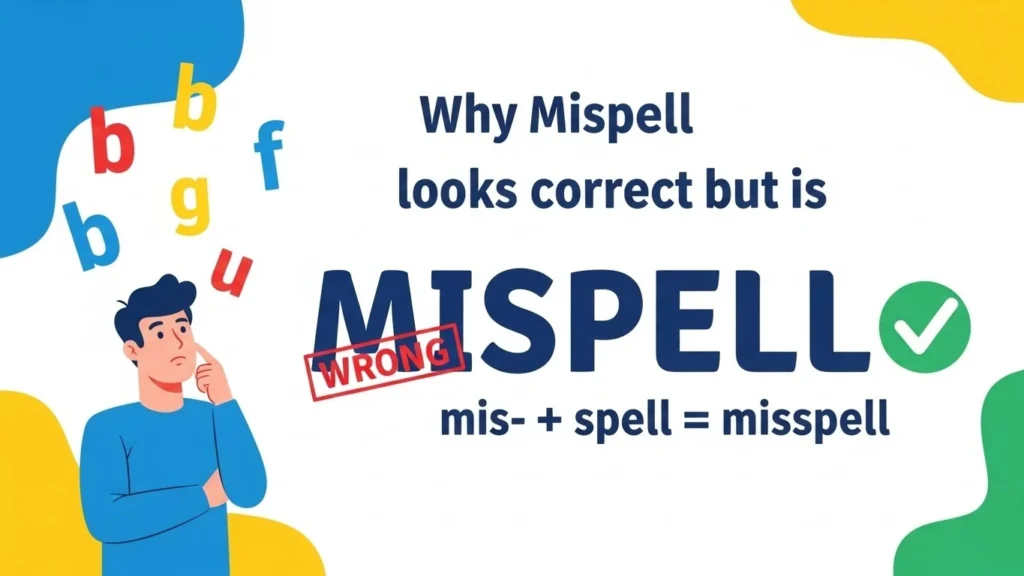
At first glance, mispell can feel logical:
- mis + spell = mispell
But English spelling is not always about simple math-style combinations. Pronunciation, spelling conventions, and historical usage all matter.
People commonly write mispell because:
- They type quickly
- They are unfamiliar with prefix rules
- They have seen the mistake repeated online
- They are ESL learners
- The word’s meaning causes mental hesitation
Despite these reasons, mispell has never been correct.
British English vs American English Spelling
Some spelling debates depend on location, but not this one.
| Feature | British English | American English |
| Correct spelling | Misspell | Misspell |
| Alternative form | ❌ Mispell | ❌ Mispell |
| Pronunciation | Same | Same |
| Formal usage | Identical | Identical |
Unlike words such as colour/color or organise/organize, misspell remains unchanged in both varieties of English.
Which Spelling Should You Use?
Always and only use:
✔️ Misspell
This applies to:
- US English
- UK English
- Academic writing
- Business communication
- SEO articles
- Blogs
- Exams
- Professional documents
There are no exceptions, no stylistic choices, and no informal allowances.
Common Mistakes with Misspell or Mispell
❌ I tend to mispell names.
✅ I tend to misspell names.
❌ She mispelled the address.
✅ She misspelled the address.
❌ Did you mispell that word?
✅ Did you misspell that word?
❌ This is a common mispeling.
✅ This is a common misspelling.
Misspell or Mispell in Everyday Examples
“Sorry, I misspelled your last name.”
News
“The article misspelled the official’s name.”
Social Media
“I always misspell this word!”
Formal Writing
“Errors occur when authors misspell technical terms.”
Misspell vs Similar Words (Pattern Recognition)
Learning this pattern helps avoid future errors.
| Word | Correct | Incorrect |
| misspell | ✅ | ❌ mispell |
| misspend | ✅ | ❌ mispend |
| misshapen | ✅ | ❌ mishapen |
| misspoken | ✅ | ❌ mispoken |
These examples reinforce that double s is a rule, not an accident.
Misspell or Mispell ; Google Trends & Usage Data
Search behavior shows:
- Misspell dominates globally
- Mispell is searched mainly for verification
- Published books and articles overwhelmingly use misspell
- Dictionaries only record mispell as an error
This proves that mispell exists because of confusion, not correctness.
Comparison Table: Misspell vs Mispell
| Feature | Misspell | Mispell |
| Correct spelling | ✅ Yes | ❌ No |
| Found in dictionaries | ✅ Yes | ❌ No |
| Accepted in UK & US | ✅ Yes | ❌ No |
| Professional usage | Standard | Error |
| Common typo | ❌ | ✅ |
FAQs
1. Is mispell ever correct?
No, it is never correct.
2. Why does misspell have double “s”?
Because the prefix mis- combines with spell, doubling the “s.”
3. Is misspell different in British English?
No, the spelling is exactly the same.
4. What is the noun form?
Misspelling
5. Why do people keep writing mispell?
Because the word is ironic and often mistyped.
6. Can spellcheck detect this mistake?
Yes, most spellcheckers flag mispell.
Conclusion
The confusion between misspell or mispell is understandable, but the rule itself is clear and unchanging. Misspell is the only correct spelling in standard English, accepted equally in British and American usage. The form mispell is always incorrect and has never been recognized by dictionaries or grammar authorities.
This confusion exists because English doubles letters when certain prefixes are added, and because the word itself refers to making spelling errors. Once you understand that rule, the spelling becomes easy to remember.Whether you’re writing an email, academic essay, blog post, or business document, always choose misspell. It keeps your writing accurate, professional, and credible. With this explanation, you’ll never need to question this spelling again.

Daniel R. Foster is an experienced English language writer and editor who specializes in explaining commonly confused words and grammar nuances. With a strong passion for clarity in communication, he creates easy-to-understand comparisons that help learners, students, and professionals use English more confidently. His articles focus on accuracy, real-world examples, and practical usage.