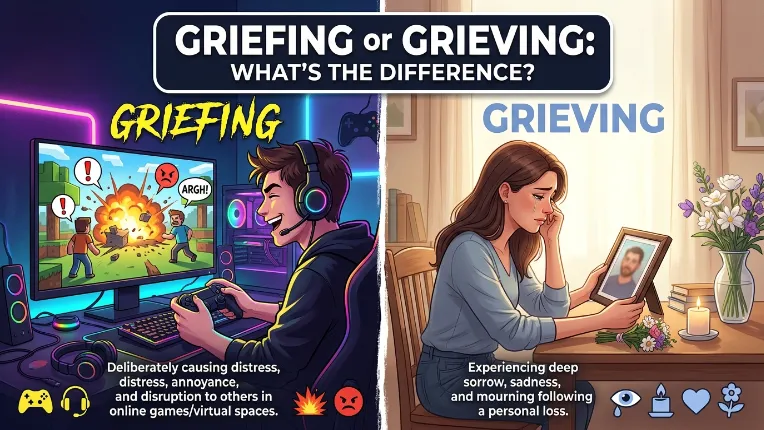
Grieving means feeling deep sadness after a loss, while griefing usually refers to intentionally annoying or harassing others, especially in online games.
Late one night, a gamer complained in an online forum: “Someone kept griefing my character for hours.” A few posts later, another user wrote about losing a loved one and said they were “griefing deeply.” The two sentences looked similar, yet the meanings were completely different.
Words like griefing and grieving often confuse writers because they look nearly identical. The only difference is a single letter, but the meanings belong to two entirely separate contexts. One word relates to emotional pain and loss, while the other is commonly used in gaming communities to describe disruptive behavior.
Many people search for “griefing or grieving” to understand which spelling fits their sentence. Is one incorrect? Is it just a typo? Or do the two words serve different purposes?
This guide explains the meanings, origins, and correct usage of both words. By the end, you will clearly understand when to use grieving and when griefing is the right word.
Griefing or Grieving – Quick Answer
The two words have different meanings.
| Word | Meaning | Example |
| Grieving | Feeling sorrow after loss | She is grieving her father’s death. |
| Griefing | Harassing others in games or online spaces | The player was banned for griefing teammates. |
Examples
- She spent months grieving after losing her pet.
- The moderator removed users who were griefing in the chat.
Even though the words look similar, their meanings belong to different situations.
The Origin of Griefing or Grieving
Origin of Grieving
The word grieving comes from the noun grief, which means deep sorrow or sadness. It originates from the Old French word grief, meaning hardship or suffering.
Over time, English formed the verb grieve, meaning “to feel intense sorrow.” The present participle grieving describes someone experiencing that emotional pain.
Examples from history and literature often use the word to describe mourning.
Origin of Griefing
The word griefing is much newer. It developed in online gaming culture in the late 1990s and early 2000s.
Gamers used the term griefer to describe players who intentionally ruined the experience for others. They might block progress, destroy items, or repeatedly harass teammates.
From this noun came the verb to grief, which means causing frustration or trouble deliberately. The action is called griefing.
So while grieving comes from emotional language, griefing evolved from internet culture.
British English vs American English Spelling
Unlike many English words, griefing and grieving do not change spelling between American and British English.
| Word | American English | British English | Correct? |
| Grieving | ✔ | ✔ | Yes |
| Griefing | ✔ | ✔ | Yes |
Both versions of English use the same spelling. The difference between the words is about meaning, not regional spelling.
Which Spelling Should You Use?
Your choice depends on the context.
Use “Grieving” When Talking About Loss
Choose grieving when referring to sadness after losing someone or something.
Examples:
- She is grieving the loss of her mother.
- The community is grieving after the tragedy.
Use “Griefing” in Gaming or Online Contexts
Choose griefing when discussing disruptive online behavior.
Examples:
- The server banned players for griefing.
- He was accused of griefing in the multiplayer match.
For Professional or Emotional Writing
In news reports, academic writing, or emotional discussions, grieving is far more common.
Common Mistakes with Griefing or Grieving
1. Using the Wrong Word for Sadness
Incorrect: She is griefing her friend’s death.
Correct: She is grieving her friend’s death.
2. Using “Grieving” for Gaming Behavior
Incorrect: The player was grieving the server.
Correct: The player was griefing the server.
3. Assuming One Is a Typo
Many people think griefing is just a misspelling. It is not. It is a real word with a specific meaning in gaming communities.
4. Confusing with “Grief”
The base word grief refers to sorrow. It does not automatically mean online harassment.
Griefing or Grieving in Everyday Examples
In News Reporting
- Families are grieving after the accident.
In Emails
- Our team is grieving the loss of a valued colleague.
On Social Media
- Fans are grieving the death of the famous actor.
In Online Gaming
- The player was removed for griefing teammates.
- Admins monitor servers to prevent griefing.
In Forums
- “Stop griefing the new players,” the moderator warned.
These examples show how context clearly separates the two words.
Google Trends & Usage Data
Search patterns show that grieving is far more common in general language. It appears frequently in:
- News articles
- Books and literature
- Counseling and psychology discussions
- Social media posts about loss
Meanwhile, griefing is most common in:
- Gaming communities
- Online forums
- Technology blogs
- Streaming platforms
Countries with high search interest include:
- United States
- United Kingdom
- Canada
- Australia
- India
The difference in usage reflects the different environments where the words appear.
Comparison Table: Griefing vs Grieving
| Feature | Griefing | Grieving |
| Meaning | Harassing others online | Feeling deep sorrow |
| Context | Gaming, internet culture | Emotional loss |
| Origin | Online gaming slang | Old French / historical English |
| Common Usage | Online communities | Everyday language |
| Tone | Negative behavior | Emotional expression |
FAQs
1. Are griefing and grieving the same word?
No. They look similar but have completely different meanings.
2. Is griefing a real English word?
Yes. It is widely used in gaming and online communities.
3. What does grieving mean?
It means experiencing deep sadness after losing someone or something.
4. Why do gamers use the word griefing?
Because the behavior causes frustration and emotional distress to other players.
5. Can griefing be used outside gaming?
Sometimes it appears in online communities, but it is mainly used in gaming contexts.
6. Which word is more common?
Grieving is much more common in general English.
7. How can I remember the difference?
Think of grieving as emotional sadness and griefing as online misbehavior.
Conclusion
The difference between griefing and grieving may seem small at first glance, but the meanings are completely different. Grieving is an emotional word that describes the deep sadness people feel after losing someone or something important. It has a long history in the English language and appears frequently in news reports, literature, and everyday conversations.
On the other hand, griefing is a modern term born in the world of online gaming. It refers to players who intentionally disrupt or harass others to ruin their experience. Although the word is newer, it has become widely recognized in gaming communities and online platforms.
Understanding this distinction helps you choose the correct word based on context. When writing about loss, sorrow, or mourning, always use grieving. When discussing disruptive behavior in games or online environments, griefing is the accurate choice.
By remembering the context behind each word, you can avoid confusion and communicate more clearly in both emotional and digital conversations.
Tardies or Tardys: Which Spelling Is Correct and When to Use It?

Michael A. Turner is a senior content writer specializing in well-researched, easy-to-understand articles. Helps readers make informed decisions through reliable content.