Introduction
Have you ever written guage and then wondered why it looks wrong or why spellcheck changes it to gage? You’re not alone. The confusion between gage or guage is extremely common, especially in technical writing, engineering, manufacturing, science, and everyday English. The reason is simple: the spelling guage looks logical based on how the word sounds, but English spelling doesn’t always match pronunciation.
People search for gage or guage because they see both forms online. One appears in informal writing, forums, or user comments, while the other appears in dictionaries and professional documents. This makes writers unsure which one is actually correct and safe to use.
This article clears up the confusion once and for all. You’ll get a clear answer, learn where the word comes from, see how British and American English handle it, and understand when (and why) one spelling is preferred. By the end, you’ll confidently know which spelling to use and avoid a very common English mistake.
More about Purposefully or Purposely: Meaning, Usage, and Correct Choice
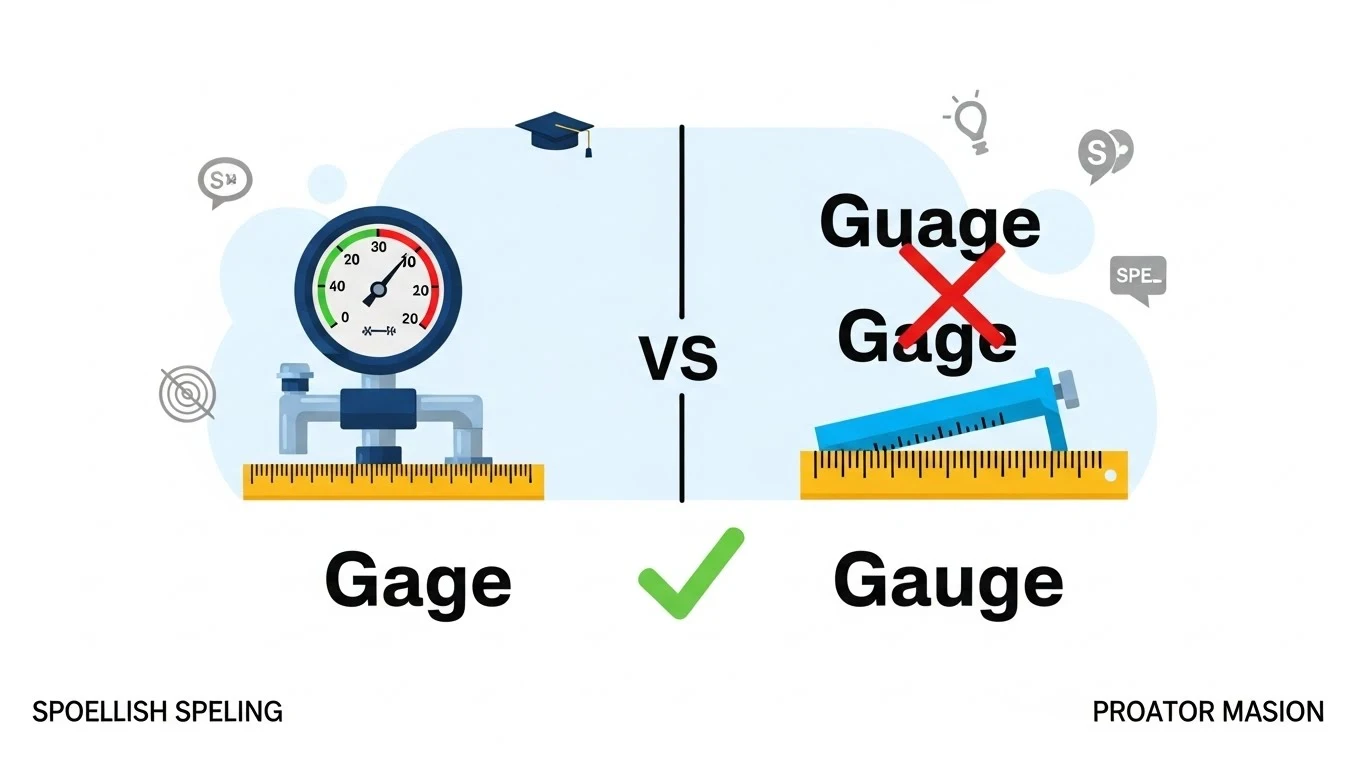
Gage or Guage ; Quick Answer
✅ Gage is the correct spelling.
❌ Guage is incorrect.
Examples:
- Check the pressure gage.
- The fuel gage is low.
The Origin of Gage or Guage
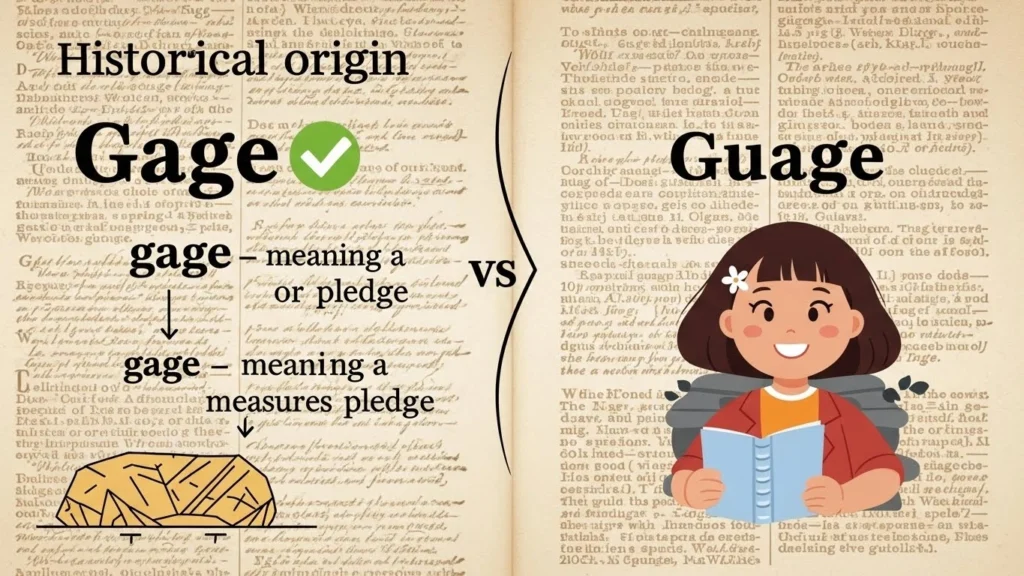
The word gage comes from Old French gage, meaning “a pledge or measuring tool.” Over time, it became a standard English word used to mean “measure” or “measurement device.” The spelling gage has always been the accepted form.
Guage developed later as a misspelling, influenced by how the word is pronounced. Since many English words with a “j” sound include -uage (like language), people assume guage must be right but historically and linguistically, it is not.
Gage vs Gauge: Important Clarification (Very Common Confusion)
Yahan ek bohot important point hai jo aksar log miss kar dete hain:
- ✅ Gage → Correct spelling (especially technical/engineering contexts)
- ✅ Gauge → Also a correct and accepted spelling (more common in general English)
- ❌ Guage → Always incorrect
📌 Example:
- pressure gauge ✅
- strain gage ✅ (technical usage)
- pressure guage ❌
👉 Guage kabhi bhi correct nahi hota, chahe context koi bhi ho.
🔹 Why Do Gage and Gauge Both Exist?
English mein kuch words ke multiple accepted spellings hotay hain because of historical evolution.
- Gage → Older spelling, French origin
- Gauge → Later variant, especially common in British and general English
💡 Isi wajah se:
- Engineering & manufacturing → gage
- Everyday English / UK usage → gauge
Lekin guage history mein kabhi standard nahi raha.
🔹 Technical & Engineering Usage (Critical Section)
Technical fields mein precision ke sath spelling bhi critical hoti hai:
- Strain gage
- Pressure gage
- Thickness gage
- Depth gage
📌 Engineering standards (ASTM, ISO, SAE) zyada tar gage use karti hain.
❗ Guage likhna manuals, specs, ya safety documents mein serious error mana jata hai.
🔹 Dictionaries & Style Guides Verdict
Major authorities kya kehti hain:
| Source | Gage | Gauge | Guage |
|---|---|---|---|
| Oxford | ✅ | ✅ | ❌ |
| Merriam-Webster | ✅ | ✅ | ❌ |
| Cambridge | ✅ | ✅ | ❌ |
| Technical Standards | ✅ Preferred | Acceptable | ❌ |
➡️ Guage sirf typo ke taur par mention hota hai, kabhi correct entry nah
British English vs American English Spelling
There is no difference between British and American English in this case.
| Word | British English | American English |
| Gage | ✅ Correct | ✅ Correct |
| Guage | ❌ Incorrect | ❌ Incorrect |
Which Spelling Should You Use?
Always use gage, regardless of audience.
- US audience: Gage
- UK/Commonwealth: Gage
- Technical or professional writing: Gage
- Global English: Gage
There are no accepted alternatives.
Common Mistakes with Gage or Guage
- ❌ Check the pressure guage
✅ Check the pressure gage - ❌ Fuel guage reading
✅ Fuel gage reading - ❌ Assuming “guage” is British
✅ It’s simply incorrect
Gage or Guage in Everyday Examples
- Email: “Please inspect the pressure gage.”
- News: “The temperature gage showed a rise.”
- Social media: “My fuel gage is broken.”
- Formal writing: “The strain gage was calibrated.”
Gage or Guage ; Google Trends & Usage Data
Search data shows that “guage” appears mainly in spelling-check queries. “Gage” dominates in engineering manuals, scientific papers, automotive documentation, and dictionaries. This confirms that guage is a common typo, not an accepted spelling variant.
Comparison Table: Gage vs Guage
| Feature | Gage | Guage |
| Correct spelling | ✅ Yes | ❌ No |
| Dictionary listed | ✅ Yes | ❌ No |
| Professional use | Standard | Incorrect |
| British/American | Same | Same |
FAQs
1. Is guage ever correct?
No, it is always incorrect.
2. Why do people spell it guage?
Because it looks like it matches pronunciation.
3. Is gauge related to gage?
Yes, gauge is a variant spelling, but guage is not.
4. Should I avoid guage in formal writing?
Yes, always.
5. Do dictionaries accept guage?
No, they list it as a misspelling.
6. Is gage used in technical fields?
Yes, very commonly.
Conclusion
The confusion between gage or guage is understandable, but the correct choice is clear. Gage is the accepted and dictionary-approved spelling in standard English. Guage is simply a misspelling that appears because English pronunciation can be misleading. This is not a regional difference, and it’s not a stylistic choice only one form is correct.
Using gage matters, especially in professional, academic, and technical writing. Misspelling it as guage can reduce credibility and cause your writing to look careless, even when the meaning is obvious. Whether you’re writing an email, a report, or a manual, choosing the correct spelling shows attention to detail.
Remember this simple rule: if you’re measuring something, it’s a gage, not a guage. Once you lock that in, you’ll never make this mistake again.

Miles Thornton is a seasoned author and content specialist with a knack for simplifying complex topics. Passionate about clear, engaging writing, creates articles that inform and inspire readers. With years of experience in digital publishing, Miles combines professionalism with creativity, delivering insightful content for diverse audiences