Few spelling questions confuse English learners and native speakers more than ei or ie.
People search for this keyword because these two letter combinations look similar, sound similar, and appear in many common words.
Think of receive, believe, their, or friend. One small spelling mistake can change how professional your writing looks.
The confusion exists because English spelling is not fully logical. It borrows words from German, French, Latin, and other languages.
Each brought its own spelling habits. Over time, rules formed but with many exceptions. This is why writers still stop and ask: Is it ei or ie here?
This guide solves that problem fast. You’ll get a quick rule, clear examples, and practical advice for everyday writing.
If you’re writing emails, school assignments, blog posts, or business content, this article helps you choose the right spelling with confidence.
By the end, you’ll know when to use ei, when to use ie, and why the rule sometimes breaks.
EI or IE – Quick Answer
The basic rule is simple:
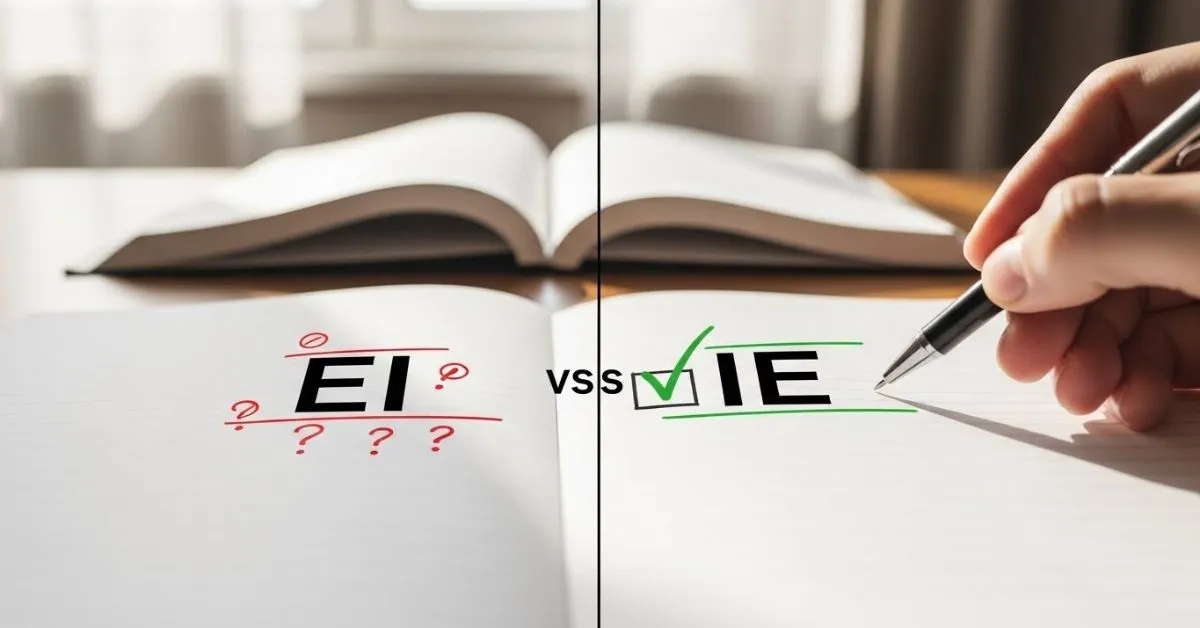
I before E, except after C.
Examples
- ie: believe, friend, piece
- ei (after C): receive, ceiling, deceive
But English loves exceptions:
- their, weird, seize
So while the rule helps, context and familiarity matter.
The Origin of EI or IE
The ei or ie spelling issue comes from English borrowing words from other languages.
- German words often use ei (example: weird).
- French and Latin words influenced ie spellings.
- Middle English writers spelled words many ways before rules existed.
When printing became common, spellings were frozen even if they made little sense. That’s why both forms survived and still cause confusion today.
Discover about:
- Excel or Excell: Which Spelling Is Correct and When to Use It?
- ✅ Occured or Occurred? Correct Spelling Explained
- Barrel or Barrell: Which Spelling Is Correct and When to Use It?
British English vs American English Spelling
Good news: ei or ie spelling is mostly the same in both British and American English.
The difference is not regional, but historical.
Comparison Table
| Word | British English | American English |
| receive | receive | receive |
| believe | believe | believe |
| neighbour | neighbour | neighbor |
| field | field | field |
The spelling rule stays the same. Only surrounding letters or word endings differ.
Which Spelling Should You Use?
Choose based on correct word spelling, not location.
- US audience: Follow standard dictionary spelling.
- UK/Commonwealth: Same rule, same spellings.
- Global audience: Use widely accepted forms (receive, believe).
When unsure, check a dictionary. Never guess.
Common Mistakes with EI or IE
Here are frequent errors writers make:
- ❌ recieve → ✅ receive
- ❌ beleive → ✅ believe
- ❌ freind → ✅ friend
- ❌ thier → ✅ their
Tip: Memorize common exception words.
EI or IE in Everyday Examples
Emails
- I believe we will receive the files today.
News
- The foreign minister addressed the crowd.
Social Media
- That’s a weird photo!
Formal Writing
- The scientific field continues to expand.
EI or IE – Google Trends & Usage Data
Search data shows ei or ie spikes during:
- School exam seasons
- ESL learning periods
- Writing and blogging growth
Top search countries include:
- United States
- United Kingdom
- India
- Philippines
Most searches are educational and spelling-related.
EI or IE Comparison Table
| Pattern | Example | Rule |
| ie | believe | I before E |
| ei after c | receive | Except after C |
| ei exception | their | Rule break |
| ie exception | friend | Rule break |
FAQs
1. Is I before E always correct?
No. Many common exceptions exist.
2. Why does weird break the rule?
It comes from German spelling influence.
3. Is their spelled wrong often?
Yes. It’s one of the most common mistakes.
4. Do British and American English differ here?
No. The rule is the same.
5. Is there an easy way to remember exceptions?
Practice common words and read often.
6. Does pronunciation help?
Sometimes, but not always.
7. Should I rely on spellcheck?
Use it but learn the rules too.
Conclusion:
The ei or ie spelling question is confusing, but manageable. The rule I before E, except after C gives a helpful starting point.
Still, English history created many exceptions that you must learn through use and exposure.
The best approach is balance. Use the rule for quick decisions. Memorize common exceptions like their, weird, and friend.
When writing professionally, always double-check spelling with a dictionary or trusted tool.
For global audiences, standard spellings work everywhere. For learners, patience and practice matter more than perfection. Over time, correct forms become natural.
Spelling may feel small, but it shapes clarity and credibility. Mastering ei or ie helps your writing look polished, confident, and professional every time.

James L. Morrison is a content writer focused on English grammar, word meanings, and usage differences. He enjoys breaking down complex language rules into simple explanations. His work is designed to help readers quickly understand the correct word choice in everyday writing and professional communication.