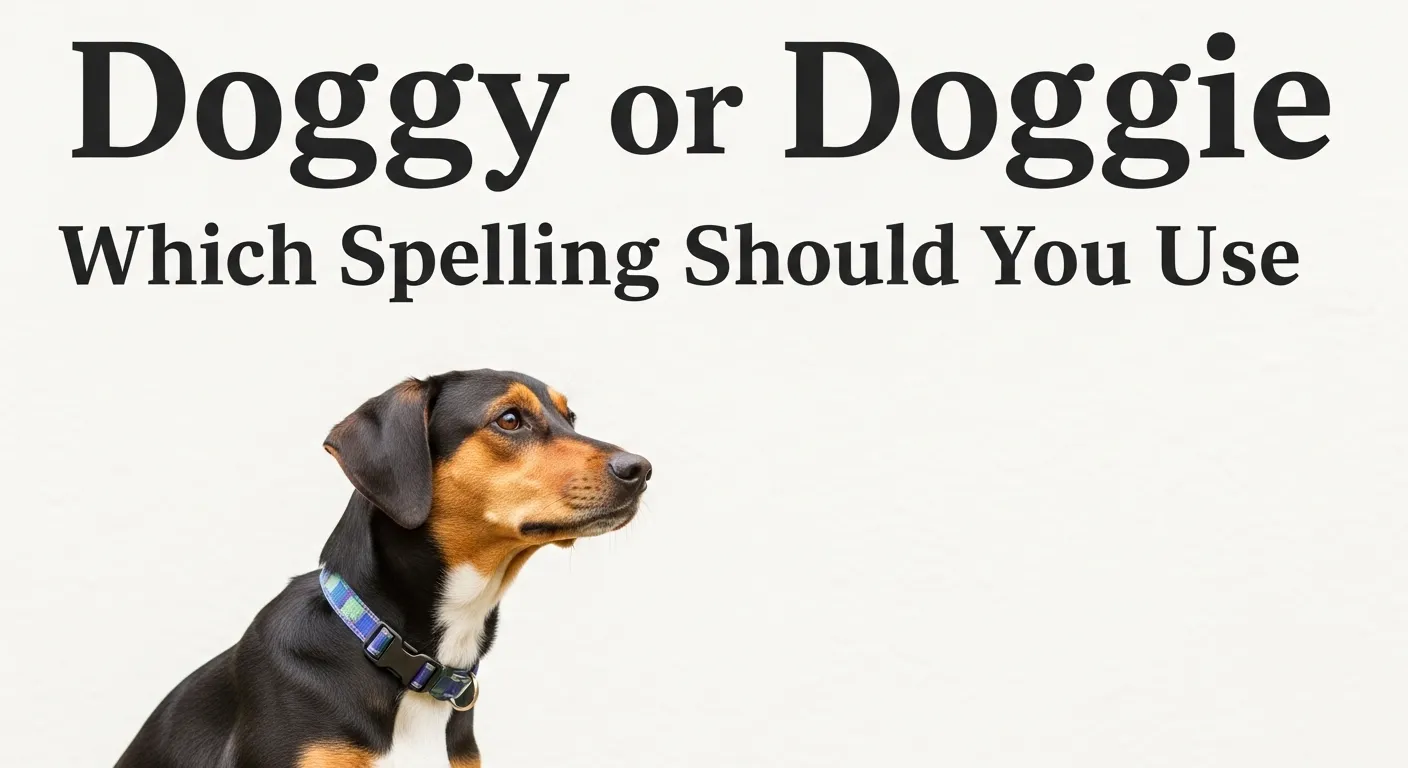
Both “doggy” and “doggie” are correct; “doggy” is more common, while “doggie” feels cuter and informal.
You’re texting a friend a cute photo of your pet and type, “Look at this little doggie!” Then you pause should it be doggy instead? This small spelling choice confuses many people because both versions look right and sound exactly the same.
People search for “doggy or doggie” because English often allows multiple spellings for informal words, especially when expressing affection. Unlike strict grammar rules, these variations depend on tone, audience, and personal style. That’s why both spellings appear online, in books, and even in marketing.
The confusion isn’t about right or wrong—it’s about which one fits better in your situation. In this guide, you’ll learn the difference, origin, usage, and when to choose each spelling. By the end, you’ll confidently pick the best option for any context.
Doggy or Doggie – Quick Answer
Both doggy and doggie are correct.
They both mean a small or cute dog, often used in a friendly or playful tone.
Examples:
- The doggy is sleeping.
- That doggie looks adorable.
👉 Simple rule:
Use doggy for general use.
Use doggie for a softer, cuter tone.
The Origin of Doggy or Doggie
Both words come from the base word “dog.” English often adds endings like -y or -ie to create affectionate forms (called diminutives).
- Dog + y → Doggy
- Dog + ie → Doggie
These forms developed naturally in spoken English, especially when talking to children or pets. Over time, both spellings became accepted.
👉 Key idea:
Both forms express affection, not difference in meaning.
British English vs American English Spelling
There is no strict rule, but usage patterns differ slightly.
| Feature | Doggy | Doggie |
| Common in US | Very common | Common |
| Common in UK | More common | Less common |
| Tone | Neutral/casual | Cute/childlike |
| Formal Writing | Rare | Rare |
👉 Key point:
“Doggy” is more widely used overall.
Which Spelling Should You Use?
Your choice depends on tone and audience.
Use “Doggy” when:
- Writing casually
- Talking to adults
- Keeping it simple
👉 Example: My doggy loves to play outside.
Use “Doggie” when:
- Talking to children
- Writing in a cute or playful tone
- Expressing affection
👉 Example: Look at the cute doggie!
Audience-Based Advice:
- US audience: Both are fine
- UK/Commonwealth: Prefer “doggy”
- Global writing: “Doggy” is safer
👉 Tip: For SEO and general writing, doggy is more common.
Common Mistakes with Doggy or Doggie
❌ Mistake:
Thinking one is wrong
✔ Fix:
Both are correct
❌ Mistake:
Using in formal writing
✔ Fix:
Use “dog” instead in formal contexts
❌ Mistake:
Overusing in professional content
✔ Fix:
Keep it casual only
👉 Tip:
Use these words mainly in informal situations.
Doggy or Doggie in Everyday Examples
Emails:
- I adopted a new doggy yesterday.
Social Media:
- This doggie is so cute 🐶
Conversations:
- Your doggy is very friendly.
Formal Writing:
- ❌ Avoid: The doggy is a mammal
✔ Use: The dog is a mammal
👉 Both words are common in daily speech.
Doggy or Doggie – Google Trends & Usage Data
Search data shows:
- Doggy is searched more often globally
- Doggie appears in cute or child-focused content
Popularity by Region:
- US: Both popular
- UK: Doggy preferred
- India & Pakistan: Doggy more common
Usage Context:
| Context | Doggy | Doggie |
| Social Media | High | High |
| Kids Content | Medium | High |
| Formal Writing | Low | Low |
| SEO Searches | Higher | Lower |
👉 Insight:
“Doggy” has broader usage.
Comparison Table: Doggy vs Doggie
| Feature | Doggy | Doggie |
| Meaning | Cute dog | Cute dog |
| Correct Word | Yes | Yes |
| Usage Frequency | Higher | Slightly lower |
| Tone | Casual | Cute/soft |
| Best For | General use | Kids & playful tone |
FAQs
1. Is “doggy” correct?
Yes, it is a common and accepted spelling.
2. Is “doggie” also correct?
Yes, both spellings are correct.
3. Which is more common?
“Doggy” is more widely used.
4. Is there a meaning difference?
No, both mean a small or cute dog.
5. Which is better for formal writing?
Neither—use “dog” instead.
6. Is this a US vs UK issue?
Not strictly, but “doggy” is more common in the UK.
7. Which should I use for SEO?
“Doggy” is usually better due to higher search volume.
Conclusion
The choice between doggy and doggie is not about correctness but about tone and preference. Both spellings are valid and widely used to describe a cute or small dog in a friendly way. However, doggy stands out as the more common and widely accepted form, especially in general writing and global usage.
On the other hand, doggie adds a softer, more affectionate feel, making it perfect for conversations with children or playful content. The key is to match your word choice with your audience and purpose.
In formal situations, it’s always better to use “dog” instead of either variation. But in everyday communication, both options work perfectly well. Once you understand this, choosing between them becomes easy and natural.

Miles Thornton is a seasoned author and content specialist with a knack for simplifying complex topics. Passionate about clear, engaging writing, creates articles that inform and inspire readers. With years of experience in digital publishing, Miles combines professionalism with creativity, delivering insightful content for diverse audiences