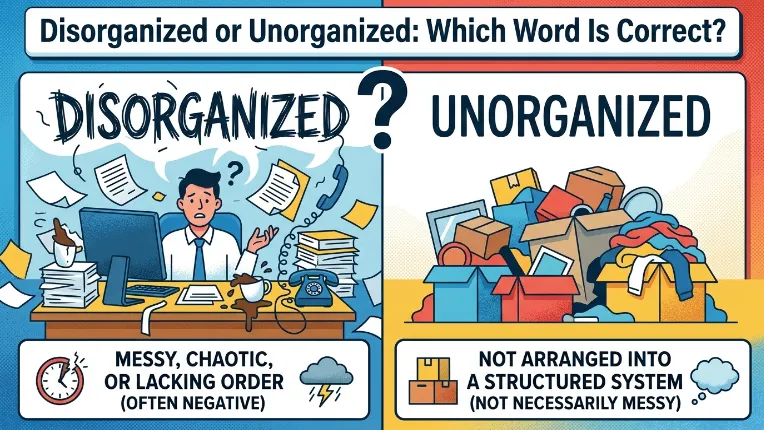
Both disorganized and unorganized are correct, but disorganized usually describes confusion or disorder, while unorganized means something has not been arranged or structured yet.
On Monday morning, Ahmed opened his email inbox and sighed. Messages were scattered everywhere. Some were unread, others half-replied, and important files were missing. His coworker laughed and said, “Your inbox looks completely disorganized.”
Later that day, Ahmed created a new folder for a project but hadn’t sorted the files yet. A colleague looked at it and said, “This folder is still unorganized.”
At first glance, these two words seem identical. Many writers, students, and professionals search online to understand the difference between disorganized and unorganized. The confusion happens because both words suggest a lack of order, yet they are used in slightly different situations.
Understanding the difference can improve writing clarity. Whether you are writing an email, a report, or a social media post, choosing the right word makes your message stronger. This guide explains the meaning, origin, spelling patterns, and real-world usage of disorganized and unorganized so you can confidently use the correct word every time.
Disorganized or Unorganized – Quick Answer
Both words describe a lack of order, but they are used differently.
Disorganized usually means something was organized before but became messy, chaotic, or confused.
Example:
- His desk is disorganized, with papers everywhere.
- The meeting became disorganized after the manager left.
Unorganized means something has not been arranged or structured yet.
Example:
- The files are still unorganized.
- The event planning is unorganized so far.
Quick Comparison
| Word | Meaning | Example |
| Disorganized | Messy, chaotic, or poorly arranged | Her schedule is disorganized |
| Unorganized | Not arranged yet | The documents remain unorganized |
In simple terms, disorganized suggests disorder, while unorganized suggests lack of organization from the start.
The Origin of Disorganized or Unorganized
Both words come from the base word organize, which comes from the Greek word organon, meaning tool or instrument. Over time, it evolved into the idea of arranging things in a structured way.
English later added prefixes to change the meaning.
The prefix dis- means opposite of or removal of something. When attached to organize, it forms disorganized, meaning the organized structure has broken down.
Example idea:
- Organized → Structured
- Disorganized → Structure lost
The prefix un- means not. So unorganized simply means something is not organized yet.
Example idea:
- Organized → Arranged
- Unorganized → Not arranged
Because both prefixes express a lack of order, the meanings overlap. However, the subtle difference helps writers describe situations more precisely.
British English vs American English Spelling
Unlike many English words, disorganized and unorganized do not change spelling between British and American English.
However, spelling differences often appear in related words, especially those ending in -ize or -ise.
American English strongly prefers -ize, while British English allows both forms.
Example Comparison
| American English | British English | Example |
| organize | organise | organize a meeting |
| organization | organisation | company organization |
| disorganized | disorganised | disorganized room |
Even though British English often uses -ise, the -ize spelling is still accepted in many British publications.
So both spellings may appear depending on the style guide.
Which Spelling Should You Use?
Choosing between disorganized and unorganized depends mostly on the meaning you want to express.
Use disorganized when:
- Something is messy or chaotic
- A system has broken down
- People or plans are confused
Example:
- The project became disorganized after the deadline changed.
Use unorganized when:
- Something has not been arranged yet
- Work is still in progress
- No system exists yet
Example:
- The research notes remain unorganized.
Audience-Based Advice
| Audience | Best Choice |
| American readers | Disorganized / Unorganized |
| British readers | Disorganised / Unorganised |
| Global audience | Disorganized is more common |
In modern writing, disorganized appears far more often, especially in professional and academic contexts.
Common Mistakes with Disorganized or Unorganized
Many writers confuse these words or use them interchangeably.
Here are common mistakes.
Mistake 1: Using Unorganized for Chaos
Incorrect:
- The office became unorganized during the meeting.
Correct:
- The office became disorganized during the meeting.
Reason: The office already had structure before it became messy.
Mistake 2: Using Disorganized for Something Not Started
Incorrect:
- My files are disorganized because I have not arranged them yet.
Better:
- My files are unorganized because I have not arranged them yet.
Mistake 3: Spelling Confusion
Incorrect:
- disorganised (in American writing)
Correct:
- disorganized
Always match spelling to your audience or style guide.
Disorganized or Unorganized in Everyday Examples
These words appear in many daily situations.
Email Example
“Sorry for the delay. My inbox was disorganized after the system update.”
Workplace Example
“Our documents are still unorganized, so the team will sort them tomorrow.”
News Example
“The emergency response became disorganized during the storm.”
Social Media Example
“My desk is so disorganized today 😅”
Academic Writing Example
“The research notes remained unorganized until the final review stage.”
These examples show how context decides the best word choice.
Disorganized or Unorganized – Google Trends & Usage Data
Search data shows that disorganized is used more frequently than unorganized.
Several reasons explain this trend:
- Disorganized describes visible chaos, which people talk about often.
- News reports frequently describe disorganized responses during crises.
- Productivity discussions commonly use the term disorganized workspace.
Popular Usage by Country
| Country | Most Used Word |
| United States | Disorganized |
| United Kingdom | Disorganised |
| Canada | Disorganized |
| Australia | Disorganised |
Unorganized appears less often because it describes an early stage rather than a visible problem.
Comparison Table: Disorganized vs Unorganized
| Feature | Disorganized | Unorganized |
| Meaning | Messy or chaotic | Not arranged yet |
| Prefix | dis- (reverse/broken) | un- (not) |
| Usage frequency | Very common | Less common |
| Example | Disorganized meeting | Unorganized files |
| Context | Disorder after structure | Structure not created |
This comparison helps writers quickly decide which word fits best.
FAQs
1. Is disorganized or unorganized correct?
Both words are correct. Disorganized describes chaos, while unorganized means something has not been arranged yet.
2. Which word is more common?
Disorganized is more widely used in everyday speech, writing, and online searches.
3. Are disorganized and unorganized synonyms?
They are similar but not identical. Disorganized implies disorder, while unorganized implies lack of structure from the start.
4. Is unorganized wrong in English?
No. Unorganized is grammatically correct, but it is used less often.
5. What is the British spelling of disorganized?
British English often spells it disorganised with -ise instead of -ize.
6. Can both words appear in professional writing?
Yes. Both appear in professional writing, but disorganized is more common in reports and analysis.
7. Which word should students use in essays?
Students usually prefer disorganized, because it clearly describes confusion or lack of structure.
Conclusion
The difference between disorganized and unorganized may seem small, but understanding it improves clarity in writing. Both words come from the same root word, organize, yet their prefixes create slightly different meanings.
Disorganized describes a situation where order has broken down. A messy desk, a chaotic meeting, or a confusing plan can all be called disorganized. This word is widely used in daily conversation, news reporting, and professional writing.
Unorganized, on the other hand, refers to something that has not been arranged yet. Files waiting to be sorted, early project notes, or unfinished plans can all be described as unorganized.
In most modern contexts, disorganized is the more common and natural choice, especially when describing visible disorder. However, unorganized remains correct when you want to show that something simply has not been structured yet.
By choosing the right word, writers can express ideas more clearly and avoid confusion. Whether you are writing emails, reports, or social media posts, understanding this subtle difference will help your communication sound more precise and professional.
Waisted vs Wasted: What’s the Real Difference?

Michael A. Turner is a senior content writer specializing in well-researched, easy-to-understand articles. Helps readers make informed decisions through reliable content.