If you’ve ever written about coffee, culture, travel, history, or international affairs and paused at columbian or colombian, you’re not alone. This confusion is one of the most common and most costly spelling mistakes in English writing.
Both words look nearly identical, sound very similar when spoken, and appear in respected academic, historical, and cultural texts. But despite their visual similarity, they are not interchangeable and do not mean the same thing.
People search for columbian or colombian because this mistake is everywhere. You’ll see “Columbian coffee” on menus, blogs, and even advertisements, despite it being incorrect. The error often comes from a lack of clarity about geography versus history.
One word relates to a modern country in South America, while the other connects to a historical figure and the institutions named after him.
Using the wrong term doesn’t just look careless, it can change the meaning of your sentence. In academic writing, journalism, marketing, and educational content, this error can seriously affect credibility.
This article breaks down the difference clearly and permanently. You’ll learn definitions, origins, usage rules, real examples, common mistakes, and memory tricks so you never confuse Columbian and Colombian again.
More about Volumn or Volume: Which Spelling Is Correct?
Columbian or Colombian ; Quick Answer
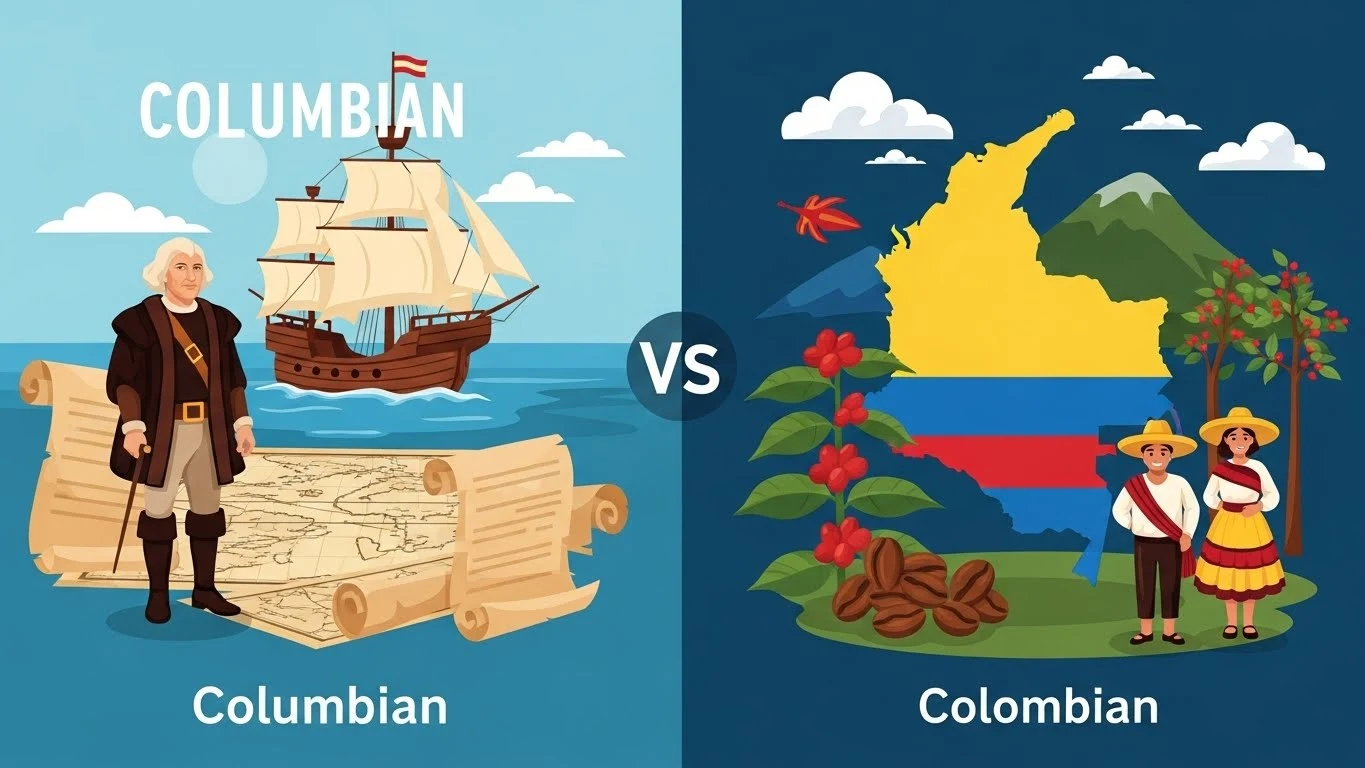
These two words are not spelling variations of the same term. They are different words with different meanings.
✅ Colombian
Refers to Colombia, the country, its people, culture, food, products, and language.
✅ Columbian
Refers to Christopher Columbus, historical eras, concepts, or institutions named after him.
❌ They cannot be used interchangeably.
Examples:
- Colombian coffee is exported worldwide. ✅
- The Columbian Exchange reshaped global history. ✅
Understanding the Core Difference (Meaning vs Spelling)
Unlike many English confusions (such as honour/honor or counsellor/counselor), this is not a British vs American spelling issue. The difference is purely about meaning.
- If your subject is modern Colombia, use Colombian
- If your subject is historical Columbus or institutions named after him, use Columbian
This rule applies everywhere in British English, American English, academic writing, journalism, and casual speech.
The Origin of Columbian or Colombian
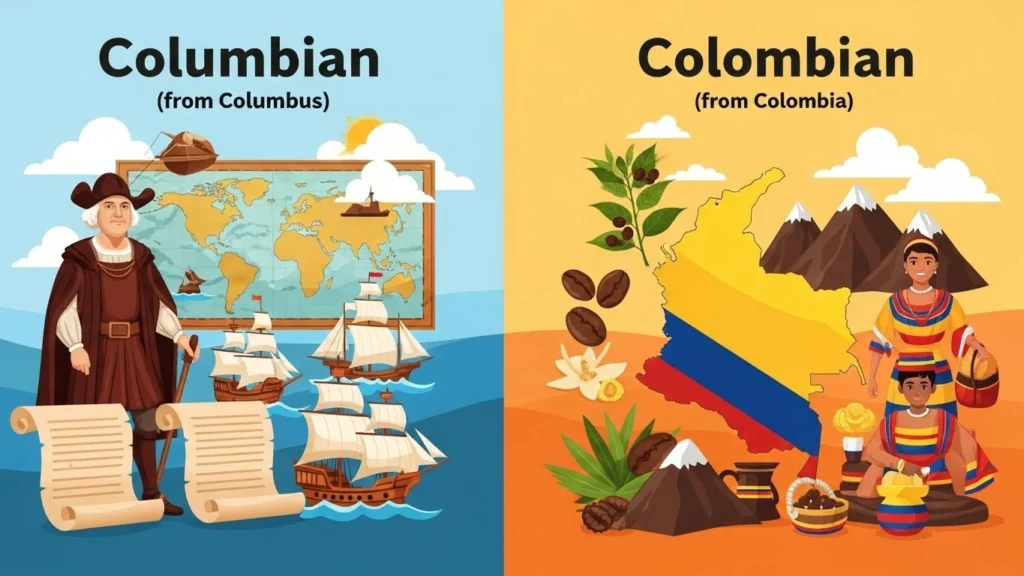
Origin of Colombian
The word Colombian comes from Colombia, the South American country named after Christopher Columbus (Cristóbal Colón in Spanish). The country gained independence in the early 19th century, and the adjective Colombian became standard to describe:
- People from Colombia
- Culture, cuisine, music, and traditions
- Products such as coffee, textiles, and exports
- Geography, politics, and national identity
Despite sharing a root with Columbus, Colombian specifically refers to the modern nation-state.
Origin of Columbian
Columbian comes directly from the name Columbus. It is traditionally used to describe:
- Historical concepts linked to Columbus’s voyages
- Eras or exchanges resulting from European exploration
- Institutions and places named in his honor
Common historical uses include:
- The Columbian Exchange
- The Columbian era
- The District of Columbia
The confusion exists because both words share the same historical root but they evolved into different meanings, not different spellings of one word.
British English vs American English Spelling
There is no regional spelling difference in this case.
| Context | Correct Word |
| Country of Colombia | Colombian |
| Coffee, culture, people | Colombian |
| Historical periods | Columbian |
| Named institutions | Columbian |
British English and American English both follow the same rule.
Which Spelling Should You Use? (The One-Question Rule)
Ask yourself this single question:
Am I referring to the country of Colombia?
- ✅ Yes → Colombian
- ❌ No → Columbian (history, institutions, Columbus-related terms)
This rule works 100% of the time.
Columbian vs Colombian in Real-World Contexts
1. Coffee & Food
- ❌ Columbian coffee
- ✅ Colombian coffee
Coffee always refers to Colombia, never Columbus.
2. People & Nationality
- ❌ Columbian people
- ✅ Colombian people
Nationality always uses Colombian.
3. History & Academia
- ❌ Colombian Exchange
- ✅ Columbian Exchange
This refers to the global exchange after Columbus’s voyages.
4. Institutions & Place Names
- District of Columbia
- Columbia University
- British Columbia
These are Columbian, not Colombian.
Common Mistakes with Columbian or Colombian
❌ Mistake 1: Columbian coffee
✔ Correct: Colombian coffee
❌ Mistake 2: Colombian Exchange
✔ Correct: Columbian Exchange
❌ Mistake 3: Columbian culture (from Colombia)
✔ Correct: Colombian culture
These errors are extremely common online but always incorrect.
Columbian or Colombian in Everyday Examples
- Email: “We import premium Colombian beans.”
- News: “The Columbian Exchange transformed agriculture.”
- Social Media: “Colombian music is amazing!”
- Academic Writing: “The Columbian era began in 1492.”
Columbian or Colombian ; Google Trends & Usage Data
Search data shows Colombian dominating worldwide due to frequent references to:
- Coffee
- Travel
- Culture
- Immigration
- Sports
Columbian, on the other hand, appears mostly in:
- Academic history searches
- Educational content
- Institutional names
Importantly, many searches for columbian coffee are actually people checking spelling mistakes, not correct usage. This highlights how widespread the confusion is.
Comparison Table: Columbian vs Colombian
| Feature | Columbian | Colombian |
| Refers to Colombia | ❌ No | ✅ Yes |
| Refers to Columbus | ✅ Yes | ❌ No |
| Coffee usage | ❌ Incorrect | ✅ Correct |
| Historical usage | ✅ Yes | ❌ No |
| Global frequency | Low | Very high |
Memory Tricks to Avoid Confusion
- ColomBIA → Colombian (think of the country’s name)
- ColumBUS → Columbian (think of Columbus)
- Coffee = Country = Colombian
- History = Columbus = Columbian
FAQs
1. Is Columbian coffee ever correct?
No. It is always Colombian coffee.
2. Why do people make this mistake so often?
Because the words look similar and share a historical root.
3. Is this a British vs American difference?
No. The rule is global.
4. Can Columbian refer to people?
No. People from Colombia are always Colombian.
5. Which word is more common online?
Colombian, due to cultural and commercial use.
6. Does pronunciation differ?
Slightly, but not enough to avoid spelling confusion.
Conclusion
The difference between columbian or colombian is not stylistic, regional, or optional it is entirely about meaning. Colombian always relates to the country of Colombia: its people, culture, coffee, and products. Columbian refers to Christopher Columbus, historical concepts, and institutions named after him.
Once you understand this distinction, the confusion disappears. If your topic is modern, cultural, geographic, or national, Colombian is the correct choice. If your topic is historical or institutional, Columbian is the right word.
Using the correct spelling strengthens your writing, protects your credibility, and ensures your message is accurate. With this rule in mind, you’ll never mix them up again.

Miles Thornton is a seasoned author and content specialist with a knack for simplifying complex topics. Passionate about clear, engaging writing, creates articles that inform and inspire readers. With years of experience in digital publishing, Miles combines professionalism with creativity, delivering insightful content for diverse audiences