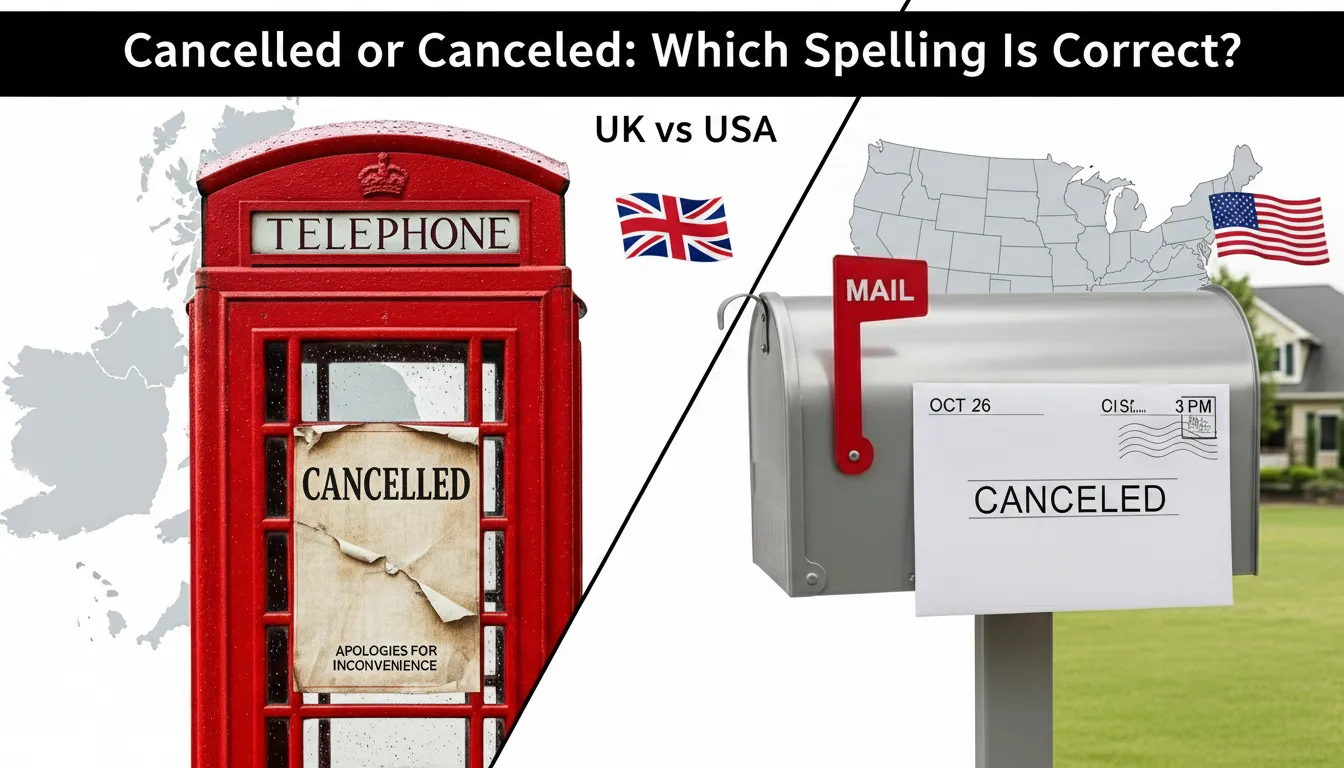
✅ Cancelled is British English, while canceled is American English both are correct depending on your audience.
Many people search for “cancelled or canceled” because both spellings appear correct, yet only one fits each regional standard. This creates confusion in emails, exams, blogs, and professional writing. If you use the wrong spelling, your content may look inconsistent or unpolished, especially for international readers.
The confusion exists because English follows different spelling rules in British and American varieties. Some verbs double the final “L” in British English but not in American English. Knowing which spelling to use helps you write with confidence and accuracy.
In this article, you’ll get a quick answer, learn the origin of the word, understand British vs American spelling rules, avoid common mistakes, and see real-life examples. By the end, you’ll clearly know when to use cancelled and when to use canceled.
Cancelled or Canceled – Quick Answer
✅ Cancelled – Correct in British English
✅ Canceled – Correct in American English
Examples:
- The flight was cancelled due to bad weather. (UK)
- The meeting was canceled this morning. (US)
Both are correct. The difference is regional, not grammatical.
The Origin of Cancelled and Canceled
The word cancel comes from the Latin cancellare, meaning to cross out. As English evolved, spelling rules changed across regions.
British English generally doubles the final “L” when adding suffixes like -ed or -ing. American English simplifies spelling and often uses one “L”.
This is why both spellings exist today.
British English vs American English Spelling
| Form | British English | American English |
| Cancelled | ✅ Correct | ❌ Not preferred |
| Canceled | ❌ Not preferred | ✅ Correct |
| Cancelling | ✅ Correct | ❌ Not preferred |
| Canceling | ❌ Not preferred | ✅ Correct |
Which Spelling Should You Use?
- Use cancelled if your audience is:
- UK
- Australia
- Canada
- Commonwealth countries
- Use canceled if your audience is:
- United States
- American-based platforms or exams
SEO tip: Stay consistent across your content.
Common Mistakes with Cancelled or Canceled
❌ The event was canceled. (UK audience)
✅ The event was cancelled.
❌ The show was cancelled. (US audience)
✅ The show was canceled.
Rule: Match spelling to your audience.
Cancelled or Canceled in Everyday Examples
Emails:
- Your appointment has been cancelled. (UK)
- Your appointment has been canceled. (US)
News:
- The match was cancelled due to rain.
- The flight was canceled unexpectedly.
Social Media:
- Plans cancelled 😢
- Trip canceled last minute!
Formal Writing:
- The contract was cancelled/canceled by mutual agreement.
Comparison Table: Cancelled vs Canceled
| Spelling | Correct Region | Example |
| Cancelled | British English | The class was cancelled today. |
| Canceled | American English | The class was canceled today. |
FAQs: Cancelled or Canceled
1. Are both spellings correct?
Yes, both are correct in different regions.
2. Which spelling should I use in exams?
Follow your exam board’s regional standard.
3. Is cancelling also different?
Yes. Cancelling (UK), canceling (US).
4. Is one more professional than the other?
No. Correct usage depends on audience.
5. Can I mix both spellings in one article?
No. Always stay consistent.
6. Which spelling is better for global audiences?
Choose one standard and apply it consistently.
Conclusion
The confusion between cancelled or canceled comes from regional spelling rules, not from incorrect grammar. Cancelled follows British English rules, while canceled follows American English rules. Both are correct when used for the right audience.
The key to professional writing is consistency. Decide your target audience first, then use the spelling that matches their expectations. Once you do that, your writing will look clear, correct, and polished every time.
Emphasize or Emphasise: Which Spelling Is Correct UK vs USA

James L. Morrison is a content writer focused on English grammar, word meanings, and usage differences. He enjoys breaking down complex language rules into simple explanations. His work is designed to help readers quickly understand the correct word choice in everyday writing and professional communication.