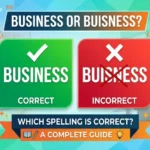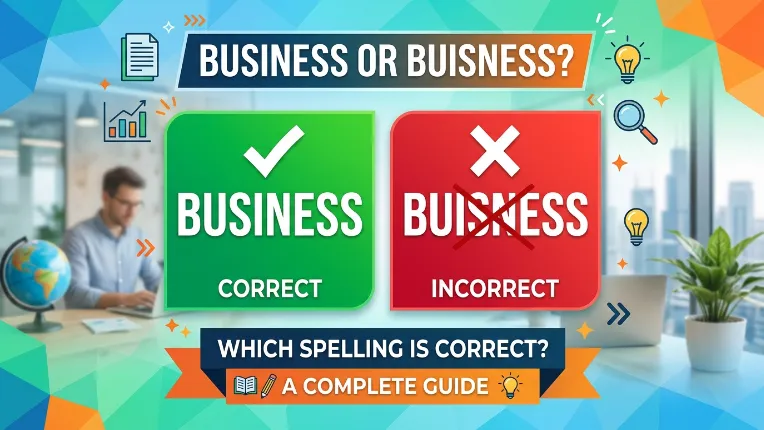
The correct spelling is business. Buisness is a common spelling mistake and is not accepted in standard English.
One evening, Sara was updating her resume. She carefully listed her experience, skills, and achievements. When she finished, she quickly checked the document again. Suddenly, one word caught her eye: “buisness management.”
She paused. Something didn’t look right.
This small spelling mistake is extremely common. Thousands of students, job seekers, and professionals search online every month to understand the difference between buisness or business. The confusion usually happens because the pronunciation of the word can make it sound like “buis-ness,” leading people to type the letters in the wrong order.
However, in standard English, only business is the correct spelling. The form buisness is simply a typographical error that appears in emails, documents, and online posts.
Understanding the correct spelling is important because business is one of the most frequently used words in education, work, and commerce. In this guide, you’ll learn the correct spelling, word origin, spelling rules, real-world examples, and common mistakes so you can confidently use business in any situation.
Buisness or Business – Quick Answer
The correct spelling is business.
The spelling buisness is incorrect and should never be used in formal writing, emails, or professional documents.
Examples of correct usage:
- She studies business at university.
- The company started a small online business.
- He works in international business.
Quick Comparison
| Word | Correct or Incorrect | Meaning |
| Business | Correct | Work, trade, or commercial activity |
| Buisness | Incorrect | Spelling mistake |
If you want to write professionally and correctly, always choose business.
The Origin of Business
The word business has a long history in the English language.
It comes from the Old English word bisignes, which meant care, anxiety, or occupation. Over time, the meaning shifted from being busy or occupied to describing commercial activity and trade.
The word evolved through several historical forms:
| Time Period | Spelling |
| Old English | bisignes |
| Middle English | bisynesse |
| Modern English | business |
The spelling business stayed consistent as English standardized spelling rules.
The confusion with buisness happens because the letters u and i appear next to each other in the middle of the word. Many writers accidentally reverse their order while typing.
However, dictionaries, academic style guides, and grammar experts all confirm that business is the only correct spelling.
British English vs American English Spelling
Unlike many English words, business does not change spelling between British and American English.
Both regions use the exact same form.
Spelling Comparison
| Region | Correct Spelling | Example |
| United States | Business | Business meeting |
| United Kingdom | Business | Business strategy |
| Canada | Business | Business school |
| Australia | Business | Business partner |
Some English words differ between American and British spelling (such as color/colour or organize/organise), but business remains identical worldwide.
That means you never need to change the spelling depending on your audience.
Which Spelling Should You Use?
The answer is simple: always use business.
This applies to every type of writing, including:
- Emails
- Academic papers
- Social media posts
- Job applications
- Professional reports
Audience-Based Advice
| Audience | Recommended Spelling |
| American readers | Business |
| British readers | Business |
| International readers | Business |
| Academic writing | Business |
Because business is the universal standard, using the incorrect spelling buisness can make writing look unprofessional.
For example, if a resume says “Buisness Administration,” employers may immediately notice the mistake.
Common Mistakes with Buisness or Business
Many writers accidentally spell business incorrectly. Here are the most common errors.
Mistake 1: Reversing the Letters
Incorrect:
- buisness
Correct:
- business
This mistake happens because people type ui instead of ui? Wait—they swap u and i.
Remember the correct order: b-u-s-i-n-e-s-s.
Mistake 2: Missing One “S”
Incorrect:
- busines
Correct:
- business
The word contains two “s” letters at the end.
Mistake 3: Writing by Sound
Because pronunciation sounds like biz-ness, some writers create incorrect versions.
Incorrect forms include:
- bizness
- buisness
- bisness
Only business is correct.
Buisness or Business in Everyday Examples
The word business appears in many everyday situations.
Email Example
“Thank you for contacting our business support team.”
Workplace Example
“Our business meeting starts at 10 AM.”
News Example
“The government announced new policies to support small businesses.”
Social Media Example
“Starting my own online business this year 🚀”
Academic Writing Example
“She completed a degree in Business Administration.”
Using the correct spelling helps your writing look more professional and credible.
Buisness or Business – Google Trends & Usage Data
Search data clearly shows that business is the dominant spelling worldwide.
However, many people still search for “buisness” because they are unsure about the correct spelling.
Popular Search Terms
| Search Term | Purpose |
| business | Correct word usage |
| buisness | Spelling check |
| business meaning | Vocabulary search |
| business definition | Academic search |
The incorrect spelling buisness appears frequently in search engines because users want to confirm whether it is correct.
Usage by Country
| Country | Common Spelling |
| United States | Business |
| United Kingdom | Business |
| Canada | Business |
| India | Business |
In all English-speaking countries, business remains the standard spelling.
Comparison Table: Buisness vs Business
| Feature | Buisness | Business |
| Spelling status | Incorrect | Correct |
| Dictionary recognition | No | Yes |
| Usage in writing | Mistake | Standard English |
| Professional acceptance | Not accepted | Fully accepted |
| Example sentence | ❌ She studies buisness | ✅ She studies business |
This comparison clearly shows that business is the only correct choice.
FAQs
1. Is buisness or business correct?
The correct spelling is business. The form buisness is a spelling mistake.
2. Why do people write buisness?
People often reverse the letters u and i while typing, which creates the incorrect spelling buisness.
3. Is business spelled differently in British English?
No. Both British and American English use the spelling “business.”
4. What does business mean?
Business refers to commercial activity, trade, or work related to producing and selling goods or services.
5. Is buisness accepted in dictionaries?
No. Major dictionaries list business as the correct spelling and mark buisness as an error.
6. How can I remember the correct spelling?
Remember the phrase “busy-ness.” The word business comes from the idea of being busy with work.
7. Why is correct spelling important in business writing?
Correct spelling improves professionalism, credibility, and clarity in emails, reports, and official documents.
Conclusion
The confusion between buisness and business is very common, but the answer is simple: business is the only correct spelling in English. The version buisness appears frequently because people accidentally reverse the letters while typing or rely on pronunciation rather than spelling rules.
The word business has a long history, originating from Old English terms related to work, occupation, and activity. Over time, it became one of the most important words used to describe commerce, companies, and professional activity.
Unlike many English words, business does not change spelling between British and American English, making it consistent across all English-speaking countries. This means writers do not need to adjust the spelling for different audiences.
Using the correct spelling is especially important in professional communication. Whether you are writing a resume, sending an email, posting on social media, or creating a company website, correct spelling helps build trust and credibility.
If you ever feel unsure, simply remember that business is the only correct spelling, and avoiding the mistake buisness will keep your writing clear, accurate, and professional.

Samuel A. Whitmore an English language writer and editor , specializes in spelling, grammar, and usage differences between British and American English. Focuses on helping readers avoid common writing mistakes through clear explanations, practical examples, and easy-to-follow comparisons. My work aims to make English spelling rules simple and accessible for students, professionals, and everyday writers.