Have you ever typed behavioral and then wondered if it should be behavioural instead? Or maybe you’ve seen both spellings used in articles, research papers, and official reports and felt unsure which one was correct. You’re not alone. This is a very common question, especially in psychology, education, workplace training, and academic writing.
People search for behavioral or behavioural because both spellings look correct, mean the same thing, and are widely used. The confusion does not come from grammar errors, but from regional spelling differences in English. If you choose the wrong version for your audience, your writing may look inconsistent or unprofessional, even though the meaning is clear.
This article solves that confusion completely. You’ll get a quick answer, learn where these spellings come from, see how British and American English differ, and understand which one you should use depending on your audience. By the end, you’ll confidently know whether to write behavioral or behavioural without guessing.
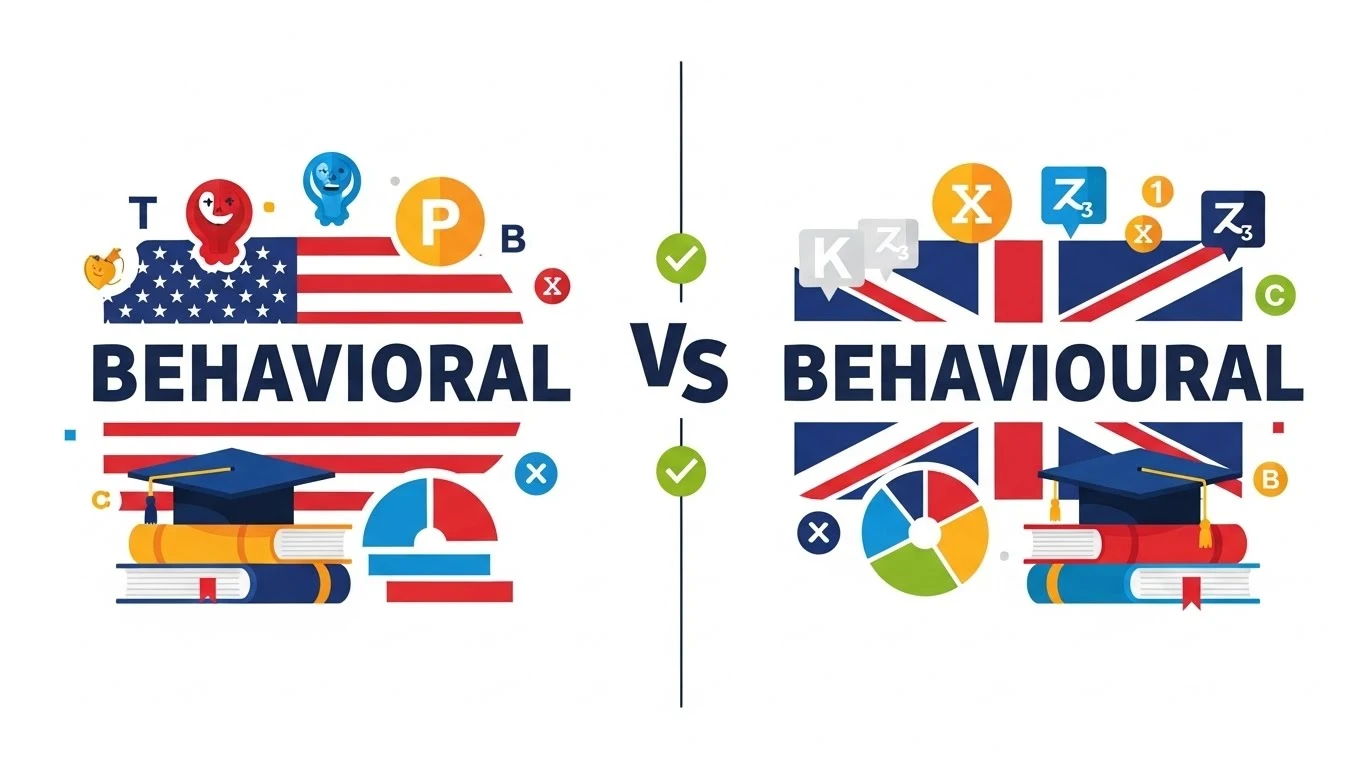
Behavioral or Behavioural ; Quick Answer
✅ Both spellings are correct.
- Behavioral is American English
- Behavioural is British English
Examples:
- American usage: behavioral science
- British usage: behavioural science
More about Cueing or Cuing? Which Spelling Is Correct in English?
The Origin of Behavioral or Behavioural
The root word behaviour/behavior comes from Old French behaver, meaning “to conduct oneself.” When English spelling began to standardize, American English simplified many words by removing the extra -our. British English kept the original form. That’s why we now have behavioral (US) and behavioural (UK). The spelling difference exists because of regional spelling reforms, not meaning.
🔹 Behavioral vs Behavioural in Psychology & Mental Health
Psychology mein yeh term sab se zyada common hai:
- Behavioral therapy (US)
- Behavioural therapy (UK)
Meaning dono ka bilkul same hota hai:
A therapy focused on changing actions, habits, and responses rather than thoughts.
📌 Important note:
Spelling badalne se theory, approach, ya concept change nahi hota, sirf regional style reflect hoti hai.
🔹 Workplace & Corporate Usage

Business, HR aur corporate training mein bhi yeh difference common hai:
- US companies:
👉 behavioral assessments, behavioral training, behavioral metrics - UK / EU companies:
👉 behavioural interviews, behavioural standards
💡 Tip for professionals:
Job applications, reports aur policies likhte waqt company country ko reference banayein.
🔹 Style Guides & Official Recommendations
Different style guides kya recommend karte hain:
| Style Guide | Preferred Spelling |
| APA (American Psychological Association) | Behavioral |
| Chicago Manual (US) | Behavioral |
| Oxford Style Guide | Behavioural |
| NHS / UK Gov | Behavioural |
➡️ Always follow the required style guide, personal preference nahi.
🔹 Similar Word Patterns (Helpful for Learners)
Yeh confusion sirf behavioral tak limited nahi:
| American | British |
| Color | Colour |
| Favor | Favour |
| Honor | Honour |
| Behavior | Behaviour |
| Behavioral | Behavioural |
💡 Rule:
Agar word ka base -or / -our se end hota ho, US usually short, UK long spelling use karta hai.
British English vs American English Spelling
This is a clear regional spelling difference.
| Feature | American English | British English |
| Base word | Behavior | Behaviour |
| Adjective | Behavioral | Behavioural |
| Extra “u” | ❌ No | ✅ Yes |
| Meaning | Same | Same |
Which Spelling Should You Use?
Choose based on your audience:
- US audience: Use behavioral
- UK & Commonwealth: Use behavioural
- Academic journals: Follow the style guide
- Global audience: Either is fine be consistent
Consistency matters more than preference.
Common Mistakes with Behavioral or Behavioural
- ❌ Mixing both spellings in one document
✅ Choose one and stay consistent - ❌ Thinking one spelling is wrong
✅ Both are correct - ❌ Changing spelling based on context
✅ Meaning stays the same
Behavioral or Behavioural in Everyday Examples
- Email: “The training focuses on behavioral change.”
- News: “The study explores behavioural patterns.”
- Social media: “Small habits create behavioral shifts.”
- Formal writing: “This paper examines behavioural economics.”
Behavioral or Behavioural ; Google Trends & Usage Data
Search trends show behavioral is used more frequently in the United States, while behavioural dominates searches in the UK, Australia, and other Commonwealth countries. Interest is especially high in psychology, healthcare, and education contexts, where consistent spelling is important.
Comparison Table: Behavioral vs Behavioural
| Feature | Behavioral | Behavioural |
| Correct spelling | ✅ Yes | ✅ Yes |
| Region | United States | UK & Commonwealth |
| Meaning | Same | Same |
| Academic use | Common | Common |
FAQs
1. Is behavioural wrong?
No, it’s correct in British English.
2. Is behavioral American only?
Yes, it’s the American spelling.
3. Do the meanings differ?
No, the meaning is identical.
4. Which should I use in research papers?
Follow the journal’s style guide.
5. Can I mix both spellings?
No, consistency is important.
6. Is one more formal than the other?
No, formality depends on context.
Conclusion
The difference between behavioral or behavioural is not about correctness it’s about regional spelling standards. Both words mean the same thing and are widely accepted in professional, academic, and everyday English. The only real difference is where they are used. Behavioral is standard in American English, while behavioural is preferred in British and Commonwealth English.
To avoid confusion or inconsistency, always think about your audience. If you’re writing for a US-based organization, publication, or school, behavioral is the better choice. If your audience is in the UK, Australia, or similar regions, behaviour will feel more natural. For global audiences, either spelling works as long as you stay consistent throughout your content.
Once you understand this simple rule, the confusion disappears. Choosing the right spelling makes your writing look clear, professional, and confident.

Daniel R. Foster is an experienced English language writer and editor who specializes in explaining commonly confused words and grammar nuances. With a strong passion for clarity in communication, he creates easy-to-understand comparisons that help learners, students, and professionals use English more confidently. His articles focus on accuracy, real-world examples, and practical usage.