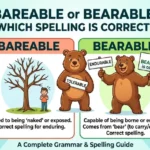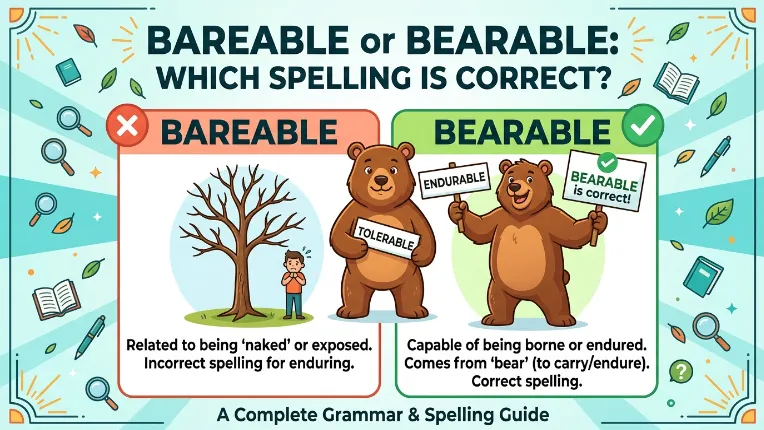
Snippet Answer: “Bearable” is the correct spelling meaning tolerable or manageable, while “bareable” is a common misspelling and not a standard English word.
Imagine sitting in a crowded room during the peak of summer. The fan is slow, the air feels heavy, and someone nearby says, “At least the heat is still bearable.” But when you later type the sentence into a message, you pause. Should it be bearable or bareable?
This small spelling confusion happens more often than you might think. Many English learners and even native speakers search for “bareable or bearable” because both words sound exactly the same. When spoken, they are identical, which makes it easy to assume that both spellings might exist.
The confusion also comes from the word bare, which is a real English word meaning uncovered or naked. Because of this, many people mistakenly believe bareable could mean something like able to be bare. However, in standard English usage, the correct spelling is bearable, which means something that can be endured or tolerated.
In this guide, you will learn the correct spelling, the history behind the word, common mistakes people make, and how to confidently use bearable in everyday writing.
Bareable or Bearable – Quick Answer
The correct spelling is bearable.
The word bearable means something that can be tolerated, endured, or managed, even if it is uncomfortable.
Examples:
✔ The pain was strong but still bearable.
✔ The weather became bearable after the rain started.
The spelling bareable is not recognized in standard dictionaries and is considered a misspelling.
Quick Comparison
| Word | Correct? | Meaning |
| bearable | ✔ Yes | able to be tolerated |
| bareable | ✖ No | incorrect spelling |
Whenever you want to describe something that is difficult but still manageable, bearable is the correct word.
The Origin of Bearable
The word bearable comes from the verb bear, which has several meanings in English. One of its important meanings is to endure or tolerate something difficult.
For example:
- I cannot bear the noise.
- She bore the pain bravely.
From this meaning, the adjective bearable developed to describe something that can be endured.
The word appeared in English several centuries ago and became common in literature and everyday speech. Because it comes from bear, the spelling naturally follows that root.
The confusion with bareable happens because English contains the word bare, which means uncovered or empty. But bare has nothing to do with the meaning of tolerance or endurance.
So the correct spelling remains bearable.
British English vs American English Spelling
Some English words change spelling between British English and American English, such as:
- colour vs color
- centre vs center
- travelled vs traveled
However, bearable does not change between dialects.
Both British and American English use the same spelling: bearable.
Comparison Table
| Feature | Bearable | Bareable |
| Meaning | tolerable or endurable | none |
| Used in US English | ✔ Yes | ✖ No |
| Used in UK English | ✔ Yes | ✖ No |
| Dictionary recognition | ✔ Yes | ✖ No |
| Recommended spelling | ✔ Bearable | ✖ Avoid |
No matter where you are writing—from the US to the UK to Australia—the correct spelling is bearable.
Which Spelling Should You Use?
The answer is simple: always use “bearable.”
Here is a quick guide for different audiences.
For American readers
Use bearable, which is the standard spelling in all forms of writing.
For British or Commonwealth readers
Again, use bearable, as it is the accepted form in British English.
For global online writing
Choose bearable because search engines, dictionaries, and professional publications all use this spelling.
Using bareable can make writing appear incorrect or unprofessional, especially in emails, articles, or academic work.
Common Mistakes with Bearable
Many writers make small errors when using this word. Here are the most frequent ones.
1. Writing bareable instead of bearable
❌ The pain was barely bareable.
✔ The pain was barely bearable.
This mistake happens because both spellings sound the same.
2. Confusing bare with bear
These two words have completely different meanings.
| Word | Meaning |
| bare | uncovered or empty |
| bear | to endure or tolerate |
Example:
✔ The situation was difficult but bearable.
✔ He walked on the bare ground.
3. Misusing the word with “barely”
Some writers mistakenly connect bare with barely. However, barely bearable simply means almost unbearable.
Example:
✔ The heat was barely bearable.
Bearable in Everyday Examples
The word bearable appears frequently in daily communication.
Emails
Hi Alex,
The workload this week is heavy but still bearable.
News Reports
Officials said the temperature has dropped to a bearable level after yesterday’s extreme heat.
Social Media
“The traffic was terrible today, but music made the drive bearable.”
Formal Writing
The medication reduced the pain to a bearable level.
These examples show how naturally the word appears in both casual and professional contexts.
Bareable or Bearable – Google Trends & Usage Data
Search data shows that bearable is overwhelmingly more common than bareable.
However, thousands of people still search for bareable each month because they are unsure about the correct spelling.
This pattern happens with many confusing English word pairs, such as:
- definitely vs definately
- separate vs seperate
- lose vs loose
Countries with strong search interest include:
- United States
- United Kingdom
- Canada
- Australia
- India
Keyword Comparison Table
| Keyword | Meaning | Usage Level |
| bearable | tolerable | Very high |
| barely bearable | almost unbearable | Medium |
| unbearable | impossible to tolerate | High |
| bareable | misspelling | Low |
Search engines often automatically correct bareable to bearable, which shows how strongly the correct spelling dominates usage.
Frequently Asked Questions
1. Is bareable a real word?
No. Bareable is considered a misspelling of bearable.
2. What does bearable mean?
Bearable means something that can be tolerated or endured, even if it is uncomfortable.
3. Why do people write bareable?
Because bearable and bareable sound the same when spoken, many people guess the spelling incorrectly.
4. How do you pronounce bearable?
It is pronounced “BAIR-uh-bul.”
5. What is the opposite of bearable?
The opposite is unbearable, meaning something that cannot be tolerated.
Example:
The noise became unbearable.
6. Can bearable describe pain?
Yes. It is often used to describe pain that is manageable but still uncomfortable.
Example:
The medicine made the pain bearable.
7. Is bearable used in both US and UK English?
Yes. The spelling bearable is standard in both dialects.
Conclusion
The confusion between bareable and bearable comes mainly from pronunciation. Because both spellings sound identical, many people assume that either version might be correct. In reality, only one form is recognized in standard English.
The correct spelling is bearable, which comes from the verb bear, meaning to endure or tolerate something difficult. It is used to describe situations, pain, weather, or experiences that are uncomfortable but still manageable.
The spelling bareable, on the other hand, is simply a common mistake. Although the word bare exists in English, it has a completely different meaning related to something being uncovered or empty.
By remembering the connection to the verb bear, you can easily avoid this mistake. Whenever you want to describe something that can be endured, choose bearable. Using the correct spelling will make your writing clearer, more accurate, and more professional in both everyday communication and formal documents.

Daniel R. Foster is an experienced English language writer and editor who specializes in explaining commonly confused words and grammar nuances. With a strong passion for clarity in communication, he creates easy-to-understand comparisons that help learners, students, and professionals use English more confidently. His articles focus on accuracy, real-world examples, and practical usage.