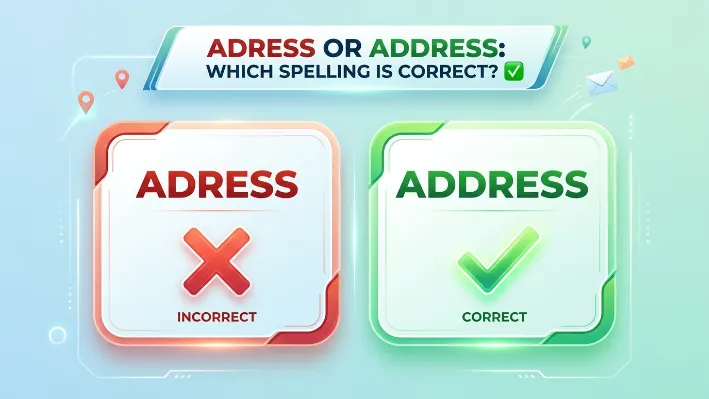
Address is the correct spelling. “Adress” is a common spelling mistake and is not a real English word.
A job applicant carefully prepared his resume. His skills were strong. His experience was solid. But at the top of the page, one small error stood out “Home Adress.” That single missing letter changed the first impression completely.
Spelling errors often happen with double letters. Words like “address” confuse writers because English does not always follow simple patterns. Many people type “adress” by accident, especially when writing fast. Search engines show thousands of queries each month from people asking which spelling is correct.
The confusion usually comes from pronunciation. When we say the word quickly, we do not strongly hear the double “d” and double “s.” As a result, many assume it has only one of each letter.
This guide explains the correct spelling, word history, grammar rules, common mistakes, and proper usage in daily writing. By the end, you will never hesitate when spelling this word again.
Adress or Address – Quick Answer
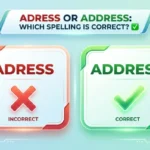
The correct spelling is address.
❌ Adress – Incorrect
✅ Address – Correct
The word “address” has:
- Double d
- Double s
Examples:
- Please write your home address clearly.
- The manager will address the issue tomorrow.
- I need your email address.
“Adress” is simply a spelling error and is not accepted in any dictionary.
The Origin of Address
The word address comes from the Old French word adresser, which means “to direct” or “to send toward.” It later entered Middle English with the same meaning.
The structure of the word developed like this:
- Latin root meaning “toward”
- French influence added structure
- English spelling kept double letters for clarity
The double d and double s became part of standard spelling centuries ago. Unlike some English words that evolved into multiple versions, “address” stayed consistent.
There has never been a correct form spelled “adress.”
British English vs American English Spelling (Address or Adress)
Some English words change spelling between the US and UK. For example:
| American English | British English |
| Color | Colour |
| Traveling | Travelling |
| Organize | Organise |
However, address is spelled the same in both American and British English.
| Spelling | US English | UK English | Correct? |
| Address | ✔ | ✔ | Yes |
| Adress | ✖ | ✖ | No |
There is no regional variation. “Adress” is incorrect everywhere.
Which Spelling Should You Use?
You should always use address, no matter your audience.
For Business Writing
Use address in reports, emails, and proposals.
For Academic Writing
Always use address in essays and research papers.
For Online Forms
Websites require the correct spelling to avoid confusion.
For Global Audience
“Address” works in every English-speaking country.
Spelling mistakes in formal writing can reduce credibility. A small error in something as basic as an address can appear careless.
Common Mistakes with Adress or Address
1. Dropping One “d”
❌ Adress
✅ Address
2. Dropping One “s”
❌ Addres
✅ Address
3. Mixing Verb and Noun Forms Incorrectly
Wrong: He gave a good address to the problem.
Correct: He addressed the problem.
Remember:
- Address (noun) – location information or speech
- Address (verb) – to deal with something
4. Capitalization Confusion
When part of a proper noun, capitalize correctly:
- Email Address (in forms)
- Home address (general usage)
Address in Everyday Examples
In Emails:
“Please confirm your mailing address.”
In News:
“The president will address the nation tonight.”
In Business:
“We must address customer complaints quickly.”
In Social Media:
“DM me your address for delivery.”
In Formal Writing:
“The research addresses climate change challenges.”
The spelling remains the same in all contexts.
Google Trends & Usage Data
Search engines show that “adress” is frequently searched, but mainly as a correction query. Most searches come from:
- United States
- India
- United Kingdom
- Pakistan
- Canada
Google automatically corrects “adress” to “address.” This confirms that only one spelling is recognized.
In books, newspapers, academic journals, and professional documents, only “address” appears.
The error usually happens due to typing speed or weak pronunciation of double letters.
Comparison Table: Adress vs Address
| Feature | Adress | Address |
| Real Word? | No | Yes |
| Dictionary Accepted? | No | Yes |
| US English Valid? | No | Yes |
| UK English Valid? | No | Yes |
| Professional Use? | No | Yes |
| Contains Double Letters? | No | Yes (dd, ss) |
This comparison clearly shows that “address” is the only correct form.
FAQs
1. Is “adress” ever correct?
No. It is always incorrect.
2. Why does “address” have double letters?
It comes from historical spelling patterns influenced by French and Latin.
3. Is there a British spelling difference?
No. Both US and UK use “address.”
4. How do you spell email address?
E-M-A-I-L space A-D-D-R-E-S-S.
5. Can “address” be a verb?
Yes. It means to deal with or speak about something.
6. Why do people misspell it?
Because double letters are often not strongly pronounced.
7. How can I remember the spelling?
Think: Add + dress = address (two d’s, two s’s).
Conclusion
Spelling can change how people see your writing. In the case of “adress or address,” the rule is simple. The correct spelling is address, with double “d” and double “s.” The incorrect form, “adress,” appears only due to typing mistakes or misunderstanding.
There is no difference between British and American English. Both follow the same spelling rule. Whether you are writing an email, filling out a form, preparing a resume, or drafting a speech, always choose the correct version.
Small spelling mistakes can weaken strong writing. Knowing the correct form helps you communicate clearly and professionally. Now that you understand the difference, you can confidently use address in every context.
Read To Know 👇
Association or Organization: Correct Usage Guide For 2026✅

Miles Thornton is a seasoned author and content specialist with a knack for simplifying complex topics. Passionate about clear, engaging writing, creates articles that inform and inspire readers. With years of experience in digital publishing, Miles combines professionalism with creativity, delivering insightful content for diverse audiences